Trading summary
Best Loser Wins Summary: Key Ideas and Takeaways
Read a practical summary of Best Loser Wins by Tom Hougaard, including key takeaways, lessons, and useful ideas.
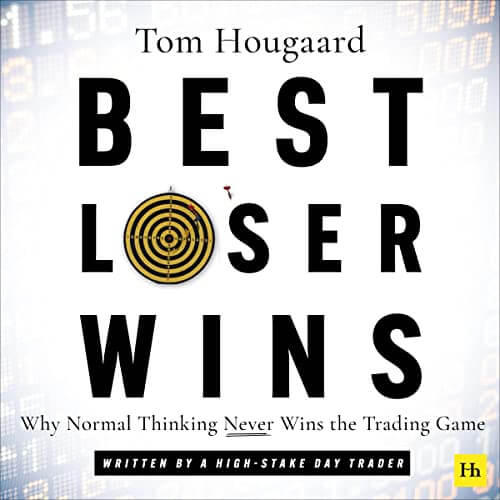
Author: Tom Hougaard
Category: Trading
Published: 2022
Pages: 250
Key Takeaways
- **The Central Paradox**: Winning in trading is not about predicting the future, but about how well you lose.
- **90/90/90 Rule**: 90% of traders lose 90% of their money in 90 days because they succumb to normal human instincts.
- **Normal vs. Abnormal**: Normal instincts (avoiding pain, seeking pleasure) destroy traders. You must act 'abnormally' (embracing pain, delaying pleasure).
- **Flip Hope and Fear**: Fear your losers (cut them) and hope for your winners (ride them). Most traders do the opposite.
- **Technical Analysis is Not Enough**: TA provides a framework for risk, but no predictive power. Mindset is the true edge.
- **Add to Winners**: Never average down. When a trade works, add to it. Use open profits to finance larger size.
- **Accept Uncertainty**: You cannot control the market. You can only control your entry, your exit, and your size.
- **Visualization**: Rehearse taking losses mentally so you don't freeze when they happen in reality.
- **Ego is the Enemy**: The need to be 'right' causes traders to hold losers. To make money, you must be willing to be wrong often.
- **High Performance**: Trading is a performance sport. Physical health and mental routine are non-negotiable.
About This Summary
Best Loser Wins: A Deep-Dive Analysis and Behavioral Guide
Based on the work of Tom Hougaard
1. Introduction
The Central Paradox: Why Losing is the Key to Winning
Tom Hougaard’s Best Loser Wins is built on a counter-intuitive premise: to win at trading, you must become an expert at losing. Most people come to the markets trying to predict the future. They spend years studying charts, indicators, and patterns, believing that if they can just "know" what happens next, they will be rich. Hougaard argues this is a fallacy. You cannot predict the future. The market is a chaotic environment where anything can happen. Therefore, your edge does not come from prediction; it comes from risk management. Specifically, it comes from how you handle the trades that go against you. The "Best Loser" is the trader who takes a loss quickly, cleanly, and without emotional damage, preserving their capital for the winning trades.
The 90/90/90 Rule
The statistics are grim: 90% of retail traders lose 90% of their money in 90 days. Why? Is it because they don't know enough technical analysis? No. Most losing traders know exactly what a "head and shoulders" pattern looks like. They fail because of their psychology. They fail because when a trade goes against them, they freeze. They hope it will come back. They refuse to take a small loss, allowing it to turn into a catastrophic one. Conversely, when a trade goes in their favor, they panic. They fear the profit will disappear, so they snatch the money off the table too early, missing the big move. The 90/90/90 rule is a testament to the fact that normal human behavior is incompatible with financial markets.
The Author: Tom Hougaard
Tom Hougaard is not an armchair theorist. He is a high-stakes day trader who has worked for major brokerages and traded his own capital publicly. He is known for his transparency, often live-streaming his trading sessions where he wins—and loses—thousands of dollars in minutes. This book is the distillation of his journey from a "normal" loser to a high-performance "abnormal" winner.
2. Detailed Analysis
Normal vs. Abnormal Behavior
The core of Hougaard’s philosophy is that "normal" human instincts are destructive in trading.
- Normal Behavior: In life, if you are in pain (physical or emotional), your instinct is to avoid it. If you touch a hot stove, you pull your hand away. In trading, "pain" is a losing trade. But instead of pulling away (cutting the loss), the normal human instinct is to avoid the realization of the loss. We hold onto the trade, hoping it will turn around, because closing it makes the pain "real."
- Abnormal Behavior: To succeed, you must act abnormally. You must lean into the pain. When a trade is losing, you must kill it immediately, accepting the small pain now to avoid the agony later. When a trade is winning, you must suppress the urge to take profit (which relieves the tension) and instead hold on, or even add to the position. This feels unnatural. It feels dangerous. But it is the only way to make money.
The Flaw of "Hope and Fear"
Hougaard identifies a fatal emotional inversion in losing traders:
- Hoping when they should Fear: When a trade is going against them, "normal" traders hope it will reverse. They pray to the market gods. They look for news to confirm their bias. They should be fearing a larger loss, but instead, they hope.
- Fearing when they should Hope: When a trade is going in their favor, "normal" traders fear the market will take it back. They are terrified of losing their paper profits. They should be hoping for a larger gain, but instead, they fear.
The Fix: You must flip this script. You must fear your losing trades (and kill them) and hope for your winning trades (and ride them).
The Technical Analysis Trap
Hougaard argues that the industry is obsessed with Technical Analysis (TA) because it gives an illusion of control. It suggests that the market is a puzzle to be solved.
- The Reality: TA is just a tool to frame risk. It has no predictive power. A support level is just a line on a chart. It does not stop the price from falling.
- The Danger: Relying solely on TA leads to "analysis paralysis" or the "blame game" (e.g., "The indicator didn't work!"). The problem is never the chart; the problem is the trader executing the trade. You don't need more indicators; you need more discipline.
Risk Management & Position Sizing
This is where Hougaard is most controversial and most profound.
- The 1% Myth: Traditional advice says "never risk more than 1% or 2% of your account." Hougaard agrees with this for entry, but he argues that to make life-changing money, you must be aggressive when you are right.
- Adding to Winners: Most traders add to losers (averaging down) to lower their breakeven price. This is suicide. Hougaard advocates adding to winners. If the market confirms your direction, buy more. Use the market's money (your open profits) to finance larger positions. This is how you turn a normal winning day into a career-defining day.
- The Logic: If you are wrong, you lose small (because you cut it). If you are right, you are heavily invested. This asymmetry is the holy grail of trading.
3. Practical Application & Drills
The "Best Loser" Toolkit
How do you train your brain to be abnormal?
- The "Stop Loss" Drill: Practice entering a trade and immediately placing a hard stop loss. Do not move it. If it gets hit, say out loud: "Good trade." You followed your rules. You took a small loss. That is a victory.
- The "Add" Drill: Force yourself to add to a winning position at least once. Even if it results in a breakeven trade, you are training the muscle of aggression.
Visualization and Discipline
Hougaard emphasizes that willpower is a finite resource. You cannot rely on it in the heat of the moment. You must prepare.
- Visualization: Before the market opens, visualize yourself taking a loss. Visualize the feeling of the market going against you and you calmly clicking "Close." Rehearse the pain so it doesn't surprise you.
- Routine: High performance requires high maintenance. Sleep, diet, and exercise are not "extras"; they are the foundation of your emotional stability. You cannot trade well if you are physically compromised.
4. Critical Synthesis & Conclusion
The Philosophical Takeaway
Best Loser Wins is more than a trading book; it is a philosophy of life. It teaches that uncertainty is the only certainty. We cannot control the world (the market), but we can control our reaction to it. The discipline required to be a "Best Loser"—the ability to admit you are wrong, to let go of ego, and to act with conviction in the face of fear—is the same discipline required to succeed in any high-performance field.
Final Verdict
This book challenges the "industry standard" advice given to retail traders. It tells you that "playing it safe" is actually the riskiest thing you can do. It tells you that your human nature is your enemy. It is a harsh, uncompromising look in the mirror. But for those willing to do the work, it offers the only real path to professional trading success. You don't need to be smarter; you just need to be a better loser.