Economics summary
Basic Economics Summary: Key Ideas and Takeaways
Read a practical summary of Basic Economics by Thomas Sowell, including key takeaways, lessons, and useful ideas.
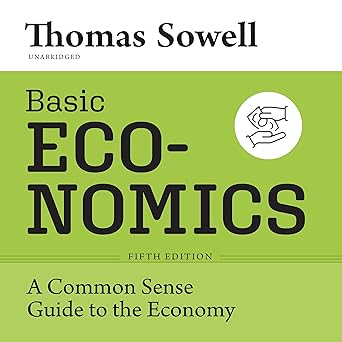
Author: Thomas Sowell
Category: Economics
Published: 2000
Pages: 704
Key Takeaways
- **Scarcity and Alternative Uses**: Economics is the study of how scarce resources with alternative uses are allocated.
- **The Price Mechanism**: Prices are information signals that coordinate supply and demand without central planning.
- **Price Controls Fail**: Rent control and minimum wage laws distort incentives, leading to shortages (rent control) or surpluses (unemployment).
- **Profit and Loss**: Losses are essential for efficiency, forcing businesses to stop wasting resources.
- **The Monopoly Myth**: True monopolies are rare in a free market; most are created or protected by government.
- **Productivity Determines Pay**: Wages are determined by the value a worker adds, not by legislation.
- **Discrimination Costs Money**: Free markets penalize discrimination because it limits the talent pool; government laws often enforce it.
- **Inflation is a Tax**: Printing money without increasing production devalues savings and distorts prices.
- **Trade Deficits are Misunderstood**: A trade deficit often signals a capital surplus and foreign investment.
- **No Solutions, Only Trade-offs**: Every policy has a cost; the goal is to weigh the benefit against the cost, not to find a perfect solution.
About This Summary
Basic Economics: A Master Guide and Deep-Dive Analysis
Based on the work of Thomas Sowell
Introduction
The Core Philosophy: Scarcity and Alternative Uses
To understand Thomas Sowell’s Basic Economics, one must first strip away the common misconception that economics is simply the study of money, banking, or stock indices. While these are components of the system, they are not the foundation. Sowell defines economics with a specific, unbreakable rule: Economics is the study of the use of scarce resources which have alternative uses.
This definition contains two critical variables: scarcity and alternative uses. Scarcity: In the real world—unlike the Garden of Eden—there is not enough of everything to satisfy every desire of every person completely. Whether it is beachfront property, iron ore, skilled labor, or time itself, resources are finite. Human desires, however, are infinite. Alternative Uses: Resources are not only limited; they can be used in different ways. A seemingly simple resource like iron ore can be used to manufacture heart monitors that save lives, or it can be used to manufacture slot machines that entertain. It can be used for the framework of a luxury hotel or the girders of a public bridge.
Because there is not enough iron ore to do all of these things simultaneously to the maximum extent desired, choices must be made. Who gets the iron? The hospital or the casino? The answer to that question determines the standard of living and the efficiency of a society. Economics, therefore, is the study of how a society organizes itself to make these trade-offs.
The Role of Prices: The Central Nervous System
If resources are scarce and have alternative uses, how does a society coordinate millions of people to ensure resources go where they are most valued? Sowell argues that there are only two ways to do this: through a central authority (feudalism, socialism, fascism) or through a price-coordinated market mechanism.
Sowell posits that the price system is the most efficient information network in human history. Prices are not arbitrary numbers set by "greedy" businesses; they are messengers. They convey the reality of scarcity and demand to millions of people simultaneously without anyone having to issue an order.
When a price rises, it sends two signals: To Consumers: "This resource is becoming scarcer or more highly valued by others; use less of it or look for a substitute." To Producers: "People want this badly; it is profitable to produce more of it."
This automatic adjustment prevents shortages and surpluses. When governments attempt to override this system—by setting prices artificially low (price ceilings) or artificially high (price floors)—they sever the communication line. The result is not a fairer distribution of goods, but a distortion of reality that leads to lines, rationing, black markets, and waste.
The Absence of Jargon
Perhaps the most distinct feature of Sowell’s approach is his rejection of "blackboard economics." There are no supply-and-demand curves, calculus equations, or complex graphs in this analysis. Sowell argues that while mathematics can be useful for modeling, it often obscures the fundamental logic of human incentives. A policy may look perfect in an equation where variables are controlled, but in the real world, humans react to incentives in messy, unpredictable ways. This guide focuses on that empirical reality: logic, evidence, and historical precedent.
Section-by-Section Detailed Analysis
Part I: Prices and Markets
The first section of the book establishes the foundation of the market economy: the price mechanism is not a barrier to getting what you want; it is the mechanism that ensures things are produced at all.
The Function of Prices
In a free market, prices dictate the flow of resources. Sowell uses the example of beachfront property. Everyone would like to live on the beach. If beachfront homes were free, there would be a massive shortage immediately. By attaching a high price to that land, the market forces individuals to ask themselves: "Do I want to live on the beach more than I want to retire early, drive a nice car, and travel?" The price forces the individual to weigh the trade-off.
This logic applies to all goods. When the price of oil rises, people don't need a government decree to tell them to conserve energy. They automatically drive less, carpool, or buy fuel-efficient vehicles to save money. Simultaneously, oil companies invest in more expensive extraction technologies (like fracking) that were not profitable when oil was cheap. The high price solves the shortage by reducing demand and increasing supply.
Price Controls: The Anatomy of Failure
Sowell dedicates a significant portion of this section to price controls, specifically Rent Control. He describes rent control as the most effective way to destroy a city, short of bombing it. The Intent: To make housing affordable for the poor. The Reality: When the government caps the price of rent below what the market dictates, demand skyrockets (because it is cheap) and supply plummets (because it is no longer profitable to build or maintain apartments). The Consequence:
- Hoarding: People stay in large apartments long after their children move out because the rent is artificially low, preventing young families from moving in.
- Deterioration: Landlords, unable to cover costs or make a profit, stop repairing buildings. Housing quality degrades into slums.
- No New Construction: Developers stop building new housing because the return on investment is gone.
Sowell points to New York City and San Francisco as case studies where rent control has resulted in severe housing shortages and higher effective costs for newcomers, while doing little to help the intended demographic.
Price Floors: Minimum Wages and Surpluses
Conversely, when a price is set artificially high, a surplus is created. In the context of agriculture, this leads to mountains of unsold grain rotting in silos because the government guaranteed a price higher than consumers were willing to pay. In the labor market, this leads to unemployment (a surplus of labor), which is discussed in Part III.
Takeaway: Prices are like a thermometer. They reflect the temperature (reality). You cannot change the weather by heating up or cooling down the thermometer.
Part II: Industry and Commerce
This section moves from the micro-level of prices to the macro-level of corporate behavior, profit, loss, and competition.
Profit and Loss
Sowell emphasizes that "profit" is a controversial word, but "loss" is the more important disciplinary mechanism. In a market economy, businesses are not in control; consumers are. If a business fails to use scarce resources efficiently to produce what people want at a price they are willing to pay, they incur losses.
The Role of Loss: Losses force inefficient businesses to stop wasting resources. When a business goes bankrupt, the resources (labor, land, capital) are released to be used by more efficient managers. Profit Margins: Sowell debunks the myth that corporations make exorbitant profits. The average profit margin for American corporations is often roughly 4% to 6%. The massive numbers reported in the news are usually totals, not margins. A supermarket may make only a few pennies on every dollar of groceries sold; they rely on high volume, not high markups.
Big Business vs. Monopoly
There is a vital distinction between a business that is "big" and a "monopoly." Efficiencies of Size: Big businesses often exist because they are efficient. Economies of scale allow a company like Walmart to sell goods cheaper than a local store. This benefits the consumer, particularly the poor. Sowell argues that penalizing a company for being big is often penalizing them for being efficient. The Monopoly Myth: True monopolies are rare and difficult to maintain without government protection. In a free market, if a "monopoly" raises prices too high, they create a massive incentive for a competitor to enter the market and undercut them. Cartels: Similarly, cartels (groups of businesses agreeing to set high prices) are inherently unstable. The moment one member cheats and lowers prices to gain market share, the cartel collapses.
Regulation and Anti-Trust
Sowell analyzes the history of anti-trust laws, noting a supreme irony: these laws are often used by failing competitors to sue successful businesses. Instead of "protecting competition," the government often ends up "protecting competitors" from the rigors of the market. If Company A produces a better product at a lower price and drives Company B out of business, the consumer has won. Anti-trust intervention often tries to stop this process, hurting the consumer to save the inefficient company.
Part III: Work and Pay
This section tackles the emotionally charged issues of wages, income inequality, and exploitation.
Productivity and Pay
Sowell argues that in a competitive market, employees are generally paid according to their marginal productivity—the value they add to the company. If a worker adds $50 of value per hour but is paid only $20, a competing employer has an incentive to offer $25 or $30 to steal that profitable worker. This bidding process drives wages up to the level of productivity. Conversely, you cannot legislate high wages. If a worker adds only $10 of value per hour, but the government mandates a minimum wage of $15, the business will simply not hire that person.
The Myth of the "Rich" and "Poor"
Sowell warns against treating income brackets as static classes of people. Income Mobility: Most people in the "bottom 20%" do not stay there. They are often young people, students, or immigrants just starting out. As they gain skills and experience (human capital), they move to the middle and top brackets. Household Statistics: Much of the "growing inequality" is a statistical illusion caused by changing household sizes. High-income households often have two or more working adults, while low-income households often consist of single individuals or the elderly. When looking at per capita income, the disparity often shrinks or disappears.
The Economics of Discrimination
Sowell provides a fascinating economic analysis of racism and sexism. The Cost of Discrimination: In a free market, discrimination costs money. If an employer refuses to hire qualified black workers, he reduces his pool of talent and must pay more for the remaining white workers. A non-discriminatory competitor can hire the qualified black workers at a competitive rate and drive the racist employer out of business. Government Enforced Discrimination: Sowell notes that the most persistent forms of discrimination in history (like Jim Crow laws or Apartheid) required government laws to enforce them because the free market naturally tended to break down barriers in pursuit of profit.
Part IV: Time and Risk
Economics takes place over time, and time represents risk. This section explains the function of interest, investment, and speculation.
Interest Rates
Interest is not simply "greed" by lenders; it is the price of time. Money today is worth more than money tomorrow because money today can be invested to grow. When you borrow money to buy a house or build a factory, you are buying the ability to use resources now rather than waiting 20 years to save up for them. The interest rate aligns the supply of savings (people willing to delay gratification) with the demand for investment.
Speculation
Sowell defends the role of speculators, often vilified as gamblers. Risk Allocation: Farmers want a guaranteed price for their wheat so they can plan. Speculators are willing to take the risk of fluctuating prices. They sign contracts ensuring the farmer gets paid, taking the risk upon themselves. Stabilizing Prices: Speculators buy when prices are low (increasing demand and stopping the price from crashing) and sell when prices are high (increasing supply and stopping the price from skyrocketing). They smooth out the volatility in the market.
Insurance and Stocks
Both insurance and the stock market are mechanisms for pooling and managing risk. They allow huge undertakings (like building ships or skyscrapers) that would be too risky for a single individual to finance. By spreading the risk across thousands of shareholders, the economy can achieve feats that would otherwise be impossible.
Part V: The National Economy
Here, Sowell discusses the macro-economy, the banking system, and the government’s role.
Money and Wealth
A crucial distinction: Money is not wealth. Wealth is the goods and services produced (houses, cars, food, medical care). Money is just the tool used to trade them. The Inflation Fallacy: Governments often think they can make people richer by printing more money. If the government prints twice as much money, but the country doesn't produce more goods, the only result is that prices double. Inflation is a hidden tax that destroys the savings of the poor and middle class.
The Role of Banks
Banks are intermediaries. They take savings from people who don't need the money right now and lend it to businesses that can use it to create wealth. Fractional Reserve Banking: Sowell explains how banks keep only a fraction of deposits on hand, lending the rest out. This expands the money supply and fuels economic growth, but it relies on confidence. If everyone panics and demands their money at once (a bank run), the system can collapse, which is why central banks and deposit insurance exist.
Government Functions
Sowell acknowledges the necessity of government for enforcing laws, property rights, and national defense. Without these, markets cannot function. However, he distinguishes between: Pro-Market: Allowing competition to determine outcomes (which may mean big businesses fail). Pro-Business: Government intervention to help specific businesses (bailouts, subsidies, tariffs). Sowell is staunchly pro-market and argues that pro-business policies usually hurt the economy as a whole.
Part VI: The International Economy
Sowell tackles the myths of globalization, trade deficits, and foreign aid.
Comparative Advantage
This is the most counter-intuitive concept in economics. Even if the United States is more efficient than Brazil at producing both computers and coffee, it still benefits the U.S. to trade. The Logic: If the U.S. spends its time growing coffee, it takes resources away from making computers (where its advantage is massive). By specializing in what it does best (computers) and trading for what it does okay (coffee), the total amount of wealth increases for both nations.
The Trade Deficit Myth
Politicians often panic when a country imports more than it exports (a trade deficit). Sowell explains why this is often meaningless. If the U.S. buys $1 billion in goods from Japan, those dollars don't vanish. They eventually come back to the U.S., often as investment (Japanese companies building factories in America or buying U.S. Treasury bonds). A trade deficit often signals a capital surplus—meaning the country is a good place to invest.
International Wealth Transfers
Sowell analyzes foreign aid and concludes it rarely leads to economic development. Wealth is not just physical resources; it is "human capital"—the skills, discipline, and cultural habits of a population. Transferring money to a nation with poor institutions and low human capital usually results in corruption, not growth.
Part VII: Special Economic Issues
The final section addresses the "morality" of markets.
The Market is Not a Person
People often complain that the market is "cruel" or "unfair." Sowell reminds readers that the market is not a person; it is a process. It is millions of people making individual choices. To say the market is unfair because a teacher earns less than a professional athlete is to say that the millions of people who choose to buy sports tickets rather than donate to education are "unfair." The market simply reflects the aggregate values of society.
Non-Economic Values
Sowell admits that economics is not everything. There are things more important than efficiency (e.g., saving a historical building rather than tearing it down for a Walmart). However, he insists that we must understand the cost of these choices. Economics doesn't tell you what to do; it tells you what it costs.
Key Themes & "Sowellisms"
"There are no solutions, only trade-offs."
This is the single most important sentence in the book. In the political sphere, candidates offer "solutions"—policies that fix a problem with no downsides. Sowell argues that this is a fantasy. Example: You want safer cars? You can mandate heavier steel and advanced sensors. The trade-off is that cars become more expensive. As a result, some people will keep driving their old, dangerous cars longer because they can't afford the new "safe" ones. The policy meant to save lives might cost lives. Every benefit has a cost; the economic question is whether the benefit is worth the cost.
Intentions vs. Results
Sowell ruthlessly distinguishes between the hopes of a policy and its actual effects. He argues that we should not judge a policy by how good it makes us feel (e.g., "Help the poor with rent control"). We must judge it by the empirical evidence of its outcome (e.g., "Did the poor actually get more housing, or did homelessness increase?"). He famously notes that politicians are judged on their stated intentions, which incentivizes them to pass laws that sound good but work poorly.
Systemic Thinking vs. Stage One Thinking
Sowell criticizes "Stage One Thinking"—the inability to see beyond the immediate effect of an action. Stage One: We place a tariff on imported steel to save American steel jobs. (Looks good). Stage Two: The price of steel goes up. Stage Three: American car manufacturers (who buy steel) now have higher costs. They have to raise car prices. Stage Four: People buy fewer cars, or buy foreign cars. American car workers lose their jobs. Result: You saved 1,000 steel jobs but lost 2,000 auto jobs. Systemic thinking requires tracing the incentives through the entire ecosystem, not just the first step.
Conclusion
Thomas Sowell’s Basic Economics is a manifesto for clarity. It strips away the confusing terminology of finance and reveals the underlying machinery of human decision-making.
The book teaches that the economy is not a machine that can be driven by a pilot; it is an ecosystem that evolves based on the reality of scarcity. Attempts to ignore this reality—to legislate plenty, to mandate equality, or to control prices—invariably fail because they fight against the fundamental nature of human incentives.
By understanding these principles, the reader moves from being a passive observer of political slogans to an active analyst of the world. One learns to ask "And then what?" when presented with a new policy. One learns to look for the hidden costs behind the promised benefits. Ultimately, Sowell provides a lens through which the chaotic world suddenly makes logical, albeit sometimes harsh, sense.