Finance summary
The Simple Path to Wealth Summary: Key Ideas and Takeaways
Read a practical summary of The Simple Path to Wealth by J.L. Collins, including key takeaways, lessons, and useful ideas.
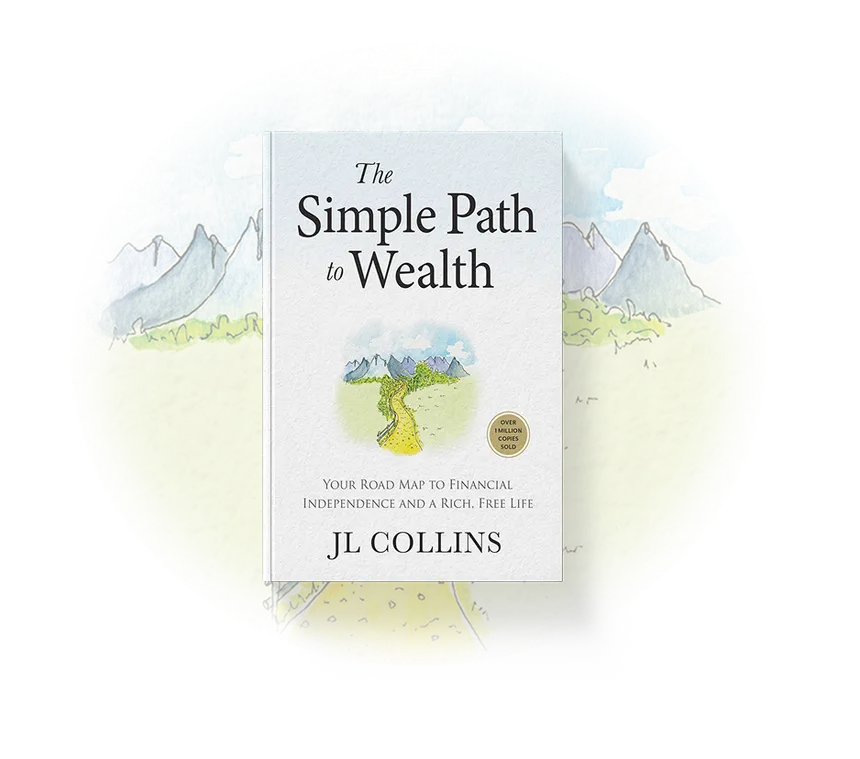
Author: J.L. Collins
Category: Finance
Published: 2016
Pages: 286
Key Takeaways
- **F-You Money is the ultimate goal.** It's not about consumption—it's about having enough wealth that you never have to do things you don't want to do for people you don't like.
- **Debt is a financial cancer.** Treat high-interest debt as a 'hair-on-fire' emergency. Eliminate it ruthlessly before investing.
- **Reverse the savings equation:** Income - Savings = Spending. Pay your future self first, then live on what remains.
- **Your savings rate determines your retirement timeline.** At 50% savings rate, you buy two years of freedom for every year worked (~17 years to FI).
- **VTSAX (or VTI) is the ultimate investment.** Own the entire market with one fund. Low fees, self-cleansing, and beats 80-90% of professional managers.
- **Simple beats complex.** The financial industry profits from making investing seem difficult. Reject the noise and specialized products.
- **Market crashes are features, not bugs.** When the market drops, do nothing (or buy more). Panic selling is the only way to lose long-term.
- **The 4% Rule defines your FI number.** Annual Expenses × 25 = Your target. Cut spending and your FI number drops dramatically.
- **Asset allocation shifts with life stage.** 100% stocks while accumulating, shift to 75/25 stocks/bonds in retirement for stability.
- **Keep 1-2 years cash in retirement.** Spend cash during downturns so you never sell stocks at a loss.
About This Summary
The Definitive Financial Independence Blueprint: The Simple Path to Wealth
Introduction: Rejecting the Noise & Defining F-You Money
Let's get one thing straight immediately: Complexity is the enemy.
The financial industry—the banks, the brokerage houses, the commission-hungry advisors, and the talking heads on CNBC—is built on a single, profitable lie. That lie is that investing is difficult, dangerous, and requires their expensive "expertise" to navigate. They want you to believe that the market is a dark forest and they are the only ones with a flashlight.
They are lying to you.
The truth is that successful investing is simple. It is not easy, because it requires discipline and the ability to control your emotions, but the mechanics are remarkably simple. In fact, simple beats complex almost every single time.
This guide is about rejecting the noise. It is about ignoring the specialized ETFs, the whole life insurance policies, the market timing newsletters, and the hot stock tips from your brother-in-law. It is about stripping your financial life down to its chassis and rebuilding it for one specific purpose: Freedom.
We are not here to buy Ferraris. We are not here to impress the neighbors. We are here to build F-You Money.
What is F-You Money?
It is the most powerful tool money can buy. It is the glorious position of having enough wealth that you no longer have to do things you do not want to do, for people you do not like, for reasons that do not matter to you.
- When your boss demands you work the weekend for the third time this month, F-You Money allows you to say, "No."
- When a company merges and the culture turns toxic, F-You Money allows you to walk away without a panic attack.
- When you want to take a year off to paint, write, or travel, F-You Money writes the check.
Money is not about consumption; it is about options. Every dollar you spend on clutter and depreciation is a soldier you have recklessly killed. Every dollar you save and invest is an employee you have recruited to work for you, 24 hours a day, 7 days a week, until the end of time.
If you are looking for a get-rich-quick scheme, stop reading. Go buy a lottery ticket and enjoy your poverty. But if you are ready to play the long game—the winning game—welcome to the Simple Path.
The Simple Path: The Three Non-Negotiable Steps
Wealth is not a function of luck or brilliance. It is a result of lifestyle choices. To achieve Financial Independence (FI), you must master three concepts. You cannot pick and choose. You must do all three.
Step 1: Debt is Destruction
There is no sugarcoating this: Debt is a financial cancer.
Specifically, I am talking about high-interest consumer debt—credit cards, personal loans, car notes, and payday loans. This debt is the mathematically guaranteed way to stay poor.
Think about the math. The stock market, on average and over time, might return 8% to 10%. Your credit card charges you 18% to 25%. If you are carrying credit card debt while trying to invest, you are paddling a canoe upstream against a category five hurricane. You are losing.
#### The "Hair on Fire" Emergency
If you have high-interest debt, you do not have a "cash flow issue." You have a hair-on-fire emergency. You should treat this debt as if your hair is literally on fire. You would not ask, "What is the optimal asset allocation for my hair?" You would put the fire out.
- Stop borrowing immediately. Cut up the cards.
- Throw every available dollar at the principal. Sell the car if you have to. Eat rice and beans.
- Do not invest (unless you get a company match, which is free money) until this fire is out.
The psychological weight of debt forces you to make bad decisions. It keeps you tethered to a job you hate because you have payments to make. You cannot build F-You Money when you owe your soul to Visa. Eliminate it. Ruthlessly.
Step 2: Save First, Spend Later
Most people follow this losing formula:
Income - Spending = Savings
Usually, there is nothing left at the end of the equation.
To be wealthy, you must reverse the equation:
Income - Savings = Spending
You must live on what is left after you have paid your future self. This is where the rubber meets the road. This is where you determine how many years you have to work.
#### The Math of the Savings Rate
Your savings rate is the single most important variable in the time it takes to reach FI. It matters more than your investment returns.
| Savings Rate | Years to Retirement | |-------------|---------------------| | 0% | Never | | 10% | ~51 years | | 25% | ~32 years | | 50% | ~17 years |
Do you see the power of that? By living on half your income, you essentially buy two years of freedom for every one year you work.
This requires you to reject the standard American narrative of "lifestyle inflation." Just because you got a raise does not mean you need a bigger house or a luxury car. The world is full of people making $200,000 a year who are living paycheck to paycheck. They are high-income poor people. Don't be them.
Spend your money on what truly brings you joy, and cut the rest mercilessly.
Step 3: Invest Simply
Once you have extinguished your debt and established a high savings rate, you must make that capital work.
If you shove your savings under a mattress or leave it in a checking account, inflation will eat it alive. Inflation is the silent tax that erodes your purchasing power by 2-3% every year. To build wealth, you must own assets that grow faster than inflation.
You need to own businesses.
But you don't need to start a business, and you don't need to pick which business will be the next Amazon.
You just need to buy the market.
This is where the transition happens. You stop working for money, and your money starts working for you. The mechanism for this is the stock market. But not the stock market as the gamblers see it. We are not trading; we are investing.
The Index Fund Masterclass
Now we arrive at the core strategy. This is where people expect complex diagrams and hedging strategies. Instead, I am going to give you the most boring, effective investment advice in history.
VTSAX & The Critique of Complexity
There is one investment vehicle that stands above all others for the aspiring FI enthusiast: The Total Stock Market Index Fund.
My personal weapon of choice is VTSAX (Vanguard Total Stock Market Index Fund). If you use an ETF strategy or a different brokerage, the equivalent is VTI.
#### What is it?
When you buy VTSAX, you are buying a tiny piece of almost every publicly traded company in the United States. You are buying Apple, Microsoft, and Google. But you are also buying the mid-sized manufacturing plant in Ohio and the small biotech startup in California. You own the entire haystack, rather than trying to find the needle.
#### Why Index Funds?
- Self-Cleansing: The stock market is a self-cleansing mechanism. Bad companies go bankrupt and drop out of the index. Good companies grow and become a larger part of the index. You don't have to monitor this. The index does it for you.
- Low Fees: Costs matter. Active managers (people who try to pick stocks) charge high fees (1% to 2%). VTSAX charges an expense ratio of around 0.04%. In the investing world, you get what you don't pay for. High fees destroy compounding.
- Active Management Fails: The data is undeniable. Over a 15-20 year period, roughly 80-90% of active fund managers fail to beat the simple index. These are professionals with supercomputers and insider access, and they still lose to a dumb index fund. Why do you think you can do better?
The Psychology of "Mr. Market"
The market will crash. It will tank. It will drop 30%, 40%, maybe 50%. This is not a bug; it is a feature.
To succeed with VTSAX, you must have nerves of steel. When the market crashes, the talking heads will scream that the world is ending. Your portfolio value will plummet.
You must do nothing.
Actually, if you are in the accumulation phase, you should celebrate, because you are buying shares on sale.
The only way you lose money in the stock market is if you panic and sell when the market is down. If you hold, the market has—historically, 100% of the time—recovered and gone on to new highs.
Portfolio Allocation: The Wealth Accumulation & Preservation Phases
We do not need complex asset classes. We don't need gold, crypto, commodities, or REITs. We need Stocks (for growth) and Bonds (for stability).
Stocks (VTSAX/VTI)
- Role: Growth and inflation-beating returns.
- Risk: High volatility. The ride is bumpy.
Bonds (VBTLX/BND)
- Role: Deflation hedge and volatility dampener. Bonds usually zag when stocks zig. They provide a cushion.
- Risk: Lower returns over the long run.
The Allocation Strategy
Your allocation depends on your stage in life and your risk tolerance.
#### The Wealth Accumulation Stage (Young/Working)
When you are building wealth, you want maximum growth. You don't need income from your portfolio yet. You should be aggressive.
Recommendation: 100% VTSAX (Stocks).
Why: You have time to recover from crashes. Bonds will only drag down your returns.
#### The Wealth Preservation Stage (Near/In Retirement)
When you stop working, you need to ensure a market crash doesn't wipe out your grocery money. We introduce bonds to smooth the ride.
Recommendation: 75% Stocks / 25% Bonds (or 80/20).
Why: You still need growth to fight inflation (hence 75% stocks), but the bonds allow you to sleep at night and give you something stable to sell if the stock market crashes.
| Life Stage | Goal | Stocks (VTSAX/VTI) | Bonds (VBTLX/BND) | Why? | |-----------|------|-------------------|-------------------|------| | Accumulation | Maximum Growth | 100% | 0% | Volatility doesn't matter; you are buying. Maximize compounding. | | Transition | Reduce Risk | 80-90% | 10-20% | Within 5 years of retirement, start adding bonds to mitigate "Sequence of Returns" risk. | | Retirement (FI) | Preservation & Income | 75% | 25% | The "Sweet Spot." Enough growth to last 30+ years, enough bonds to smooth the bumps. |
The Four Stages of Your Financial Life
To execute this masterclass, you must understand where you sit in the timeline.
- The Accumulation Phase: This is the grind. You are working, saving 50%, and buying VTSAX. You embrace market crashes because stocks are on sale.
- The Boring Middle: You have paid off debt and your portfolio is growing. It feels like nothing is happening. This is where most people lose focus and buy a boat. Stay the course.
- The Transition Phase: You are 5 years out from your FI number. You start shifting slightly into bonds. You mentally prepare to leave the workforce.
- The Decumulation Phase: You have reached your number. You quit. You start selling small portions of your portfolio to live.
The Final Stage: Drawdown & The 4% Rule
So, how do you know when you are done? How do you know when you have F-You Money?
You need a number. That number is derived from the 4% Rule.
The Math of Freedom
Based on the Trinity Study, a portfolio invested in a mix of stocks and bonds can support a withdrawal rate of 4% of the initial balance, adjusted for inflation, for 30 years or more with a 95%+ success rate.
To find your FI Number, you do simple algebra:
Annual Expenses × 25 = Your FI Number
- If you spend $40,000 a year: $40,000 × 25 = $1,000,000 needed.
- If you spend $80,000 a year: $80,000 × 25 = $2,000,000 needed.
Do you see the relationship? If you cut your spending, your FI number drops drastically.
Execution: Spending the Nest Egg
When you retire, you stop reinvesting dividends. You take the dividends as cash. If that isn't enough to cover your expenses, you sell a small amount of VTSAX (or bonds) to make up the difference.
The Flexibility Clause
The 4% rule is a guideline, not a law of physics. If the market crashes 40% the year you retire, do not blindly spend 4%. Be flexible. Cut your spending. Skip the vacation. Spend 3% that year.
If the market booms, maybe you buy a new car. The ability to adjust your spending is the ultimate safety net.
The Cash Cushion
I recommend keeping 1–2 years of expenses in cash (High-Yield Savings Account) once you are retired.
- Market Up? Sell stocks to pay for your life.
- Market Down? Spend your cash. Don't sell stocks at a loss. Wait for them to recover.
Conclusion & Final Mandates
We have stripped away the nonsense. We have looked at the math.
The Simple Path is not about getting rich overnight. It is about getting rich eventually, and inevitably. It is about realizing that money is a tool for freedom, not a scorecard for status.
The financial industry wants you to believe you are incapable. They want you scared. They want you trading, guessing, and paying fees.
You now know better.
Control your spending. Control your debt. Control your emotions. If you can do these three things, you will own your life.
The 10 Non-Negotiable Commandments
- Spend less than you earn. If you can't do this, nothing else matters.
- Avoid debt like the plague. If you have it, pay it off. Now.
- Build F-You Money. Always have a buffer that allows you to walk away.
- Invest in VTSAX. Bet on the whole market, not the needle in the haystack.
- Ignore the news. The market will fluctuate. Ignore the noise.
- Keep fees low. Expense ratios are termites in your wealth.
- Max out tax-advantaged accounts. 401ks and IRAs are gifts from the government. Take them.
- Understand your "Enough." Know how much you need to be happy, and stop chasing more.
- Stay the course. When the market drops, do not sell. When the market soars, do not get cocky.
- Value your time over your stuff. You can always make more money. You can never make more time.