Self-Help summary
The 7 Habits of Highly Effective People Summary: Key Ideas and Takeaways
Read a practical summary of The 7 Habits of Highly Effective People by Stephen R. Covey, including key takeaways, lessons, and useful ideas.
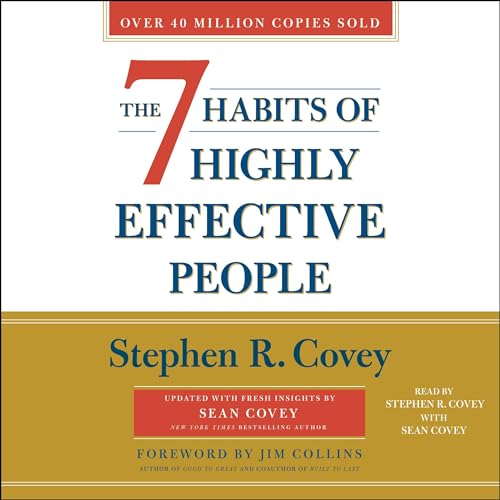
Author: Stephen R. Covey
Category: Self-Help
Published: 1989
Pages: 381
Key Takeaways
- **Character vs. Personality Ethic**: True effectiveness comes from character (integrity, humility, courage) not personality techniques (image, charm). Without character foundation, success is temporary.
- **Be Proactive (Habit 1)**: Between stimulus and response lies your freedom to choose. Focus on your Circle of Influence, not Circle of Concern. Use proactive language: 'I choose' not 'I have to.'
- **Begin with the End in Mind (Habit 2)**: All things are created twice—mentally then physically. Create a Personal Mission Statement. Ask: What do I want said at my funeral?
- **Put First Things First (Habit 3)**: Focus on Quadrant II (Important but Not Urgent): prevention, planning, relationships, growth. Schedule your 'big rocks' first, not last.
- **Think Win-Win (Habit 4)**: Seek mutual benefit in all interactions. Abundance Mentality vs. Scarcity Mentality. Build your Emotional Bank Account through consistent deposits.
- **Seek First to Understand (Habit 5)**: Listen with intent to understand, not to reply. Practice empathic listening—reflecting feelings and meaning, not just content.
- **Synergize (Habit 6)**: Value differences to create Third Alternatives better than either original proposal. The whole is greater than the sum (1+1=3+).
- **Sharpen the Saw (Habit 7)**: Continuous renewal in four dimensions: Physical (exercise, nutrition), Mental (learning, planning), Spiritual (meditation, values), Social/Emotional (relationships, service).
- **The Maturity Continuum**: Dependence → Independence (Private Victory: Habits 1-3) → Interdependence (Public Victory: Habits 4-6). You can't skip steps.
- **Inside-Out Approach**: Start with yourself—your paradigms, character, motives. Outside-In (blaming circumstances) leads to victimhood. Real change begins internally.
About This Summary
THE 7 HABITS OF HIGHLY EFFECTIVE PEOPLE
A Comprehensive Masterclass on Principle-Centered Leadership and Personal Effectiveness
INTRODUCTION: The Foundation of True Effectiveness
When Stephen R. Covey published The 7 Habits of Highly Effective People in 1989, he ignited a fundamental shift in how millions approached success and personal development. The book has sold over 40 million copies and remains one of the most influential works on personal effectiveness ever written.
The Character Ethic vs. The Personality Ethic
Covey's research into 200 years of success literature revealed a striking pattern. For the first 150 years, success literature focused on the Character Ethic—foundational principles such as integrity, humility, fidelity, temperance, courage, justice, patience, industry, simplicity, and modesty.
However, following World War I, success shifted toward the Personality Ethic—public image, attitudes, behaviors, skills, and techniques. This newer approach promised quick fixes but produced only temporary success built on a foundation of sand.
"What you are shouts so loudly in my ears I cannot hear what you say." — Ralph Waldo Emerson
The Power of Paradigm Shifts
A paradigm is a mental map—our perception of how things are and should be. These paradigms shape how we interpret everything. If our paradigms are flawed, no amount of effort will produce lasting change.
The 7 Habits represent paradigm shifts in how we see ourselves, others, and relationships. They align us with universal, timeless principles—"natural laws" of effectiveness.
THE MATURITY CONTINUUM
Human growth progresses through three stages:
1. Dependence: "You take care of me"
Dependent people need others to validate their worth, blame external circumstances, and let others determine their happiness.
2. Independence: "I can do it"
Independent individuals take responsibility for their own lives and don't need others to determine their self-worth. Habits 1-3 (Private Victory) move us from dependence to independence.
3. Interdependence: "We can do it together"
The highest level—recognizing that life's richest experiences come through cooperation. Habits 4-6 (Public Victory) focus on effective interdependence.
Critical: You cannot skip to interdependence. The Private Victory must precede the Public Victory.
THE PRIVATE VICTORY: Habits 1-3
HABIT 1: BE PROACTIVE
Core Concept: Between stimulus and response, there is a space. In that space lies our power to choose our response. In our response lies our growth and our freedom.
Reactive people are driven by feelings, circumstances, and conditions. Proactive people are driven by values—carefully thought about, selected, and internalized values.
Circle of Concern vs. Circle of Influence: Proactive people focus on their Circle of Influence—things they can actually do something about. When we focus on our Circle of Influence, it expands.
Actionable Steps:
- 30-Day Proactivity Challenge: Work only within your Circle of Influence
- Language Audit: Replace "I have to" with "I choose to"
- Commitment Keeping: Make small commitments and keep them
- Mirror Exercise: "I am not a product of my circumstances. I am a product of my decisions."
HABIT 2: BEGIN WITH THE END IN MIND
Core Concept: All things are created twice: first in the mind (mental creation), then in reality (physical creation). The blueprint precedes the building.
Covey invites us to imagine our own funeral. What would we want speakers to say about us? This helps us access our deepest values and clarify what truly matters.
The most effective application is developing a Personal Mission Statement—a written expression of your purpose, values, and principles.
Actionable Steps:
- Funeral Visualization Exercise: Write what you'd want each speaker to say
- Role Identification: List your roles and what you want to achieve in each
- Draft Personal Mission Statement
- Weekly Review Alignment: Review your mission and assess alignment
HABIT 3: PUT FIRST THINGS FIRST
Core Concept: If Habit 1 says "You're the programmer" and Habit 2 says "Write the program," then Habit 3 says "Run the program."
The Time Management Matrix:
QUADRANT I (Urgent & Important): Crises, deadlines, problems QUADRANT II (Not Urgent & Important): Prevention, planning, relationships, growth ← FOCUS HERE QUADRANT III (Urgent & Not Important): Interruptions, some calls/emails QUADRANT IV (Not Urgent & Not Important): Time-wasters, escapism
The key to effectiveness is Quadrant II—important but not urgent activities that have enormous impact but rarely scream for attention.
P/PC Balance: Balance between Production (golden eggs) and Production Capability (the goose). Quadrant II activities are primarily PC activities.
Actionable Steps:
- Time Audit: Log activities by quadrant for one week
- Identify Your Quadrant II Activities
- Schedule Quadrant II First during weekly planning
- Practice Saying No to Quadrant III requests
THE PUBLIC VICTORY: Habits 4-6
HABIT 4: THINK WIN-WIN
Core Concept: Win-Win seeks mutual benefit in all interactions. It's based on the paradigm that there is plenty for everyone.
Six Paradigms of Interaction:
- Win-Win: Both parties benefit
- Win-Lose: I beat you
- Lose-Win: Peace at any price (doormat)
- Lose-Lose: If I can't win, neither will you
- Win: Your outcome is irrelevant
- Win-Win or No Deal: Mutual benefit or no agreement
Emotional Bank Account: Every interaction either makes a deposit (building trust) or a withdrawal (breaking promises, disrespect).
Abundance Mentality vs. Scarcity Mentality: Scarcity sees life as a fixed pie. Abundance sees plenty for everyone and enables genuine delight in others' achievements.
Actionable Steps:
- Emotional Bank Account Audit: Assess balance in key relationships
- Six Major Deposits: Understanding, attending to little things, keeping commitments, clarifying expectations, showing integrity, apologizing sincerely
- Script a Win-Win Conversation before negotiations
HABIT 5: SEEK FIRST TO UNDERSTAND, THEN TO BE UNDERSTOOD
Core Concept: Most people listen with intent to reply, not to understand. We filter everything through our own experiences.
Four Autobiographical Responses that undermine understanding:
- Evaluating: Agreeing or disagreeing
- Probing: Asking questions from our frame of reference
- Advising: Giving counsel based on our experience
- Interpreting: Explaining others' motives based on our motives
Empathic listening means listening with intent to understand—not just words, but feelings and meaning beneath the meaning.
Actionable Steps:
- Empathic Listening Practice: Understand completely before presenting your viewpoint
- Reflect Feeling, Not Just Content: "You're feeling frustrated because..."
- Catch Yourself Being Autobiographical: Notice when preparing your response while others speak
HABIT 6: SYNERGIZE
Core Concept: Synergy means the whole is greater than the sum of its parts. One plus one can equal three, eight, or a hundred.
Most disagreements involve two positions: my way or your way. Synergistic thinking discovers a Third Alternative—not a compromise but a creative solution genuinely better than either original proposal.
This requires valuing differences. The person who sees things differently is providing additional information and opportunity for synergy.
Actionable Steps:
- Value the Difference: Ask "What are they seeing that I'm not?"
- Seek Third Alternatives: "Let's find a solution better than either of us proposed"
- Create Synergistic Environments: Establish ground rules encouraging diverse viewpoints
HABIT 7: SHARPEN THE SAW
Core Concept: Habit 7 is about self-renewal—preserving and enhancing the greatest asset you have: yourself.
Four Dimensions Requiring Renewal:
- Physical: Exercise, nutrition, sleep, stress management
- Mental: Reading, writing, learning, planning
- Spiritual: Value clarification, meditation, nature, service, prayer
- Social/Emotional: Connection, service, empathy, synergy
Just as a lumberjack who never sharpens their saw becomes less effective despite enormous effort, people who never invest in renewal eventually burn out.
The Upward Spiral: Renewal is an ongoing process of learning, committing, and doing—then learning more, committing more, and doing more.
Actionable Steps:
- Daily Renewal Ritual: Practice addressing all four dimensions
- Weekly "Sharpen the Saw" Appointments
- Annual Renewal Review: Assess investment in each dimension
CONCLUSION: The Inside-Out Paradigm
The 7 Habits represent an "Inside-Out" approach—starting with the most internal part: our paradigms, character, and motives. This contrasts with the "Outside-In" approach that blames circumstances and seeks external solutions to internal problems.
The habits are not separate practices but a holistic, integrated framework:
- Private Victory (Habits 1-3): Independence
- Public Victory (Habits 4-6): Interdependence
- Renewal (Habit 7): Sustains all others
Together, these habits move us along the Maturity Continuum and align us with universal, timeless principles that govern human effectiveness.
"Sow a thought, reap an action; sow an action, reap a habit; sow a habit, reap a character; sow a character, reap a destiny." — Stephen R. Covey