Finance summary
One Up On Wall Street Summary: Key Ideas and Takeaways
Read a practical summary of One Up On Wall Street by Peter Lynch with John Rothchild, including key takeaways, lessons, and useful ideas.
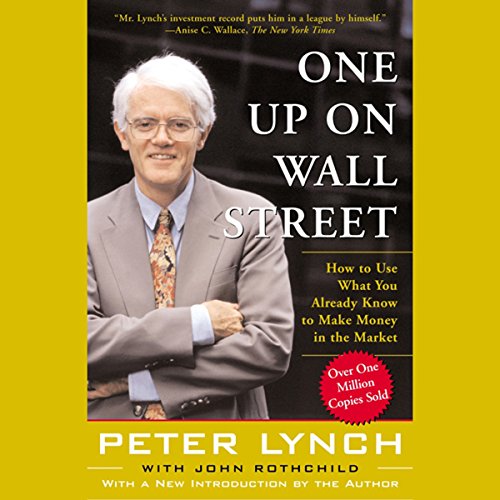
Author: Peter Lynch with John Rothchild
Category: Finance
Published: 1989
Pages: 304
Key Takeaways
- **The Amateur's Edge**: You have an advantage over Wall Street because you are not constrained by bureaucracy and can find opportunities in your daily life.
- **Stomach Over Brains**: Investing is 80% psychology. You must have the stomach to hold through volatility when everyone else is panicking.
- **Know What You Own**: Never invest in a company you cannot explain to a 10-year-old in two minutes.
- **The Six Categories**: Classify every stock (Slow Grower, Stalwart, Fast Grower, Cyclical, Turnaround, Asset Play) to know what to expect.
- **The PEG Ratio**: The P/E ratio should be roughly equal to the growth rate. A PEG under 0.5 is a screaming buy.
- **Invest in Dull**: Boring, disagreeable, or 'no-growth' industries often produce the best winners because they lack competition.
- **Insider Buying**: When insiders buy with their own money, it is the strongest signal that the stock is undervalued.
- **Avoid Diworseification**: Be wary of companies that acquire businesses outside their core competency.
- **Check the Debt**: Avoid companies with high bank debt. Cash on the balance sheet provides a safety floor.
- **Time is on Your Side**: In the short run, the market is a voting machine (emotion). In the long run, it is a weighing machine (earnings).
About This Summary
THE AMATEUR’S EDGE: A MASTERCLASS IN COMMON SENSE INVESTING
Based on One Up On Wall Street by Peter Lynch
INTRODUCTION: The Amateur’s Edge & The Psychology of the Long Game
Welcome to the masterclass. If you are reading this, you’ve probably been told that investing is a game for the professionals—that unless you have a Bloomberg terminal, a Wharton MBA, and a direct line to the trading floor, you’re just "dumb money."
I am here to tell you that is absolute baloney.
In fact, the amateur investor—the "sleeve roller," the person who actually shops at the mall, eats at the chain restaurants, and works in the factories—has a massive, distinct advantage over Wall Street. The professional fund manager is hamstrung by bureaucracy, compliance rules, and the herd mentality. They can’t buy a stock until it’s big enough to move the needle on a billion-dollar fund. By the time they get in, the "tenbagger" (a stock that goes up ten times in value) has already had its first big run.
You, on the other hand, have the freedom of anonymity. You can find the best investments in your own backyard, often months or years before the analysts in New York even know the company exists.
The Psychology of Winning: Stomach Over Brains
Everyone thinks stock picking is a game of mathematics. It isn’t. Investing is a game of stomach.
The single most important organ in your body for investing is your gut, not your head. Why? Because the market is going to drop. It’s going to crash. It’s going to scare the living daylights out of you. When the market drops, the "smart" people on Wall Street panic.
If you are susceptible to selling everything in a panic the moment the news anchor looks worried, you should not be in stocks. The key to the amateur’s edge is patience and independent thinking. You must be able to ignore the noise.
SECTION I: The Six Stock Categories
Before you buy a single share, you have to know what you are buying. Not all stocks are the same. Almost every stock falls into one of six categories.
1. The Slow Growers (The "Sluggards")
- Definition: Large, aging companies (e.g., electric utilities). Expected to grow slightly faster than the economy.
- Strategy: Buy for the dividend (5-7% yield).
- When to Sell: When the dividend yield drops or is threatened.
- Warning: Do not expect capital appreciation.
2. The Stalwarts
- Definition: Multi-billion dollar heavyweights (e.g., Coca-Cola). Grow earnings at 10-12% a year.
- Strategy: Good for protection during recessions. Trade for a 30-50% gain, then rotate.
- Warning: Don't pay a high P/E. If you overpay, you will wait a decade to break even.
3. The Fast Growers
- Definition: The Holy Grail. Small, aggressive companies growing at 20-25% a year. The land of the tenbagger.
- Strategy: Buy companies with a proven model expanding into new markets. Hold as long as earnings are growing.
- Warning: High risk. If growth stops, the stock collapses.
4. The Cyclicals
- Definition: Sales and profits rise and fall with the economy (e.g., Autos, Airlines, Steel).
- Strategy: Timing is everything. Buy when P/E is high (earnings depressed). Sell when P/E is low (earnings at peak).
- Warning: Mistaking a Cyclical for a Stalwart is fatal.
5. The Turnarounds
- Definition: Battered companies facing bankruptcy. "No growers."
- Strategy: Bet on a recovery plan (bailout, restructuring). Check cash vs. debt.
- Warning: They can go to zero.
6. The Asset Plays
- Definition: Companies sitting on overlooked valuable assets (real estate, cash, subscribers).
- Strategy: Patience. Wait for the market to wake up or a buyout.
- Warning: The "wait" can be long.
SECTION II: The Shopping Checklist – How to Find a Multi-Bagger
How do you find the stocks? Look at the world around you.
1. It Sounds Dull—Or Even Better, Ridiculous
The perfect stock has a name like "Bob Evans Farms." If it sounds boring, Wall Street ignores it, keeping the price low.
2. It Does Something Dull
Companies that make bottle caps or auto parts don't attract competition.
3. It Does Something Disagreeable
Better than dull is disgusting. Waste management, grease cleaning, funeral homes. Wall Street analysts don't want to visit them.
4. It’s a Spin-Off
Large companies often spin off divisions. Institutions sell them indiscriminately. If insiders buy, it's a great sign.
5. It’s a No-Growth Industry
I prefer a high-growth company in a no-growth industry. You want to be the best rock quarry in town, not one of a thousand AI startups.
6. The Institutions Don’t Own It
If 0% of shares are owned by institutions, you are early. When they jump in, they drive the price up.
7. The Company is Buying Back Shares
This increases Earnings Per Share (EPS). It's the purest signal that management believes in the company.
8. Insiders Are Buying
There is only one reason an insider buys: They think the price is going up.
SECTION III: The Golden Rules of Fundamental Analysis
You don't need calculus. You need fourth-grade arithmetic.
1. The P/E Ratio vs. The Growth Rate (The PEG)
The P/E ratio should be roughly equal to the earnings growth rate.
- PEG < 0.5: Screaming Buy
- PEG = 1.0: Fair Value
- PEG > 2.0: Sell/Avoid
2. The Debt-to-Equity Ratio
- Ideal: No debt.
- Danger: Debt exceeds equity (> 1.0). Be wary of Bank Debt (can be called anytime) vs. Funded Debt (fixed maturity).
3. The Cash Position
Cash provides a floor for the stock price. Deduct cash per share from the stock price to see what you are really paying for the business.
4. Inventory: The Silent Killer
Inventory should grow in line with sales. If inventory is rising faster than sales, it's a red flag.
5. "Diworseification"
Avoid companies that make stupid acquisitions in businesses they know nothing about.
6. The "Whisper Stock" Red Flag
Avoid companies with no earnings and only a "great story."
SECTION IV: The Investor’s Final Mandates
- Know What You Own: Explain it to a 10-year-old in two minutes.
- Don’t Predict the Economy: Focus on the company, not the Fed.
- Volatility is the Price of Admission: Don't panic sell.
- You Can’t Kiss All the Girls: You can miss Amazon and still make a fortune.
- Time is on Your Side: In the long run, stock prices follow earnings.
- Avoid "The Next...": Buy the current winner, not the "next" one.
- Check the Story: Re-evaluate every 6 months.
- Be Suspicious of High P/E Ratios: Perfection is priced in.
- Look in Your Own Backyard: Your job or hobbies give you an edge.
- Insider Buying is the Best Signal: Follow the money.
- Sell on Fundamentals, Not Price: Don't sell just because it went up.
- Ignore the "Hot" Tips: If it's whispered at a party, ignore it.
- Bottom Fishing is Dangerous: Don't catch a falling knife.
- Small Companies > Big Companies: Big companies have small moves.
- The Person Who Turns Over the Most Rocks Wins: Look at more companies to find more winners.
Final Thoughts: You have the edge. You have the patience. Go to the mall, look at what people are buying, check the balance sheet, and trust your gut.