Finance summary
I Will Teach You To Be Rich Summary: Key Ideas and Takeaways
Read a practical summary of I Will Teach You To Be Rich by Ramit Sethi, including key takeaways, lessons, and useful ideas.
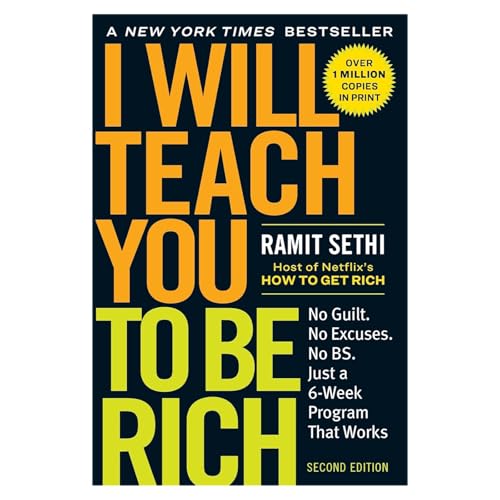
Author: Ramit Sethi
Category: Finance
Published: 2019
Pages: 352
Key Takeaways
- **Spend Extravagantly on What You Love**: Cut costs mercilessly on what you don't. This is the core of the Rich Life.
- **Automate Everything**: Build a system where money flows automatically to savings, investing, and bills. Willpower fails; automation works.
- **The Conscious Spending Plan**: Don't budget. Allocate your money into Fixed Costs (50-60%), Investments (10%), Savings (5-10%), and Guilt-Free Spending (20-35%).
- **Invest in Index Funds**: Don't pick stocks. Use Target Date Funds or a simple 3-fund portfolio. You cannot beat the market.
- **The Ladder of Personal Finance**: 401(k) Match -> High-Interest Debt -> Roth IRA -> Max 401(k) -> HSA -> Taxable Brokerage.
- **Focus on Big Wins**: Negotiating your salary, optimizing your housing, and buying used cars matters 100x more than cutting lattes.
- **Credit Cards are Tools**: Pay them off in full every month to build credit and get rewards. Never carry a balance.
- **Start Today**: The 85% solution—getting started imperfectly—is better than waiting for 100% perfection.
- **Rich Life is Personal**: Your Rich Life might be buying $200 jeans or traveling 3 months a year. Define it for yourself.
- **No Guilt**: Once your savings and investments are automated, spend the rest of your money guilt-free.
About This Summary
The Implementation Guide: The No-BS Roadmap to Automating Your Money
Based on I Will Teach You To Be Rich by Ramit Sethi
Introduction: The Philosophy of the 'Rich Life'
Stop asking $3 questions. Start asking $30,000 questions.
Most people are experts at being average. They agonize over buying a latte, spend hours hunting for a $10 coupon, and then lose tens of thousands of dollars because they didn’t negotiate their salary or chose a mutual fund with a 1% expense ratio. This is what I call playing offense with your money, rather than defense.
The "Rich Life" is not about being a miser. It is not about cutting back on everything you love until you die sitting on a pile of money you never enjoyed.
My core philosophy is simple: Spend extravagantly on the things you love, and cut costs mercilessly on the things you don’t.
To do this, you must reject the "Invisible Scripts" society has handed you—that debt is normal, that investing is gambling, and that you need to be a math wizard to get rich. You don’t. You need a system.
This guide is not a suggestion. It is an Action Plan. We are going to build an automated financial machine that handles your money for you, allowing you to focus on your Big Wins and "Guilt-Free Spending."
If you follow this guide, you will be richer than 99% of your friends within 12 months. Let’s get to work.
Phase 1: Credit Cards & Banking
Optimize the Infrastructure.
Before we talk about investing, we have to fix the plumbing. Most people treat their bank accounts like a storage unit—dumping money in and hoping it doesn’t rot. We are going to treat your accounts like a logistics hub.
Part A: Credit Cards – Your First Line of Defense
Credit cards are not evil; they are power tools. If used correctly, they offer free short-term loans, exceptional fraud protection, and rewards worth thousands.
The Golden Rules of Credit Cards:
- Pay it off in full, every single month. No exceptions. If you cannot do this, switch to debit immediately until you can.
- Automate the payment. Set your credit card to "Autopay: Full Statement Balance."
- Get the perks. Stop using a debit card for daily purchases. You get zero points and zero protection.
Action Step: Optimize Your Cards
- Call your credit card company. Ask if you have an annual fee. If you do, ask for it to be waived.
- Request a Credit Limit Increase. This lowers your credit utilization ratio, boosting your credit score.
Part B: The Banking Setup
You need two accounts: A Checking Account (The Hub) and a Savings Account (The Growth Engine).
1. The Checking Account (No Fees)
This is where your money lands. You want a bank that treats you like a human, not a profit center.
- Requirements: No minimum balance fees, no overdraft fees, free ATM reimbursement (preferred).
- Top Picks: Charles Schwab Investor Checking, Ally Bank, Capital One 360.
- Action: If your current bank charges a monthly maintenance fee, close the account today.
2. The High-Yield Savings Account (HYSA)
Most big banks pay you 0.01% interest. That is an insult. You are losing money to inflation every second it sits there.
- Requirements: FDIC insured, interest rate close to the current federal rate (currently 4.0% - 5.0%+).
- Top Picks: Ally Bank, Marcus by Goldman Sachs, Capital One 360.
- Action: Open an HYSA today. Link it to your checking account.
Phase 2: Defeating Debt & Optimization
Stop Crying, Start Attacking.
Debt is the single biggest barrier to the Rich Life. It destroys your cash flow and your psychology. We are going to tackle it with math, not emotion.
The Math: Avalanche vs. Snowball
- The Snowball Method: Pay off the smallest balance first to get a psychological "win."
- The Avalanche Method: Pay off the highest interest rate first.
I recommend the Avalanche Method. Why? Because math. Paying off a 24% APR card saves you significantly more money than paying off a 5% student loan.
The 5-Step Debt Destruction Plan
- The Audit: List every single debt (Creditor, Balance, APR, Min Payment).
- The Negotiation (Crucial): Call your credit card companies and negotiate the APR.
- Prioritize: Sort by APR (Highest to Lowest). The debt at the top is your target.
- Automate the Minimums: Set up automatic payments for the minimum amount due on ALL debts.
- Attack the Target: Throw every spare dollar at the #1 debt.
Warning: Do not pause your 401(k) match to pay off debt. The 100% return on an employer match outweighs credit card interest.
Phase 3: The Conscious Spending Plan (CSP)
Budgets are for victims. The CSP is for winners.
Most people hate budgeting because it is backward-looking. A Conscious Spending Plan is forward-looking. It decides where your money goes before you spend it.
The Four Buckets
You will allocate every dollar of take-home pay into these four categories.
| Category | Recommended % | What belongs here? | | :--- | :--- | :--- | | 1. Fixed Costs | 50-60% | Rent/Mortgage, Utilities, Debt Payoff, Groceries, Insurance. | | 2. Investments | 10% | 401(k), Roth IRA. This is for "Future You." | | 3. Savings | 5-10% | Emergency Fund, Wedding, House Down Payment, Travel goals. | | 4. Guilt-Free Spending | 20-35% | Dining out, clothes, drinks, gadgets. Anything you want. |
Implementation Steps
- Calculate Your Fixed Costs: Sum up your rent, bills, and debt minimums. Add a 15% buffer.
- Fund the Investments: This is non-negotiable. 10% comes off the top.
- Fund the Savings Goals: Use "Sub-Savings Accounts" in your HYSA (e.g., "Vegas Trip", "New Mac").
- Determine Your Guilt-Free Number: What is left is yours. Spend it with zero guilt.
Phase 4: Automation—The Invisible Financial Engine
Willpower is a finite resource. Automation is infinite.
We are going to build a system where money flows automatically. You will be accumulating wealth while you sleep.
The Hub-and-Spoke Model
Your Checking Account is the Hub. All income flows in here, and the system pushes it out.
The Flow Chart
- Income hits Checking Account (after 401k deduction).
- Automatic Transfer to Roth IRA (Investments).
- Automatic Transfer to HYSA (Savings Goals).
- Autopay pays Fixed Costs Bills (Rent/Utilities).
- Autopay pays Credit Card Bill (Full Balance).
- What's left? -> Guilt-Free Spending.
The Result: You spend less than 1 hour per month managing your finances. You are not "budgeting." You are monitoring a machine that makes you rich.
Phase 5: Investing: Index Funds & Simplicity
Investing is not about picking stocks. It is about asset allocation.
Stop trying to beat the market. You can’t. 80-90% of actively managed funds fail to beat the S&P 500 over a 10-year period.
The Ladder of Personal Finance
Follow this exact order of operations:
- 401(k) Match: Contribute exactly enough to get the full match. Free money.
- Debt: Pay off high-interest debt.
- Roth IRA: Max this out ($7,000/year roughly). Tax-free growth.
- Max out 401(k): Fill it up to the max limit.
- HSA: If eligible, max this out.
- Taxable Brokerage: For anything left over.
What to Buy? (The Strategy)
Do not buy individual stocks. Buy Index Funds.
Option A: The "One-Decision" Solution (Target Date Funds)
- Best for: 90% of people.
- What is it?: A fund based on the year you plan to retire (e.g., "Vanguard Target Retirement 2060").
- How it works: It automatically balances stocks and bonds for you.
Option B: The 3-Fund Portfolio (For Control Freaks)
- Total US Stock Market Index (e.g., VTI): 60%
- Total International Stock Market Index (e.g., VXUS): 20%
- Total Bond Market Index (e.g., BND): 20%
Phase 6: The Big Wins
Focus on the $30,000 Wins, ignore the $3 lattes.
1. Salary Negotiation
A $5,000 raise invested today is worth $100,000+ over your career.
- Tactic: Do not ask for a raise based on your "needs." Ask based on market value and your performance.
2. Housing
Buying a house is not always a good investment. Renting can often be cheaper.
- Rule: Buy only if you plan to stay for 10+ years, you have a 20% down payment, and the total monthly cost is less than 28% of your gross income.
3. Automobiles
Stop buying new cars. A new car loses 20% of its value the moment you drive it off the lot.
- Rule: Buy a reliable used car (3-5 years old), drive it for 10 years, and maintain it well.
The Master Checklist
- [ ] Set up "Autopay: Full Statement Balance" on credit cards.
- [ ] Call credit card company to waive fees/lower APR.
- [ ] Open a High-Yield Savings Account.
- [ ] Ensure you are getting the full 401(k) match.
- [ ] Check 401(k) allocation (Target Date Fund).
- [ ] Open a Roth IRA and set up automatic transfers.
- [ ] Draft your Conscious Spending Plan.
- [ ] Cancel one unused subscription.
- [ ] Buy something nice with Guilt-Free money.