Trading summary
Market Wizards Summary: Key Ideas and Takeaways
Read a practical summary of Market Wizards by Jack D. Schwager, including key takeaways, lessons, and useful ideas.
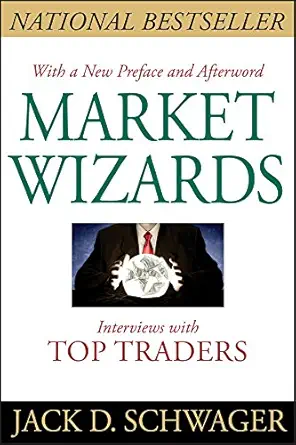
Author: Jack D. Schwager
Category: Trading
Published: 1989
Pages: 480
Key Takeaways
- **Psychology is the Bedrock**: Methodology is secondary. Your mindset, discipline, and emotional control determine your success.
- **Everybody Gets What They Want**: If you are losing, your subconscious might be seeking drama or martyrdom. Align your intent with profit.
- **Risk Management is Paramount**: Never risk more than 1-2% of equity on a trade. Capital preservation is the highest priority.
- **Cut Losses Ruthlessly**: A loss is just the cost of doing business. Do not attach your ego to a trade.
- **The Trend is Your Friend**: Most Wizards follow the trend because it is mathematically valid and driven by human psychology.
- **Patience pays**: Wait for the 'Fat Pitch'—the low-risk, high-reward setup. Do not overtrade.
- **Position Sizing**: Adjust your size based on volatility. Trade smaller when you are losing or when volatility is high.
- **Know Your Exit**: Never enter a trade without knowing exactly where you will get out if you are wrong.
- **The Market is the Mirror**: Trading reveals your internal flaws. You must master yourself to master the market.
- **Survive**: The goal of the beginning trader is survival, not riches. If you survive, you can learn to thrive.
About This Summary
THE MARKET WIZARDS MASTERCLASS: A DEFINITIVE SYNTHESIS
The Universal Principles of Peak Performance Trading
Role: Financial Analyst & Trading Psychologist Source Material: Market Wizards (Original Volume) by Jack D. Schwager
INTRODUCTION: THE ILLUSION OF THE HOLY GRAIL
If you strip away the charts, the tickers, and the noise of the trading floor, you are left with the central premise of Jack Schwager’s Market Wizards: There is no secret sauce. There is no single indicator, no magical algorithm, and no insider whisper that guarantees wealth.
The novice trader spends years searching for the Holy Grail—a system that never loses, a methodology that predicts the future with certainty. The defining characteristic of the "Wizards"—from the macro-global dominance of Paul Tudor Jones to the systematic precision of Ed Seykota and the currency mastery of Bruce Kovner—is that they stopped looking for the Holy Grail outside of themselves. They realized that they are the edge.
This guide serves as a Masterclass synthesis of the original text. We are not interested in the specific moving averages used by Marty Schwartz in 1984, nor the specific grain forecasts of Michael Marcus. Those are artifacts of time. We are interested in the immutable laws of trading that allowed these individuals to compound capital at rates that defy statistical probability.
The synthesis reveals that trading success is a stool supported by three legs: Psychology, Risk Management, and Methodology. If any leg is weak, the stool collapses. However, the Wizards are unanimous in their assessment of the hierarchy: Methodology is the least important, while Psychology is the bedrock.
PILLAR I: THE PSYCHOLOGY OF THE WIZARD
The most profound realization in Market Wizards is that the market is not a battleground of prices, but a mirror of the self. The defining chasm between the amateur and the Wizard is not intellectual—it is psychological.
1. The Subconscious Mandate
The most radical psychological concept in the book comes from Ed Seykota, the father of computerized trend following. His assertion is chilling in its accuracy: "Everybody gets what they want out of the market."
Seykota argues that many traders subconsciously want to lose. They trade for the adrenaline rush, the self-pity, the attention from peers, or to validate a self-image of martyrdom. If you are consistently losing, it is likely because your subconscious is deriving a payoff from the drama of losing. The Wizard has done the internal work to align their conscious desire for profit with their subconscious intent.
2. Emotional Detachment and the Ego
Paul Tudor Jones provides a masterclass in ego management. The market is the ultimate humiliator. The moment you believe you are bigger than the market—the moment you think you have "figured it out"—you are doomed. The Wizards share a trait of radical humility.
Bruce Kovner notes that he is unsure where the market is going 99% of the time. The amateur feels the need to have an opinion on everything; the Wizard is comfortable with the unknown. They view the market as a flow of probabilities, not a test of their personal worth.
3. Resilience and the "Loss" Fallacy
Michael Marcus, who turned $30,000 into $80 million, lost his entire stake multiple times early in his career. The difference between him and a wash-out was resilience. The Wizards view losing differently than the public.
- The Amateur: Views a loss as a failure, a mistake, or a personal flaw.
- The Wizard: Views a loss as the Cost of Goods Sold (COGS).
Just as a restaurant owner does not cry when they buy vegetables that must be cooked, a trader must not despair when they pay a stop-loss. It is an operating expense.
4. Discipline Over Intelligence
Intelligence is often a liability in trading. Highly intelligent people are accustomed to being right and shaping their environment. The market cannot be shaped. The Wizards possess unwavering discipline rather than raw IQ.
This discipline manifests in the ability to pull the trigger when the system says "go," even if it feels terrifying, and the ability to exit when the system says "stop," even if the loss is painful.
PILLAR II: RISK MANAGEMENT: THE PRIME DIRECTIVE
If Psychology is the engine, Risk Management is the brakes. Without brakes, the engine will eventually drive you off a cliff. The universal consensus among every trader in Market Wizards—without a single exception—is that Capital Preservation is the highest priority.
1. The Mathematics of Ruin
Larry Hite breaks trading down to pure probabilities. He emphasizes that if you risk too much, the law of large numbers will eventually destroy you. "If you don't bet, you can't win. If you lose all your chips, you can't bet."
The Wizards understand the asymmetry of drawdown recovery:
- Lose 10%, you need 11% to recover.
- Lose 50%, you need 100% to recover.
- Lose 90%, you need 900% to recover.
To prevent this, the Wizards employ strict position sizing. They never risk more than 1% to 2% of their total equity on a single trade idea.
2. The Stop-Loss: The Non-Negotiable
Bruce Kovner is adamant: "Place your stops at a point that, if reached, will reasonably indicate that the trade is wrong, not at a point determined primarily by the maximum dollar amount you are willing to lose."
However, the synthesis of the interviews suggests a dual-layer approach to stops:
- Structural Stop: Where the chart says the trade is invalid.
- Money Management Stop: The maximum dollar amount you can lose.
If the Structural Stop requires a risk larger than the Money Management Stop allows, you do not take the trade.
3. Position Sizing and Volatility
The "Holy Grail" of risk management is Volatility-Adjusted Sizing. A position in a quiet utility stock should be larger than a position in a volatile cryptocurrency or commodity to maintain the same risk exposure.
4. The "Uncle Point"
Many Wizards discuss the concept of an "Uncle Point"—a total equity drawdown level where they liquidate everything and take a vacation. This prevents the psychological spiral of "revenge trading."
PILLAR III: THE EDGE AND SYSTEM DESIGN
While psychology and risk management are defensive, your Edge is your offense.
1. Define Your Methodology: Technical vs. Fundamental
The book resolves the "Technical vs. Fundamental" debate by proving both work—but rarely for the same person.
- Technical Analysis: Focuses on price action, psychology of the crowd, and trends (Seykota, Dennis, Schwartz).
- Fundamental Analysis: Focuses on supply/demand imbalances and value (Rogers, Kovner).
The Lesson: You must choose a methodology that fits your worldview.
2. The "Fat Pitch" and Patience
Jim Rogers offers one of the most famous quotes in the book: "I just wait until there is money lying in the corner, and all I have to do is go over there and pick it up. I do nothing in the meantime."
This is the concept of the Low-Risk/High-Reward trade. The Wizards do not trade for the sake of activity; they trade for the sake of probability. They spend the vast majority of their time waiting.
3. Trend Following vs. Mean Reversion
Most Wizards in this volume lean toward Trend Following. The logic is simple: Trends persist due to feedback loops in human psychology (fear and greed). "The trend is your friend" is a cliché because it is mathematically valid.
4. Customization: The Personality Fit
You cannot simply copy a Wizard’s system. Van Tharp stresses that a system must be congruent with your personality.
PILLAR IV: ACTIONABLE MANDATES & SYNTHESIS
We have analyzed the mind, the math, and the method. Now, we synthesize these lessons into actionable mandates.
THE WIZARD MANDATES
- Protect the Capital First: Your primary job is not to make money; it is to keep what you have.
- Know Your Exit Before Your Entry: Never enter a trade without defining exactly where you will get out if you are wrong.
- Cut Losses Ruthlessly: When the market invalidates your thesis, get out immediately. Never "hope" a trade comes back.
- Earn the Right to Size Up: Start small. Only increase your trading size after you have generated profits.
- The Trend is the Reality: Do not argue with the tape.
- Avoid Heroism: Don't try to pick the absolute top or bottom. Capture the "meat" of the move.
- Respect Volatility: Adjust your position size based on the volatility of the asset.
- Trade What You See, Not What You Think: Your opinion is irrelevant. The price action is the only truth.
- The "News" is Noise: By the time you read it, it's already in the price. Buy the rumor, sell the news.
- Rest is a Position: If you are unsure, losing money, or emotionally compromised, go to cash.
- Keep a Diary: You must track your psychology and your trades.
- Divorce Your Ego: Being "right" is expensive. Making money often requires admitting you were wrong.
- Don't Chase: If you missed the entry, let it go.
- Avoid Correlation Risk: Do not bet the farm on five different stocks that all move in the same direction.
- Accept the Unknown: You do not need to know where the market is going to make money.
- Love the Game: If you are trading solely for the money, you will quit during the first drawdown.
FINAL SYNTHESIS
Jack Schwager’s Market Wizards serves as a testament to the fact that trading is the hardest way to make easy money. The "Secret" hidden in these pages is that success is an internal journey.
The Wizards did not conquer the market; they conquered themselves. They mastered their fear of losing, their greed for quick riches, and their ego’s need to be right. They built systems that respected the unknowable nature of the future and applied mathematical rigor to survive the inevitable storms.
To walk the path of the Wizard, you must stop looking for the magic indicator. You must look in the mirror. You must build a fortress of discipline around a kernel of statistical edge.