Psychology summary
Don't Believe Everything You Think Summary: Key Ideas and Takeaways
Read a practical summary of Don't Believe Everything You Think by Joseph Nguyen, including key takeaways, lessons, and useful ideas.
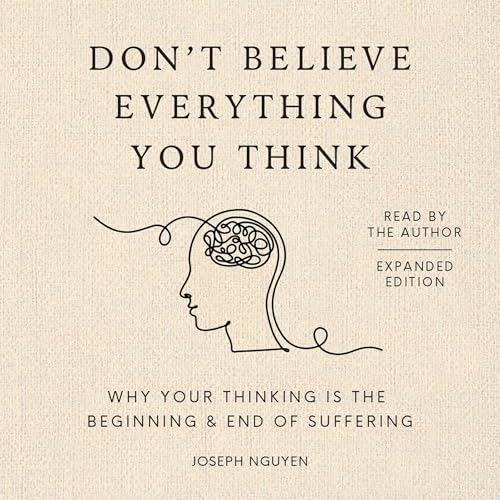
Author: Joseph Nguyen
Category: Psychology
Published: 2022
Pages: 147
Key Takeaways
- **Thinking is the Root of All Suffering**: Pain is inevitable, but suffering is the psychological story we construct around pain through thinking—the difference is the 'Second Arrow.'
- **Thoughts vs. Thinking**: Thoughts are spontaneous, neutral energy like trains passing through a station; Thinking is jumping on the train and engaging with the thought, creating emotional turbulence.
- **The Inside-Out Paradigm**: Your experience of life is 100% generated by your internal mental state, not external events—feelings are indicators of your thinking quality, not reality.
- **The Psychological Immune System**: Like the body heals itself if you stop picking the scab, the mind naturally returns to peace and clarity when you stop interfering with incessant thinking.
- **Intuition Over Intellect**: The best decisions and creativity come from the 'Space of No-Thought'—intellectual thinking is slow and based on the past; intuition is instant and responsive to the present.
- **Your Brain is Designed for Survival, Not Happiness**: Anxiety is evolutionary biology gone overdrive—modern life triggers fight-or-flight responses to non-life-threatening situations like emails and deadlines.
- **Feelings as a Feedback Loop**: Negative emotions are a 'Check Engine Light' signaling distorted thinking, not a commentary on your circumstances—when you feel bad, stop and let the mind settle.
- **The 'How' Trap**: Seeking a method to stop thinking is more thinking—the solution is insight, not technique; once you see that thinking causes suffering, you naturally stop, like pulling your hand from a hot stove.
- **The Muddy Water Principle**: Clarity returns when you leave the mind alone—trying to force calm or 'fix' your state just swirls the dirt; stillness allows natural settling.
- **Via Negativa—Improvement by Subtraction**: You don't need to 'become' confident or peaceful; you are already whole—simply stop doing the things (overthinking) that obscure your natural state of peace and wisdom.
About This Summary
Companion Guide: Don't Believe Everything You Think
Author: Joseph Nguyen Genre: Psychology / Spirituality / Self-Help Guide Tone: Authoritative, Empathetic, Analytical
Part 1: Executive Introduction
The Architecture of Suffering
We live in an age of information overload, where the prevailing wisdom suggests that to solve a problem, we must think our way out of it. We treat the mind like a complex machine that requires constant inputs, strategies, and analysis to function correctly. We believe that if we can just figure out why we are anxious, or how to be successful, we will finally arrive at peace.
Joseph Nguyen's Don't Believe Everything You Think presents a radical departure from this additive approach. It posits a subtractive psychology. The central premise of the book is a paradigm shift that challenges the very foundation of human suffering. Nguyen argues that human beings are not suffering from their circumstances, their past trauma, their finances, or their relationships. We are suffering from one thing and one thing only: Thinking.
This introduction requires a disclaimer: The book does not advocate for stupidity or a vegetative state. It draws a razor-sharp distinction between Thoughts (inevitable, creative energy) and Thinking (the manual, agonizing processing of that energy).
The "Inside-Out" understanding of reality presented in this book suggests that our experience of life is 100% generated by our internal mental state, not external events. When we realize that our feelings are not telling us about the world, but are merely indicators of our current level of thinking, we unlock the door to "The Space of No-Thought"—a state of flow, intuition, and boundless creativity.
This guide will dissect Nguyen's philosophy, proving that the path to peace is not about doing more, but understanding the mechanism of your own mind so deeply that you naturally do less.
Part 2: Chapter-by-Chapter Granular Breakdown
Chapter 1: The Journey to Finding the Root Cause of Suffering
The Core Thesis:
Nguyen begins by dismantling the traditional self-help roadmap. He explains that most personal development is focused on changing external behaviors or applying "Band-Aids" to internal wounds. The thesis here is that we have been looking for the cure in the wrong place. We look at the fruit (the behavior/emotion) rather than the root.
Key Analogies & Stories:
The Golden Buddha: Nguyen references the story of the Golden Buddha covered in clay. For years, monks ignored the clay statue until a crack revealed gold underneath. We are the gold (innate wisdom/peace), but we have covered ourselves in the clay of our conditioning and thinking. We don't need to add gold; we need to chip away the clay.
Deep Analysis:
This chapter sets the stage for "Via Negativa"—improvement by subtraction. The implication is profound: You are already whole. You do not need to "become" confident or peaceful; you simply need to stop doing the things (thinking) that obscure your natural confidence and peace.
Key Quote:
"We don't need to learn how to be happy, we need to unlearn the things that make us unhappy."
Chapter 2: The Root Cause of All Suffering
The Core Thesis:
Here, Nguyen delivers the absolute: Thinking is the root of all suffering. Pain is inevitable (physical sensation or immediate grief), but suffering is the psychological story we construct around pain.
Key Analogies & Stories:
The Hot Stove: If you touch a hot stove, you feel pain. This is useful; it makes you pull your hand away. However, if you stand there screaming at the stove, analyzing why the stove is hot, and worrying if the stove hates you, that is suffering.
The Arrow: Borrowing from Buddhist philosophy, the "First Arrow" is the event (e.g., losing a job). The "Second Arrow" is our reaction to it ("I am a failure"). We can survive the first arrow; the second arrow kills us.
Deep Analysis:
This chapter forces the reader to confront their own narrative. It suggests that an event has zero emotional charge until we attach a thought to it. A rainy day is just water falling from the sky. It only becomes "gloomy" or "ruining my plans" when we engage in thinking about it. This liberates the reader from being a victim of circumstance.
Key Quote:
"Thinking is the act of engaging with thoughts and judging them, which creates our emotional experience."
Chapter 3: Why We Think
The Core Thesis:
If thinking causes suffering, why do we do it? Nguyen explains the evolutionary biology behind the brain. The brain is a survival mechanism designed to detect threats. It is not designed to make you happy; it is designed to keep you safe.
Deep Analysis:
This chapter promotes self-compassion. Readers often feel guilty for their anxiety. Nguyen reframes anxiety as a biological function gone overdrive. In modern society, we don't face saber-toothed tigers; we face emails and social expectations. The brain treats these as life-or-death threats, triggering the "fight or flight" thinking spiral. Understanding this biological mismatch helps us take our thoughts less seriously.
Key Quote:
"Your brain's primary job is survival, not happiness."
Chapter 4: Thoughts vs. Thinking (The Crucial Distinction)
The Core Thesis:
This is arguably the most important chapter in the book. Nguyen distinguishes the noun (Thought) from the verb (Thinking).
- Thoughts: Spontaneous, uncontrollable energy. Like a heartbeat or breathing. They pop up and pass. They are neutral.
- Thinking: The active engagement with a thought. It is the conversation you have about the thought.
Key Analogies & Stories:
The Train Station: Imagine you are on a platform. Trains (thoughts) pass by constantly. You can watch them pass (awareness/observation), or you can jump on a train (thinking) and let it take you to a destination you didn't want to visit (anxiety/depression). The goal is to stay on the platform.
Deep Analysis:
This distinction is the "off-switch" for suffering. Most people try to stop having negative thoughts (which is impossible). Nguyen argues you simply need to stop engaging with them. A negative thought left alone will die of starvation. A negative thought engaged with becomes a monster.
Key Quote:
"A thought is harmless unless we believe it. It's not our thoughts that cause us pain, but our engagement with them."
Chapter 5: If We Don't Think, How Do We Exist? (Intuition & Wisdom)
The Core Thesis:
A common fear is that without thinking, we will be zombies. Nguyen introduces the concept of Intuition (or Universal Intelligence/Wisdom). This is the knowledge that exists before logic. It is the state of "Flow."
Key Analogies & Stories:
Musicians and Athletes: When an athlete makes a game-winning play, they aren't thinking, "Move left foot 30 degrees." They are in a state of "No-Mind" (Mushin). They are operating purely on intuition. Thinking actually slows them down and causes errors (the "yips").
Deep Analysis:
This chapter redefines intelligence. Intellectual thinking is slow, linear, and based on the past. Intuition is instant, holistic, and responsive to the present. The author argues that our best decisions come when we clear the noise of thinking, allowing the signal of intuition to come through.
Key Quote:
"Intuition is the whisper of the soul. Thinking is the noise of the mind."
Chapters 6-8: The Creative Flow and "The Zone"
The Core Thesis:
These chapters expand on the benefits of a quiet mind. Nguyen connects the state of non-thinking to high performance and creativity. When the mind is empty of clutter, it becomes a vessel for divine inspiration.
Deep Analysis:
Nguyen argues that you cannot "think" outside the box, because thinking is the box. Thinking is recycling old data. To create something truly new, you must step into the unknown, which requires the suspension of analytical thought. He links this to the concept of Divine Wisdom—we are conduits for ideas, not the originators.
Key Quotes:
"You cannot solve a problem with the same level of thinking that created it." (Einstein, adapted)
Chapters 9-10: Feelings as a Guidance System
The Core Thesis:
How do we know when we are "thinking" too much? Nguyen introduces emotions as a feedback loop.
- Negative Feelings (Anxiety, Anger, Stress): These are not telling you that your life is bad. They are a "Check Engine Light" telling you that your thinking is currently distorted or muddy.
- Positive/Neutral Feelings (Peace, Clarity): These indicate you are aligned with reality and your thinking is clear.
Key Analogies & Stories:
The Muddy Water: If you have a jar of muddy water, the only way to clear it is to leave it alone. The dirt will settle. If you try to push the dirt down (more thinking), you just swirl it up.
The Check Engine Light: If the light comes on in your car, you don't tape over the light or smash the dashboard. You pull over and check the engine. Similarly, when you feel bad, don't try to "fix" the feeling. Recognize it as a signal to stop thinking and let the mind settle.
Deep Analysis:
This reverses the causal link most people believe in. We usually think: "I feel bad because my job is stressful." Nguyen says: "You feel bad because you are thinking stressful thoughts about your job." The feeling is the shadow of the thought.
Key Quote:
"Feelings are not a feedback mechanism about the world; they are a feedback mechanism about your thinking."
Chapters 11-13: Love, Relationships, and Peace
The Core Thesis:
Suffering in relationships stems from projecting our thinking onto others. We fall in love with our thoughts about a person, and we fight with our thoughts about a person. True love exists in the space of no-thought, where we connect essence-to-essence.
Deep Analysis:
Unconditional love is only possible when we remove the conditions created by the intellect. Judgment is a thought. When we drop judgment, what remains is love. Nguyen posits that love is our factory setting; thinking is what obscures it.
Chapters 14-15: The "How" Trap and The Unknown
The Core Thesis:
The biggest obstacle to this work is the question, "How?"
- "How do I stop thinking?"
- "How do I use intuition?"
Nguyen warns that "How" is a trap of the intellect. It seeks a method, a step-by-step plan, which is just more thinking.
Deep Analysis:
The solution is not a method, but an insight. Once you see the truth (that thinking causes suffering), you naturally stop doing it, just as you naturally stop touching a hot stove once you realize it burns. You don't need a "10-step method to not touch stoves." You just stop.
Key Quote:
"The moment you look for a 'how', you are back in the mind."
Part 3: Thematic Deep Dives
Theme 1: The Inside-Out Paradigm (The Psychological Immune System)
The most profound theme in the book is the Inside-Out nature of reality. Society conditions us to believe in an Outside-In paradigm:
- Outside-In: Money → Happiness. Divorce → Sadness. Traffic → Anger.
- Inside-Out: Thinking → Feeling → Perception of Reality.
Nguyen argues that the human mind has a built-in Self-Correcting Mechanism, similar to the body's immune system. If you cut your finger, you don't have to "think" about healing it. The body knows what to do if you keep the wound clean. Similarly, the psychological system is designed to return to clarity and peace (homeostasis). We don't need to "fix" our minds; we need to stop picking at the scab with our thinking. When we stop interfering, the mind heals itself.
Theme 2: The Illusion of Control
Thinking gives us a false sense of control. We believe that if we worry about the future, we are somehow preparing for it. Nguyen exposes worry as a completely useless expenditure of energy. It is an abuse of the imagination. We use our incredible creative power to visualize worst-case scenarios that haven't happened.
The book advocates for Surrender—not giving up, but giving over the heavy lifting to the greater intelligence of life/intuition.
Theme 3: Non-Duality and The Space Between
The book touches on non-dualism—the idea that the separation between "me" and "my problems" is a construct of thought. In the "Space Between Thoughts," there is no "me" to suffer. There is just experience.
Nguyen describes this space as the realm of infinite potential. All great inventions, art, and solutions come from this void. By identifying with the space (consciousness) rather than the noise (thinking), we become invincible to psychological suffering.
Part 4: Practical Application & Mastery
While Nguyen warns against "methods," the transition from intellectual understanding to embodied living requires a shift in perspective. Here is how to apply the book's philosophy in daily life.
1. The "Is It True?" Filter (The Reality Check)
When you feel a negative emotion spike, immediately pause and ask:
"Am I reacting to a fact, or a thought about a fact?"
- Fact: My bank account has $10.
- Thought: I am broke, I will never recover, I am a loser.
- Action: Acknowledge the fact. Discard the thought.
2. The Feeling Barometer Exercise
Use your emotions as a passive alarm system.
The Practice: Throughout the day, check your "internal weather."
- If you feel heavy, anxious, or urgent: STOP. Do not make decisions. Do not send that text. Do not have that difficult conversation. Your "Thinking Compass" is spinning and unreliable.
- Wait until the feeling subsides. Do dishes, take a walk, stare at a wall.
- Only act when the feeling returns to neutral or calm.
3. The "Don't Touch the Scab" Visualization
When a persistent intrusive thought arises (e.g., a past embarrassment or a future fear):
- Visualize it as a physical wound.
- Remind yourself: "Thinking about this is picking the scab. If I leave it alone, it will heal and vanish."
- Practice "looking away." Refocus on the sensory details of the present moment (the feeling of your feet on the floor, the hum of the fridge).
4. The "What If" Reversal
We usually ask, "What if it goes wrong?"
Flip the mechanism. When the brain offers a catastrophe, consciously offer the opposite thought, not as a belief, but as a possibility.
- Brain: "What if I get fired?"
- Counter: "What if I get promoted? Or what if getting fired leads to my dream job?"
This neutralizes the validity of the negative thought, showing that it is just a story, not a prophecy.
5. Embracing "I Don't Know"
Cultivate comfort with the phrase "I don't know."
The intellect hates the unknown. The spirit thrives in it. When faced with a problem, admit you don't know the answer. Rest in that uncertainty. This signals the brain to stop churning and opens the channel for Intuition to deliver the answer later (often in the shower or while driving).
Part 5: Conclusion
Don't Believe Everything You Think is not merely a book; it is an invitation to lay down a heavy burden you didn't know you were carrying.
For years, we have been taught that the mind is a weapon to be sharpened, a tool to be kept running 24/7 to analyze, dissect, and conquer our reality. Joseph Nguyen reveals that this constant revving of the mental engine is exactly what creates the smog of suffering.
The transformative power of this book lies in its simplicity. It does not ask you to chant mantras, wake up at 4 AM, or master complex cognitive behavioral techniques. It asks you to do something far more radical: Trust.
Trust that you are designed for peace. Trust that your feelings are intelligent indicators of your mental state. Trust that beneath the noise of your insecure thinking, there is a wellspring of wisdom that knows exactly what to do.
By distinguishing between the inevitable spark of thoughts and the voluntary fire of thinking, you regain your power. You realize that you are not the voice in your head; you are the one hearing it. In that space of separation lies your freedom.
The world may be chaotic, but your internal world need not be. As you close this guide and return to your life, remember the golden rule of mental peace: When the water is muddy, do not stir. Be still, and let clarity return to you.
Why Read This Book?
If you are tired of "working" on yourself, if you are exhausted by your own internal monologue, and if you seek a peace that is not dependent on your bank account or relationship status, this book is essential. It is the manual for being human that we were never given at birth. Read it not to learn, but to remember who you were before you started thinking you had to be someone else.