Trading summary
Reminiscences of a Stock Operator Summary: Key Ideas and Takeaways
Read a practical summary of Reminiscences of a Stock Operator by Edwin Lefèvre, including key takeaways, lessons, and useful ideas.
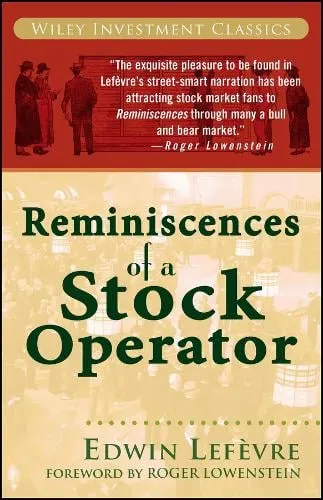
Author: Edwin Lefèvre
Category: Trading
Published: 1923
Pages: 299
Key Takeaways
- **The Market is Never Wrong**: Opinions are often wrong, but the tape contains the verdict. Don't argue with the price action.
- **The Line of Least Resistance**: Prices move along the line of least resistance. Wait for the market to define this line before entering.
- **Sit Tight**: 'It was never my thinking that made the big money for me. It was always my sitting.' Big profits come from riding the major trend, not scalping minor fluctuations.
- **Cut Losses Quickly**: The first loss is the smallest. Never average down on a losing position. If a trade is wrong, get out immediately.
- **Don't Fight the Tape**: If the market is bullish, go long. If bearish, go short. Don't try to be a contrarian for the sake of it.
- **Pivot Points**: Identify psychological price levels where the trend is likely to accelerate. Enter trades at these pivot points to minimize risk and maximize reward.
- **Beware of Tips**: 'I don't believe in tips.' Rely on your own research and judgment. Inside information is often misleading or false.
- **Markets Never Change**: 'The pockets change, the suckers change, the stocks change, but the Wall Street game never changes, because human nature never changes.'
- **Trading is a Business**: Treat speculation as a profession. Keep records, analyze your mistakes, and work hard. It is not a casino.
- **Price vs. Value**: Don't buy a stock just because it looks 'cheap' after a fall, and don't sell just because it looks 'high'. Price is determined by supply and demand, not theoretical value.
About This Summary
Executive Summary
"Reminiscences of a Stock Operator" is widely regarded as the most important investment book ever written. First published in 1923 by Edwin Lefèvre, it is a thinly veiled biography of Jesse Livermore, one of the greatest stock market speculators in history. The book chronicles the life of "Larry Livingston" from his early days as a "boy plunger" in bucket shops to his emergence as a dominant force on Wall Street who made and lost millions of dollars multiple times.
Unlike modern textbooks that focus on mathematical formulas or economic theory, this masterpiece delves into the psychological and strategic realities of trading. It explores the mental discipline, emotional control, and deep understanding of human nature required to succeed in the markets. Livermore's insights on reading the tape, identifying pivot points, testing the market, and managing risk remain as relevant today as they were a century ago.
The book is not just a collection of war stories; it is a complete course in the art of speculation. It teaches that the market is never wrong, but opinions often are; that big money is made not in the individual fluctuations but in the main movements; and that the greatest enemy of the trader is not the market, but their own human nature.
Part I: The Education of a Speculator
Chapter 1: The Boy Plunger
The story begins with Livingston as a young boy working as a quotation-board boy in a brokerage office. His job is to post stock prices on a chalkboard as they come in over the ticker tape. He notices that stock prices don't move randomly; they follow patterns. He starts keeping a notebook of his observations, predicting price movements based on these patterns.
One day, a co-worker suggests they bet on a stock in a "bucket shop"—an establishment that allows people to bet on stock prices without actually buying the shares. Livingston checks his notebook, sees a favorable pattern, and agrees. He makes a profit on his first trade.
This marks the beginning of his career as a "boy plunger." He realizes he has a talent for reading the tape—interpreting price and volume data to predict short-term movements. He trades exclusively in bucket shops, where execution is instant and he doesn't need to worry about the actual mechanics of the stock exchange.
Key Lesson: The tape is the ultimate truth. It doesn't matter what should happen; what matters is what is happening. Observation and pattern recognition are the foundations of successful speculation.
Chapter 2: The Bucket Shop Era
Livingston's success in the bucket shops becomes legendary. He wins so consistently that the shops start banning him. They recognize him as a "wolf" who will bankrupt them. He has to use disguises and fake names to place trades, but eventually, he is shut out of every bucket shop in the region.
This period teaches him the mechanics of price movement but gives him a false sense of security. In a bucket shop, you bet against the house. If the price moves in your favor, you win. But on Wall Street, buying a stock affects its price, and execution is not instantaneous. This distinction will later cost him dearly.
Key Lesson: A system that works in one environment may fail in another. Adaptability is crucial. Also, if you are too successful, the "house" may change the rules.
Chapter 3: First Steps on Wall Street
With his bucket shop profits, Livingston moves to New York to trade on the New York Stock Exchange. He confidently applies his tape-reading skills, expecting the same results. He is wrong.
He loses his entire fortune. He realizes that his bucket shop methods—scalping small profits on minor fluctuations—don't work on the big board. The delay in trade execution (slippage) and the impact of his own orders on the price make his old strategy obsolete. He is "trading in a rig that is not built for the roads he is traveling."
He goes broke and has to borrow money to survive. This is his first major failure, but he views it as tuition paid for his education.
Key Lesson: There is a huge difference between betting on price fluctuations and actually buying and selling assets. Slippage, commissions, and market impact must be factored into any strategy.
Chapter 4: The Tuition of Failure
Livingston returns to the bucket shops (where he can still sneak in occasionally) to rebuild his stake. He manages to make some money but realizes he can't stay there forever. He returns to Wall Street, determined to learn the game properly.
He discovers that he is often "right too soon." He correctly predicts a move but enters too early, gets stopped out by a minor fluctuation, and then watches the stock move exactly as he predicted. He learns that being right is not enough; timing is everything.
Key Lesson: Timing is distinct from direction. You can be right about the direction of the market and still lose money if your timing is off. Patience is a skill that must be cultivated.
Part II: The Art of Speculation
Chapter 5: The General Conditions
Livingston begins to understand that individual stock movements are subordinate to the general market trend. He stops trying to pick tops and bottoms of individual stocks and starts studying the "general conditions" of the economy and the market.
He realizes that in a bull market, you should be long; in a bear market, you should be short. It sounds simple, but it is the hardest lesson to learn. Most traders are obsessed with the "action" of the moment and ignore the tidal wave of the broader trend.
Key Lesson: Disregard the minor fluctuations and focus on the main trend. "It was never my thinking that made the big money for me. It was always my sitting."
Chapter 6: The Line of Least Resistance
Livingston develops the concept of the "line of least resistance." Prices move along the path of least resistance. If buying pressure is stronger than selling pressure, the price will rise. If selling pressure is stronger, it will fall.
He learns to wait for the market to define its line of least resistance before entering a trade. He stops trying to anticipate the market and starts following it. He waits for a stock to break a critical level (a "pivot point") which confirms the direction of the move.
Key Lesson: Don't fight the market. Wait for the market to tell you which way it wants to go, then join it. The trend is your friend.
Chapter 7: The Big Swing
Livingston makes his first real fortune by shorting the market before the Panic of 1907. He sees the signs of a tightening money supply and an overextended market. While everyone else is bullish, he starts selling.
When the crash comes, he makes millions. But more importantly, he learns the power of the "big swing." He realizes that the big money is not in the day-to-day trading but in catching the major moves that last for months or years.
Key Lesson: The big money is made by sitting tight. Men who can be both right and sit tight are uncommon. It is the hardest thing to learn.
Chapter 8: The Danger of Tips
Throughout his career, Livingston is bombarded with "tips" and "inside information." He learns to despise them. He realizes that tips are often wrong, or if they are right, they are given too late.
He tells the story of how he was persuaded by a famous commodities trader, Percy Thomas, to go against his own judgment in the cotton market. Thomas convinces him with fundamental arguments that contradict the tape. Livingston listens, covers his shorts, goes long, and loses almost everything.
This disaster teaches him that he must rely solely on his own judgment. If he buys because Smith tells him to, he must sell when Smith tells him to. But what if Smith is on vacation when the time comes to sell?
Key Lesson: A man must believe in himself and his judgment if he expects to make a living at this game. That is why I don't believe in tips.
Part III: The Psychology of Trading
Chapter 9: Human Nature
Livingston emphasizes that the stock market is driven by human emotions: hope, fear, and greed.
- Hope: When a trader is losing money, they hope the market will turn back in their favor. This hope prevents them from cutting their loss.
- Fear: When a trader is making money, they fear the profit will disappear. This fear causes them to sell too early and miss the big move.
A successful speculator must fight these natural instincts. He must fear his losses (and cut them quickly) and hope for his profits (and let them run).
Key Lesson: The speculator's chief enemies are always boring from within. It is inseparable from human nature to hope and to fear. In speculation, when the market goes against you, you hope that every day will be the last day—and you lose more than you should not have lost... And when the market goes your way you become fearful that the next day will take away your profit, and you get out—too soon.
Chapter 10: The Pivot Point
Livingston refines his timing using "pivot points." A pivot point is a psychological price level. When a stock breaks through a pivot point with volume, it is a signal that the move is real and is likely to continue.
He waits for the stock to reach this point before entering. If he buys at the pivot point, he is buying at the exact moment the move is starting. This minimizes his risk (he can get out quickly if it fails) and maximizes his profit potential.
Key Lesson: Patience is key. Watch the stock. Let it develop. Wait for the psychological moment when the line of least resistance is clarified.
Chapter 11: Testing the Market
Before committing his full line (maximum position size), Livingston "tests" the market. He buys a small amount to see how the market reacts.
If the price goes up easily, it means there is little selling pressure. He buys more. If the price feels "heavy" or sluggish, he knows something is wrong and backs off. He uses these probes to gauge the health of the market before risking significant capital.
Key Lesson: Don't go all in at once. Use probe trades to gather information. If the trade starts working, add to it (pyramid). If it doesn't, cut it.
Chapter 12: The Cotton King
Livingston recounts his adventures in the commodities markets—wheat, corn, and cotton. He explains that the principles of speculation are universal. Whether it's stocks or commodities, the game is the same because human nature is the same.
He describes a massive operation in the cotton market where he corners the market not by manipulation, but by recognizing that the supply is genuinely short. He buys quietly, accumulating a massive position without spiking the price, and then waits for the public to realize the shortage.
Key Lesson: Markets are driven by supply and demand. Manipulation can only move prices temporarily. In the end, the facts will assert themselves.
Part IV: Manipulation and Strategy
Chapter 13: The Manipulator's Art
In the later chapters, Livingston describes his role as a market manipulator. In the early 20th century, it was legal for syndicates to hire operators to manipulate stock prices to distribute shares to the public.
Livingston explains the process in detail. The goal of manipulation is not to trick people into buying worthless stock, but to create a market for a stock that has genuine value but no liquidity.
He uses "wash sales" (buying and selling to himself) to create volume and attract attention. He supports the price on dips to give the stock the appearance of strength. He drives the price up to new highs to trigger short covering and attract momentum buyers.
Key Lesson: The goal of manipulation is to induce the public to buy. The best way to do this is to make the stock look strong and active. "Stocks are manipulated to the highest point possible and then sold to the public on the way down."
Chapter 14: Distributing Stock
The ultimate goal of the manipulator is to sell his line to the public. He does this by driving the price up, creating excitement, and then selling into the buying frenzy.
He explains that you cannot sell a large block of stock when the market is going down. You must sell when the market is strong and people are eager to buy. You must sell "on the way down" from the top, but while the public still believes it is a correction in a bull market.
Key Lesson: You can only sell what the market will take. You must feed your stock to the market when it is hungry.
Chapter 15: The Trap of "Inside Information"
Livingston concludes with a warning about "inside information." He explains that company insiders often lie or mislead the public to sell their own shares. They will issue bullish statements while secretly selling.
He argues that the tape tells the truth while insiders lie. If a company president says business is great, but the stock price is breaking to new lows, believe the price, not the president.
Key Lesson: The public always wants to be told. They want a tip. They want to be told what to buy and when. But there is no easy road to riches. Success requires work, study, and self-reliance.
Conclusion: The Legacy of Jesse Livermore
"Reminiscences of a Stock Operator" ends with Livingston (Livermore) as a wealthy but humble student of the market. He acknowledges that the game never ends and that the market will always find a way to humble those who become arrogant.
The book's enduring legacy lies in its identification of the immutable laws of trading:
- The Trend is Supreme: Always trade in the direction of the general market.
- Cut Losses: Never argue with a loss. Accept it and move on.
- Let Profits Run: Be patient with winning trades.
- Price Action Rules: Ignore news, tips, and opinions. Focus on price and volume.
- Emotional Discipline: Master your fear and greed.
Jesse Livermore eventually lost his fortune again and tragically took his own life in 1940. His life serves as both an inspiration and a cautionary tale. His methods for making money were unparalleled, but his inability to conquer his own demons ultimately destroyed him. "Reminiscences" remains his testament—a timeless guide to the most fascinating game in the world.