Sociology summary
Sapiens: A Brief History of Humankind Summary: Key Ideas and Takeaways
Read a practical summary of Sapiens: A Brief History of Humankind by Yuval Noah Harari, including key takeaways, lessons, and useful ideas.
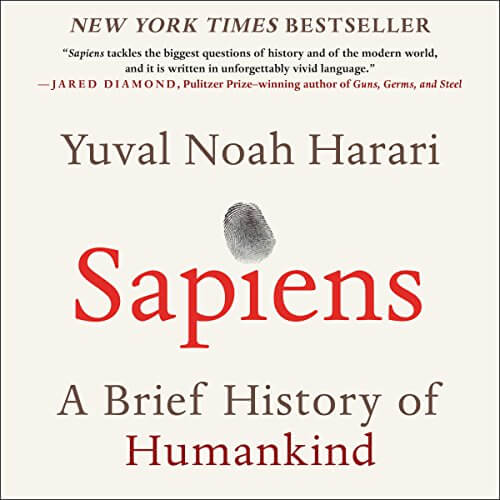
Author: Yuval Noah Harari
Category: Sociology
Published: 2011
Key Takeaways
- The Cognitive Revolution 70,000 years ago was humanity's defining moment, enabling us to create and believe in shared fictions that allow massive cooperation
- Our ability to invent and collectively believe in imagined realities (gods, nations, corporations) is what separates us from all other animals
- The Agricultural Revolution was 'history's biggest fraud' - it increased population but decreased individual quality of life and happiness
- Wheat didn't make humans' lives easier; instead, wheat domesticated humans by trapping them in cycles of hard agricultural labor
- Large-scale human cooperation is only possible through shared myths and stories that have no objective reality
- Money is the most universal system of trust ever created, allowing strangers to cooperate despite different beliefs and cultures
- Empires, despite their violence, have been the primary engines of human unification throughout history
- Universal religions created shared identities and moral codes that transcended tribal and ethnic boundaries
- The Scientific Revolution was unique because it was based on admitting ignorance rather than claiming absolute knowledge
- Science, imperialism, and capitalism formed a powerful alliance that gave humans unprecedented global power
- Most of human civilization is built on collective fictions we've agreed to believe in, not objective realities
- Progress in power and knowledge hasn't necessarily made humans happier than our hunter-gatherer ancestors
- We are on the verge of transcending natural selection through biotechnology, AI, and genetic engineering
- Humans are becoming god-like in power but lack the wisdom to handle such capabilities responsibly
- The future may see the end of Homo sapiens as we upgrade ourselves into a new post-human species
About This Summary
The Ape That Became a God: A Comprehensive Summary of Yuval Noah Harari's "Sapiens: A Brief History of Humankind"
In his landmark book, "Sapiens: A Brief History of Humankind," Yuval Noah Harari embarks on one of the most audacious projects in modern non-fiction: to tell the entire story of our species in a single, sweeping, and intellectually exhilarating narrative. It is a tale of epic proportions, charting the improbable journey of how an insignificant ape, once confined to a corner of Africa and living in constant fear of predators, became the undisputed, and often catastrophic, ruler of Planet Earth. Harari's work is not a mere chronicle of dates, dynasties, and documents; it is a profound and often provocative synthesis of history, biology, anthropology, and economics. By focusing on the pivotal revolutions that propelled our species forward, he masterfully dismantles our most cherished myths about ourselves, our societies, and our progress, forcing us to reconsider the very foundations of what it means to be human.
Narrative and Structural Focus: The Four Great Acts of the Human Story
Harari structures his grand narrative around four critical turning points, each representing a fundamental and irreversible shift in the human experience. These are not merely historical periods but complete reconfigurations of life itself.
1. The Cognitive Revolution: The Birth of Fiction and the Dawn of History
Around 70,000 years ago, while Homo sapiens was still a middle-of-the-food-chain animal, something remarkable and mysterious happened inside our minds. While the exact cause remains unknown—perhaps a random genetic mutation—a change in our cognitive abilities sparked what Harari calls the Cognitive Revolution. This was the moment that Sapiens diverged from all other animals, including the other human species like the Neanderthals and Homo erectus who then shared the planet.
This revolution was not simply the development of language. Many animals have language. A monkey can shout, "Look out, a lion!" or "Look out, an eagle!" What made Sapiens' language unique was its incredible suppleness. We could connect a limited number of sounds to produce an infinite number of sentences with distinct meanings. This allowed us to absorb, store, and communicate a prodigious amount of information about the world around us. But even more critically, it allowed us to do something truly unprecedented: to speak about things that do not exist at all. This is the power to create and believe in shared fictions or, as Harari terms them, "imagined realities."
This was our species' unique and devastatingly effective secret weapon. A chimpanzee or a Neanderthal group could cooperate effectively, but only in small, kin-based bands limited by the necessity of intimate, personal knowledge. Cooperation broke down beyond a certain number, roughly 150 individuals (a concept known as Dunbar's number). Sapiens, however, could transcend this biological limit. We could unite hundreds, thousands, or even millions of strangers around a common myth—a belief in ancestral spirits, a tribal totem, a national god, or the divine right of a king. This ability for large-scale, flexible cooperation was the key that unlocked history.
It allowed Sapiens to form complex hunting parties that could systematically drive entire herds of large game off cliffs. It enabled the formation of sophisticated social structures, long-distance trade networks, and coordinated warfare. It was this unique advantage that allowed our ancestors to spread out of Africa and, in a remarkably short period, to outcompete and likely eradicate all other human species from the face of the Earth. We were not stronger or individually more intelligent than the Neanderthals, but our ability to cooperate flexibly in large numbers made us unstoppable. As Harari powerfully argues, everything that has happened since—from the building of the pyramids and the founding of ancient empires to the creation of modern corporations and the concept of human rights—is built upon this foundational and uniquely human ability to invent and believe in collective stories.
2. The Agricultural Revolution: History's Biggest and Most Consequential Fraud
For tens of thousands of years following the Cognitive Revolution, Sapiens lived as nomadic hunter-gatherers. Then, roughly 12,000 years ago, in several parts of the world independently, we began to abandon this ancient lifestyle to settle down and cultivate a handful of plant and animal species. This shift to farming, known as the Agricultural Revolution, is often celebrated as the great leap forward for humanity, the dawn of civilization. Harari, in one of his most provocative arguments, labels it "history's biggest fraud."
From the grand perspective of the species, agriculture was a wild success. The ability to produce more food per unit of territory enabled a massive population boom, allowing Homo sapiens to multiply exponentially. But from the perspective of the average individual, life became significantly, demonstrably worse. The evidence from ancient skeletons shows that early farmers were generally smaller, less nourished, and more disease-ridden than their forager ancestors.
The hunter-gatherer diet was varied and nutritious, consisting of a wide range of fruits, nuts, roots, and game. Their workdays were often shorter and more varied, and their small, mobile bands were less susceptible to the devastating famines and epidemics that plagued early agricultural settlements. In stark contrast, early farmers relied on a handful of cereal crops like wheat or rice, leading to widespread malnutrition and vitamin deficiencies. They worked longer, harder hours performing back-breaking labor under the hot sun—clearing fields, sowing seeds, weeding, and hauling water. Living in dense, permanent settlements next to their own waste and domesticated animals created the perfect breeding grounds for infectious diseases to flourish.
The Agricultural Revolution also introduced a new and pervasive kind of psychological burden: anxiety about the future. The forager's world was the immediate present. The farmer, however, became tethered to a small plot of land, and their entire existence became a gamble on future outcomes. They were constantly worrying about factors beyond their control—droughts, floods, locust swarms, and blights that could wipe out their entire food supply and spell starvation. As Harari memorably puts it, the conventional wisdom is that Sapiens domesticated wheat. The reality is that wheat domesticated Sapiens. This seemingly innocuous plant lured our species into a demographic trap. A little extra food led to more children, which meant the band could no longer return to foraging. They were locked into farming, working harder and harder to feed a growing population on a worsening diet. This revolution created the concepts of private property, surplus food, and, consequently, a leisured elite, laying the foundation for complex societies, kingdoms, and the deep social hierarchies that have characterized most of human history.
3. The Unification of Humankind: The Inexorable Rise of the Global Village
Following the Agricultural Revolution, human societies grew larger and more complex, giving rise to cities, kingdoms, and empires. For millennia, however, these remained largely separate worlds with distinct cultures, languages, and beliefs. Yet, over the last few thousand years, a powerful and inexorable trend toward global unification has emerged. Harari identifies three universal "imagined orders" that successfully breached cultural and geographical divides, eroding local differences and laying the groundwork for today's interconnected global civilization:
Money: Harari calls money the most successful and universal system of mutual trust ever devised. A gold coin or a dollar bill has no intrinsic value; you can't eat it or wear it. It is a pure shared fiction. Yet, its power is absolute. It allows two people who do not share a god, a king, or a language to cooperate effectively on trade. A Christian knight and a Muslim merchant in a Crusader-era marketplace might despise each other's beliefs, but they both trusted the value of a gold coin. Money is the ultimate universal converter, turning land into loyalty, justice into health, and violence into knowledge.
Empires: Empires are vast political structures that govern diverse ethnic and cultural groups under a single rule. While often established and maintained through brutal violence and exploitation, empires have been one of the most significant engines of human unification. By imposing standardized laws, languages (like Latin or Arabic), currencies, and norms, empires like the Roman, the Han, the Mongol, and the British gradually eroded local differences and stitched disparate peoples into a larger, shared cultural fabric. Their universalistic ideology—the idea that their rule was for the benefit of all the world's peoples—was a powerful tool for legitimizing their conquests and fostering a sense of shared identity among their diverse subjects.
Universal Religions: The final great unifier was the emergence of universal, missionary religions. Belief systems like Buddhism, Christianity, and Islam were revolutionary because they were open to all of humanity, claiming a single, universal truth that transcended tribal affiliations and ethnic loyalties. Unlike the local gods and ancestral spirits of earlier belief systems, these religions gave disparate peoples across vast territories a shared identity, a common moral code, and a powerful justification for large-scale social and political order. They provided a sense of cosmic purpose that could unite millions under a single banner, whether it be Christendom, the Islamic Ummah, or the global Buddhist community.
4. The Scientific Revolution: The Awesome Power of Admitted Ignorance
Beginning around 500 years ago in Western Europe, humankind embarked on its most transformative and power-generating revolution yet. The Scientific Revolution was unique and profoundly different from all previous knowledge systems because it was built on a foundation of willing ignorance—the frank admission that "we don't know." Prior to this, it was generally believed that all the important knowledge about the world was already contained in ancient texts, like the Bible, the Quran, or the works of Aristotle. The revolutionary idea of science was to reject this dogma and to seek new knowledge through empirical observation and mathematical analysis.
This new scientific mindset did not develop in a vacuum. It formed a powerful and world-altering alliance with two other uniquely European forces: imperialism and capitalism. Science provided the technological tools—advanced weaponry, superior navigation techniques, new medicines—that made global conquest possible. European empires, in turn, funded scientific expeditions and provided a constant stream of new data from around the world. Captain James Cook's voyage, for instance, was both a military expedition and a massive scientific undertaking that brought back a trove of new knowledge in astronomy, botany, and anthropology.
Capitalism provided the fuel for this entire enterprise. The modern capitalist economy is built on a shared fiction called credit, which is a belief in the future. Capitalists and investors were willing to fund risky scientific and imperial ventures because they believed in progress—the idea that the future would be better and more prosperous than the present. This potent trio—science, empire, and capital—created an unstoppable feedback loop of discovery, conquest, and economic growth. This potent combination gave humankind unprecedented, god-like powers, allowing us to reshape the planet's geography, alter its climate, harness unimaginable sources of energy, and, for the first time, to begin manipulating the very building blocks of life itself.
Core Themes and Provocative Insights: Weaving the Narrative Together
Woven throughout this historical narrative are several of Harari's most profound, challenging, and recurring arguments:
The Overwhelming Power of Shared Myths: This is the central, unifying thesis of "Sapiens." Harari argues with relentless clarity that our large-scale human societies are not built on objective reality, but on imagined realities. Everything from nations and laws to corporations and human rights are fictions that exist only because we collectively agree to believe in them. A company like Peugeot is a "legal fiction," a story we invented. It is not a physical object, yet it can own property, sue in court, and employ hundreds of thousands of people. This insight is crucial for understanding how our modern world functions.
The Persistent Question of Happiness: In a challenge to all standard narratives of progress, Harari repeatedly asks a simple but profound question: Has all of our progress—our increased power, wealth, and knowledge—actually made us happier? He is deeply skeptical. He explores this question from biological, psychological, and philosophical perspectives, suggesting that human happiness may have a biochemical set point that is not significantly altered by external circumstances. Despite our immense power and material comfort, it is not at all clear that the average modern human is more content or satisfied with their life than our hunter-gatherer ancestors or a medieval peasant. This challenges the foundational modern belief that progress inevitably leads to greater well-being.
The End of History... and the End of Sapiens? The book concludes with a chilling and awe-inspiring look to the very near future. For the first time in four billion years of evolution, life on Earth is poised to break free from the constraints of natural selection and enter the age of intelligent design—a design directed by us. Through the "Gilgamesh Project"—the scientific quest to defeat death—and advances in biotechnology, cyborg engineering, and artificial intelligence, we are beginning to upgrade Homo sapiens into something new: a post-human, god-like being, or "Homo Deus." This brings us to the ultimate and most terrifying question, one that Harari leaves ringing in the reader's ears: As we acquire the divine powers of creation and destruction, what do we want to want? We are faced with the monumental task of deciding our own evolutionary destiny, without a clear understanding of our own desires or the wisdom to handle the consequences.
Overarching Narrative Arc and Enduring Impact
The epic arc of "Sapiens" traces our species' improbable, exhilarating, and often brutal journey from an animal of no significance to the self-proclaimed god of Planet Earth, a species now standing on the precipice of its own self-made obsolescence. Harari's book is far more than a brilliant work of history; it is a profound philosophical inquiry into the nature of humanity itself. Its enduring power lies in its ability to shatter our most fundamental assumptions about progress, happiness, freedom, and our sacred place in the universe. By offering a humbling and intellectually exhilarating macro-perspective, "Sapiens" provides a stimulating, essential, and unforgettable window into who we are, how we got here, and the breathtaking, uncertain future that awaits us.