Finance summary
A Random Walk Down Wall Street Summary: Key Ideas and Takeaways
Read a practical summary of A Random Walk Down Wall Street by Burton G. Malkiel, including key takeaways, lessons, and useful ideas.
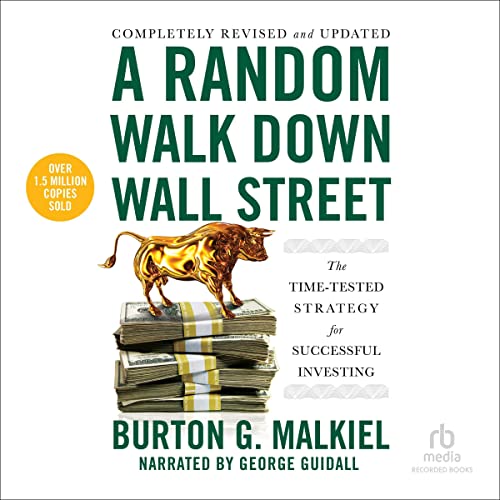
Author: Burton G. Malkiel
Category: Finance
Published: 2000
Pages: 704
Key Takeaways
- **The Random Walk Theory**: Stock prices follow a random walk—future price movements are independent of past movements, making short-term prediction impossible.
- **Efficient Market Hypothesis (EMH)**: Markets efficiently incorporate all available information into stock prices, rendering technical and fundamental analysis ineffective for consistent outperformance.
- **Technical Analysis is Futile**: The Weak Form EMH proves that past price patterns cannot predict future prices. Charting is statistically meaningless after transaction costs.
- **Fundamental Analysis Cannot Beat the Market**: The Semi-Strong Form EMH shows that by the time you act on public information, the market has already priced it in.
- **The Indexing Imperative**: Since beating the market is nearly impossible, the optimal strategy is to match the market through ultra-low-cost broad-market index funds.
- **Fees are the Enemy**: High management fees and transaction costs are guaranteed drags on performance. A 1.5% annual fee can destroy over 50% of your wealth over 40 years.
- **Historical Bubbles Prove Irrationality**: From Tulip Mania to the Dot-Com Bubble, human psychology consistently creates speculative frenzies that end in disaster.
- **Behavioral Biases are Universal**: Overconfidence, loss aversion, anchoring, and herd behavior cause investors to make irrational decisions that harm returns.
- **Life-Cycle Asset Allocation**: Young investors should hold mostly stocks (high risk/high return). As you age, gradually shift to bonds (low risk/low return) to protect accumulated wealth.
- **Diversification is the Only Free Lunch**: Spread investments across U.S. stocks, international stocks, emerging markets, bonds, and REITs to reduce risk without sacrificing returns.
- **Time and Compounding are Your Greatest Assets**: Start investing early. The power of compound interest over decades is the primary driver of wealth accumulation.
- **Rebalance Annually**: Once per year, adjust your portfolio back to target allocation. This forces you to sell high and buy low systematically.
- **Tax-Advantaged Accounts are Essential**: Maximize contributions to 401(k)s, IRAs, and HSAs. Tax savings provide a guaranteed return boost.
- **The Four-Fund Portfolio**: A simple, complete portfolio consists of: U.S. Total Stock Market, International Developed Markets, Emerging Markets, and U.S. Total Bond Market index funds.
- **Discipline, Not Genius**: Investment success comes from following a simple, evidence-based plan with discipline, not from attempting to outsmart the market.
About This Summary
📚 The Epistemology of Prudence: A Deconstruction of Malkiel's "A Random Walk Down Wall Street"
1. Executive Summary and Foundational Framework
Burton G. Malkiel's "A Random Walk Down Wall Street: The Time-Tested Strategy for Successful Investing" stands as a foundational text in modern financial literature, offering a profoundly counterintuitive yet empirically grounded thesis: that the short-term, daily price movements of stocks are fundamentally unpredictable—a random walk.
Concise Introduction 📝
Malkiel's central, challenging thesis is that the price of a stock at any given moment is an unbiased reflection of all available information, rendering future short-term movements essentially random and impervious to technical or fundamental prediction. The core problem this analysis solves is the futility of active management—the demonstrable inability of professional fund managers to consistently "beat the market" after accounting for fees and taxes. Malkiel systematically marshals decades of academic evidence to prove that the average investor engaging in stock picking or tactical timing will, over the long run, invariably underperform a simple, unmanaged, broad-market benchmark. The book's unique value proposition lies in its direct translation of rigorous academic finance theory—specifically the Efficient Market Hypothesis (EMH)—into a simple, low-cost, and universally accessible Practical Prescription: the Indexing Imperative. The work is a skeptical, evidence-based antidote to the speculative frenzy, promising not the elusive, high-risk prospect of "getting rich quick," but the near-certainty of achieving superior, long-term, market-matching returns through patience and simplicity.
The Core Theoretical Pillars 🏛️
The entire structure of Malkiel's argument is built upon a handful of inseparable theoretical pillars that dictate the optimal investment strategy.
#### 1. The Random Walk Theory
This theory, borrowed from statistics, suggests that the price changes of a security follow a stochastic process where all subsequent movements are independent of previous movements. In the context of stock prices, it means that the historical price path of a stock holds no information predictive of its future price path.
Definition: A price series where the change in price from one period to the next is a random variable with zero expected value.
Analogy: The famous illustration is a blindfolded monkey throwing darts at a list of stocks. Malkiel's assertion, backed by data, is that a portfolio selected randomly by the monkey would perform just as well as, and often better than, a portfolio selected by a high-priced expert, primarily due to the expert's high transaction costs and management fees.
#### 2. The Efficient Market Hypothesis (EMH)
The EMH is the financial theory that provides the rational explanation for the random walk. It posits that, in a well-developed, highly competitive market, all relevant information is instantaneously and correctly factored into the current stock price. Malkiel meticulously details the three forms of the EMH:
Weak Form EMH: Asserts that current stock prices reflect all past market data (historical prices and trading volumes). Implication: Technical Analysis (charting, pattern recognition) is useless because patterns are non-existent or statistically insignificant. The past cannot predict the future.
Semi-Strong Form EMH: Asserts that current stock prices reflect all publicly available information (financial statements, news articles, company announcements, economic data). Implication: Fundamental Analysis (researching a company's value) is useless because by the time the average investor acts on the information, the market has already fully discounted it into the price. This is the most practically important form for the average investor, as it invalidates the efforts of most professional active managers.
Strong Form EMH: Asserts that current stock prices reflect all information, both public and private (insider information). Implication: Even corporate insiders cannot consistently make abnormal profits. Malkiel acknowledges this form is demonstrably false (insider trading laws exist for a reason) and is primarily a theoretical benchmark.
#### 3. The Indexing Imperative
If the EMH is true, and it is impossible to consistently predict or outperform the market, the mathematical and economic conclusion is to stop trying. The most rational strategy is to simply own the market by buying a broad market index fund.
Rationale: Since the market portfolio—the aggregate of all investors—defines the average return, and every dollar paid in active management fees is a guaranteed drag on performance, the index fund, which perfectly replicates the market at a near-zero cost, is guaranteed to outperform the majority of actively managed funds over the long run.
#### 4. Thematic Thesis: The Only Free Lunches in Finance
Malkiel's work constantly redirects the investor away from speculative activities (stock picking, timing) and toward scientifically proven factors for return:
- Time: The power of compounding is the single greatest asset of the young investor.
- Diversification: The only way to significantly reduce unsystematic risk (company-specific risk) without sacrificing expected return.
- Minimizing Fees and Taxes: The elimination of these guaranteed return subtractors is the only assured way to increase net return.
The target reader is anyone from the novice investor to the seasoned professional who is willing to replace their attachment to complexity, speculation, and the myth of individual genius with the simplicity and certainty afforded by academic evidence. The promised transformation is the psychological and financial shift from attempting to beat the market—a statistically futile endeavor—to assuredly match it, leading to a superior final accumulation of wealth.
2. Deep Deconstruction: The Theoretical and Practical Arguments
The book's core argument is structured in three logical phases: first, a destructive critique of traditional investment strategies; second, a constructive presentation of the scientific evidence; and finally, a prescriptive guide for building a successful, life-cycle-oriented portfolio.
Phase 1: The Delusions of Speculation (Critique of Active Strategies)
Malkiel begins his deconstruction by directly attacking the two dominant methodologies of active investment management: Technical Analysis and Fundamental Analysis. He frames their failure not as a theoretical accident, but as a necessary consequence of market efficiency.
#### Critique of Technical Analysis: The Weak Form EMH Violation
Technical analysis—often called "charting"—is the attempt to forecast stock prices by interpreting historical trading data, such as price movement, volume, and patterns (e.g., "head and shoulders," "double bottom"). The entire discipline is predicated on the belief that stock prices move in predictable, discernible trends and that these trends tend to repeat themselves.
The Flaw: Technical analysis fails because its central premise—that the history of price movements contains predictive power—is directly contradicted by the Weak Form EMH. If past prices could reliably predict future prices, then all rational market participants would exploit this information until the predictability was entirely eliminated. The remaining movements must therefore be random.
Empirical Evidence (Tests of Serial Correlation): Malkiel cites numerous academic studies that employ statistical tests for serial correlation (the dependence of a stock's current return on its past return). These rigorous tests consistently show that the correlation coefficients for stock returns over short periods (days, weeks) are either statistically insignificant or too small to be profitably exploited after accounting for transaction costs. Stock prices violate the Weak Form EMH because any apparent patterns are merely artifacts of randomness, much like seeing shapes in clouds.
#### The Timeless Nature of Human Folly: Historical Bubbles 🎈
Malkiel reinforces the critique of speculation by cataloging historical episodes of market mania, demonstrating that the failure of technical and speculative trading is rooted in psychology, not just statistics. These episodes serve as powerful, timeless parables of irrational exuberance and the folly of "this time is different" thinking:
- Tulip Mania (17th Century Holland): The absurd escalation of tulip bulb prices to the cost of a mansion, driven purely by speculative fever and the "greater fool theory." When belief failed, the price instantly collapsed.
- The South Sea Bubble (18th Century England): A massive scheme involving a company that promised to take over the British national debt. The stock price soared based on hype and insider manipulation before imploding, financially ruining thousands of investors.
- The Roaring Twenties and the 1929 Crash: The belief that a perpetually rising market justified excessive speculation, leading to leverage (margin) and a catastrophic collapse.
- The Nifty Fifty (1960s-70s): The unquestioned belief that a handful of dominant growth stocks (e.g., IBM, Kodak) were so excellent that their stocks were "worth any price," leading to stratospheric P/E ratios and subsequent crushing underperformance.
- The Dot-Com Bubble (Late 1990s): The modern manifestation, where companies with no profits, no tangible assets, and only a "dot-com" suffix reached multi-billion dollar valuations, only to evaporate almost instantly.
These examples illustrate that, regardless of the era, the root cause of speculative failure is always the same: human psychological bias overpowering rational valuation.
#### Critique of Fundamental Analysis: The Semi-Strong Form EMH Constraint
Fundamental analysis is the attempt to determine the intrinsic value of a stock by examining the underlying company's financial health (earnings, assets, debt, growth prospects) and its industry. The goal is to buy stocks trading below their intrinsic value and sell those trading above it.
The Flaw: Fundamental analysis fails to consistently produce market-beating returns because of the Semi-Strong Form EMH. This form stipulates that all publicly available information is already reflected in the stock's current price.
Example: If a fundamental analyst determines Company X is undervalued based on its P/E ratio, it implies that the analyst has discovered information that the entire, aggregated, highly competitive market has somehow missed. Malkiel argues this is a profound act of hubris. In reality, the "undervaluation" is either already known and priced in, or the analyst is simply wrong in their assessment of future growth or risk.
The Competition: The market is not populated by passive participants; it is an arena of fiercely competitive, highly intelligent, and well-resourced analysts (e.g., Wall Street firms, hedge funds). Any information gleaned from a corporate balance sheet is immediately disseminated and acted upon, ensuring its price impact is instantaneous.
The Expert vs. Random Experiment: While not a single, named experiment, Malkiel effectively uses the comparison of actively managed mutual funds against broad market indices. Year after year, the majority (often 70% or more) of actively managed funds underperform their respective passive benchmarks, especially after deducting their high management fees. This vast, continuous experiment—the mutual fund industry itself—proves that the "experts" applying fundamental analysis cannot consistently beat the market. The high cost of their expertise ensures the market wins.
Phase 2: The Scientific Evidence (The Random Walk & EMH Analysis)
Having demolished the rationale for active trading, Malkiel shifts to the constructive, evidence-based foundation for his investment prescription.
#### The Academic Evidence: Statistical Support for EMH
The empirical support for the Weak and Semi-Strong forms of the EMH is overwhelming, forming the bedrock of modern portfolio theory.
Tests of Serial Correlation (Weak Form): As mentioned, extensive statistical analysis of daily and weekly stock returns shows a near-zero correlation between past and future price changes.
The Result: If you know a stock went up yesterday, the probability it will go up today is statistically identical to the probability it will go down. There is no memory in the price series.
Event Studies (Semi-Strong Form): These studies test how quickly stock prices adjust to the public release of new information (e.g., earnings announcements, stock splits, mergers).
The Result: Prices adjust almost instantaneously to new public information. Investors cannot reliably profit from buying a stock after an earnings announcement, as the price fully reflects the news within moments of its release. The only people who profit are those with illicit prior knowledge (insiders) or those who are paying zero transaction costs.
Malkiel concludes that for the vast majority of investors, the market is "efficient enough" to render any attempt at price prediction or stock selection a net negative, or at best, an activity that yields a market-matching return at an unnecessarily high cost.
#### Behavioral Challenges and Anomalies 🧠
Malkiel devotes considerable space to the field of Behavioral Finance, which attempts to explain market irrationality, bubbles, and anomalies by incorporating human psychology. He acknowledges the insights but rigorously argues that they do not invalidate the EMH's practical prescription.
Key Biases and Their Effect:
- Overconfidence: Investors systematically overestimate their own abilities, leading to excessive trading and risk-taking.
- Loss Aversion: Investors feel the pain of a loss approximately twice as intensely as the pleasure of an equivalent gain, leading to the suboptimal behavior of selling winners too soon and holding onto losers too long.
- Anchoring: Investors become overly attached to a historical price point (e.g., their purchase price) and refuse to sell a stock until it returns to that "anchor."
- Herd Behavior (Social Proof): The psychological tendency to follow the crowd, leading to the creation of speculative bubbles and subsequent crashes.
Malkiel's Counter-Argument: The existence of these widespread psychological biases and the resultant market anomalies (e.g., the January effect, small-cap premium) do not, in practice, invalidate the Semi-Strong EMH for the typical investor because:
- Exploitation is Expensive: Even if an anomaly exists, the transaction costs and taxes required to consistently exploit it will typically eat up any potential abnormal return. The "anomaly" is only profitable in theory, not in the real-world brokerage account.
- Anomalies Disappear: Once an anomaly is discovered and published (i.e., it becomes public information), rational investors act to arbitrage it away, causing it to rapidly vanish.
- The Proverbial Expert: While behavioral finance posits that irrational traders create mispricings, Malkiel notes that it still requires a rational, highly skilled, and low-cost arbitrageur to consistently exploit them. The average investor is one of the irrational traders, not the savvy arbitrageur.
The presence of behavioral biases, in fact, strengthens Malkiel's conclusion: the market's irrationality makes active management even more unpredictable and dangerous for the individual investor. The solution remains to ignore the noise and own the market's total return.
Phase 3: The Practical Prescription (The Life-Cycle Investment Guide)
The third and most crucial section of the book translates the overwhelming academic evidence into a single, concrete, and actionable strategy for achieving superior long-term results.
#### The Indexing Imperative: The Quantitative Argument for Low Fees
The core of Malkiel's practical advice is the inescapable mathematical conclusion derived from the EMH: fees matter, and they matter immensely.
The Guaranteed Drag: Every active fund manager must, by definition, match the market's gross return before costs. Since the average active manager charges an expense ratio of 1.0% to 1.5% and has high transaction costs (turnover), and an index fund charges 0.03% to 0.10% with minimal turnover, the active fund is guaranteed to underperform the index by the entire amount of its fee over the long term.
The Power of Compounding Fees: Over a 40-year investment horizon, a seemingly small 1.5% annual fee can erase over 50% of an investor's potential final portfolio value due to the compounding effect of the lost capital and lost future earnings on that capital.
Superior Long-Term, Tax-Efficient Returns: Index funds are inherently tax-efficient because their ultra-low turnover generates very few capital gains distributions for the investor, particularly when compared to active funds, which frequently buy and sell securities. This tax efficiency dramatically improves the after-tax, after-fee net return for the index investor.
Conclusion: The only way for an investor to be statistically assured of achieving an above-average net return is to ensure their costs (fees and taxes) are significantly below average. This is achieved exclusively through ultra-low-cost, broad-market indexing.
#### Life-Cycle Investing: Portfolio Construction by Time Horizon
Malkiel's investment guide is not a static prescription; it is a dynamic, life-cycle approach based on the investor's time horizon and, proxying for that, their age. The fundamental principle is that risk capacity is highest when time horizon is longest.
The Risk/Reward Tradeoff: Equities (stocks) are volatile in the short run but offer the highest long-term expected returns. Bonds are less volatile but offer lower long-term expected returns.
The Shifting Allocation: As an investor ages and their time horizon shortens toward retirement, the proportion of risk assets (equities) must gradually decrease, and the proportion of safety assets (bonds/cash) must increase. This protects the accrued principal from a catastrophic market drop just before retirement.
Allocation Rules of Thumb: While flexible, Malkiel offers simple rules to guide this rebalancing:
- The "100 Minus Age" Rule: The most basic heuristic suggests the percentage allocated to equities should be 100 minus the investor's age. (e.g., A 30-year-old allocates 70% to equities).
- The "110/120 Minus Age" Rule: Malkiel often suggests a more aggressive starting point for today's younger investor (given longer life expectancies), using 110 or 120 minus age as the equity percentage, reflecting an increased tolerance for long-term risk and a greater need for equity growth.
The Crucial Need for International Diversification: Modern portfolio theory shows that adding non-U.S. equities provides significant risk reduction without sacrificing expected returns because global markets are not perfectly correlated. A complete index portfolio must include a significant allocation (e.g., 20% to 40%) to an International Developed Market Index and, for further reach, an Emerging Markets Index.
#### The Case for REITs and Real Assets
Malkiel also advocates for diversification beyond traditional stocks and bonds into real assets, primarily to mitigate two specific risks: inflation and poor correlation.
Real Estate Investment Trusts (REITs): REITs are companies that own or finance income-producing real estate.
- Inflation Protection: Real estate rents and property values tend to rise with inflation, providing an excellent hedge against the declining purchasing power of currency.
- Risk Reduction: REITs have a correlation with the general stock market that is less than one, meaning they don't move perfectly in sync. Adding them to a portfolio can smooth out overall returns and lower volatility.
Tangible Assets (Commodities/Treasury Inflation-Protected Securities - TIPS): While not advocating for speculative commodity trading, Malkiel supports the inclusion of assets that provide direct inflation linkage. TIPS, in particular, are bonds whose principal value adjusts with the Consumer Price Index (CPI), guaranteeing protection against inflation eroding the bond's real return.
The inclusion of these assets is not an attempt to "beat the market" but a sophisticated application of diversification—the only true "free lunch" in finance—to reduce portfolio risk and protect against macroeconomic factors.
"The Action Blueprint" 🛠️
Malkiel's ultimate, definitive advice for a young investor (e.g., someone under 35 with a 30+ year horizon) can be condensed into a simple, four-step, perpetual action plan:
- Maximize Tax-Advantaged Accounts First: Fund all available tax-advantaged vehicles (e.g., 401(k), IRA, HSA) to the maximum legal limit. The tax savings are the highest guaranteed return available.
- Use Four Specific, Ultra-Low-Cost Index Funds: Construct the equity portion of the portfolio using a simple, diversified basket of four core, low-cost index funds that together represent the global market:
- U.S. Total Stock Market Index Fund (or S&P 500 equivalent): For broad U.S. exposure.
- International Developed Market Stock Index Fund: For non-U.S. diversification.
- Emerging Market Stock Index Fund: For higher growth/higher risk global exposure.
- U.S. Total Bond Market Index Fund (or TIPS fund): For stability and capital preservation.
- Set the Initial Asset Allocation and Automate Contributions: Determine the allocation (e.g., 90% stocks, 10% bonds for a young investor) and set up automatic payroll deductions or bank transfers. Automate the process to eliminate the dangerous temptation of market timing.
- Rebalance Annually (and Only Annually): Once a year, adjust the portfolio back to the target allocation. This forces the investor to systematically sell high and buy low (selling off the winners that have grown past the target weight and buying the underperforming assets). Do nothing else in between.
3. Synthesis and Final Assessment
Synthesized Actionable Imperatives 💡
The Malkiel playbook distills into five universally actionable, evidence-based principles that transcend market cycles and economic conditions:
- Index, Don't Trade (The Folly of Prediction): Recognize the empirical truth of the EMH. Do not attempt to pick individual stocks or time the market, as this is a statistically futile and costly endeavor.
- Minimize Fees, Maximize Return (The Cost Imperative): Treat fees and taxes as guaranteed subtractions from future wealth. The greatest return enhancer is the aggressive minimization of all costs by exclusively using ultra-low-cost index funds and tax-advantaged accounts.
- Diversification is Non-Negotiable (The Only Free Lunch): Spread risk across thousands of global securities (U.S., International, Emerging Markets) and asset classes (stocks, bonds, real estate) to eliminate unsystematic risk.
- Time is Your Best Asset (The Compounding Rule): Start early and remain patient. The power of compounded growth over decades is the primary engine of wealth accumulation.
- Rebalance, Don't Panic (The Discipline Imperative): Establish a simple, appropriate asset allocation and maintain it through a mechanical, periodic rebalancing schedule. Discipline, not genius, is the key to long-term success.
Critique and Context 🔄
The enduring relevance of "A Random Walk Down Wall Street" is undeniable. The book provided the intellectual justification for the rise of passive investing and the trillions of dollars now managed in low-cost index funds and Exchange Traded Funds (ETFs). Its core tenet—that fees are the greatest drag on performance—has fundamentally reshaped the asset management industry.
However, no theory is without debate. Malkiel's work is often criticized by proponents of modern behavioral finance for understating the persistence of certain market anomalies (e.g., value premium, momentum) that might challenge the pure Semi-Strong EMH. Furthermore, the Strong Form EMH remains a clear non-starter in practice. While Malkiel successfully addresses these critiques by arguing that anomalies are too fleeting or costly to exploit for the average investor, the academic discussion continues. Fundamentally, the book does not claim the market is perfectly efficient, only that it is efficient enough to render active management a losing game for the typical participant. This distinction is crucial and holds true today.
Conclusion 🏆
Burton G. Malkiel's "A Random Walk Down Wall Street" is more than just an investment guide; it is a profound philosophical treatise on the epistemology of financial markets. It dismantles the costly illusions of speculation and replaces them with the clear, unassailable wisdom of academic evidence. By demonstrating the logical necessity of the Efficient Market Hypothesis and translating it into the practical imperative of low-cost, globally diversified indexing, Malkiel has provided the single most definitive, indispensable guide for any serious long-term investor. The book's prescription is a recipe for guaranteed success, defined not as beating the market, but as achieving the market's full return with minimal risk, cost, and stress—an achievement that, paradoxically, guarantees outperformance relative to the vast majority of professionals.