Self-Help summary
Atomic Habits Summary: Key Ideas and Takeaways
Read a practical summary of Atomic Habits by James Clear, including key takeaways, lessons, and useful ideas.
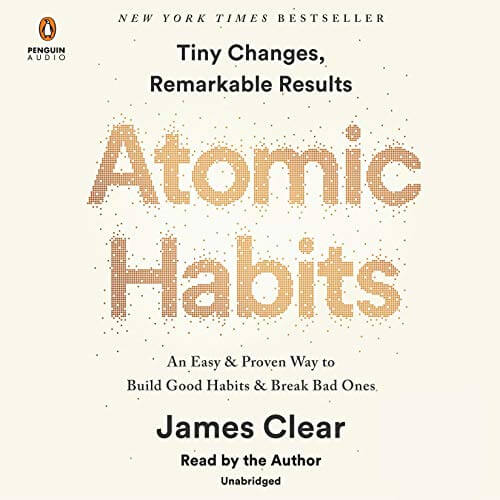
Author: James Clear
Category: Self-Help
Published: 2018
Key Takeaways
- Small habits compound over time - getting 1% better daily leads to 37x improvement over a year
- Focus on identity-based habits: ask 'What would a [desired identity] person do?' rather than focusing on outcomes
- Use the Four Laws: Make it Obvious, Attractive, Easy, and Satisfying to build good habits
- Environment design is crucial - make cues for good habits visible and cues for bad habits invisible
- The Two-Minute Rule: start new habits with actions that take less than two minutes
- Habit stacking: pair new habits with established ones using 'After [current habit], I will [new habit]'
- Never miss twice - missing once is an accident, missing twice starts a new (bad) habit
- Track your habits visually to maintain motivation and see progress
- The Goldilocks Rule: peak motivation occurs when working on tasks at the edge of your abilities
- You don't rise to the level of your goals; you fall to the level of your systems
About This Summary
Atomic Habits: An Easy & Proven Way to Build Good Habits & Break Bad Ones
James Clear's groundbreaking book has emerged as a powerful manual for anyone seeking enduring personal transformation. The heart of Clear's philosophy lies in his conviction that lasting change is not achieved through dramatic, sweeping actions, but through tiny, incremental improvements that aggregate over time.
The Genesis of Atomic Habits: Recovery and Reflection
The formative event behind "Atomic Habits" is Clear's own story of resilience. Following a devastating accident on the baseball field, Clear's existence was upended: the physical trauma left him in a medically induced coma and triggered a prolonged recovery process during which even basic motor functions had to be relearned.
This period of suffering and slow progress forged the foundation of his insights on change. Clear observed that the path back to health—indeed, to competitive athletics—was marked not by miraculous, overnight recoveries, but by persistent commitment to making small, positive choices every day. The steady accumulation of tiny wins led, ultimately, to major victories. This principle, that consistent micro-actions yield tremendous dividends over time, became the central thesis for "Atomic Habits".
The Science Behind Small Changes
Clear advances the radical but scientifically supported idea that "habits are the compound interest of self-improvement." Mathematical thinking—especially the concept of compounding—forms the backbone of his model.
If a person gets just 1% better each day, their improvement compounds rapidly; after one year, they may be thirty-seven times improved in their desired area.
Such a system encourages focusing on daily actions, rather than the distant or daunting goal. The magic of compounding means that incremental progress, when aligned and consistent, grows exponentially rather than linearly.
This shifts the narrative from heroic one-time acts (e.g., a New Year's resolution or an intensive boot camp) to everyday discipline. The transformation that Clear describes is less an event and more a process—a series of tiny, often invisible decisions that gradually reshape behavior and, ultimately, identity.
Systems Versus Goals: A Paradigm Shift
One of Clear's signature contributions is the reversal of traditional goal-setting wisdom. Goals, he argues, are common. Both successful people and those who struggle often share similar dreams or ambitions. What truly differentiates outcomes is not the nature of the goal, but the systems people put in place to move toward it.
Understanding the Difference:
- Goal: The desired end state (e.g., losing twenty pounds)
- System: The series of daily behaviors that make that outcome inevitable (e.g., eating healthier, daily movement, mindful snacking)
Winners focus on the process—a network of habits and routines that, together, make success probable and sustainable. Systems-driven design helps to avoid the "yo-yo" effect, where temporary effort achieves short-term gains but fails to produce lasting change. Instead, shifting focus to habits embeds change at the foundational level, so results become a natural consequence of everyday life decisions.
The Four Laws of Behavior Change: Blueprint for Habit Formation
Clear's central behavioral model is the Four Laws of Behavior Change—a practical, actionable framework simplifying the complexities of psychology into four steps: cue, craving, response, and reward.
1. Make It Obvious (Cue)
Habits begin with triggers—cues that prompt behaviors. To build a good habit, cues should be made as visible and apparent as possible. This often means intentionally designing one's environment so that the desired behavior is hard to miss:
- Placing running shoes by the door
- Leaving a book on the nightstand
- Prepping healthy snacks for easy access
Conversely, to break bad habits, cues must be made invisible—hiding the cookie jar or disabling social media notifications prevents the habit loop from even beginning.
2. Make It Attractive (Craving)
Habits persist when they are rewarding or desirable. Clear encourages leveraging social influence, anticipation of pleasure, and positive association to make new habits more compelling:
- Joining a gym with friends
- Coupling a workout with an enjoyable podcast
- Framing the activity to connect with core values
To undermine bad habits, making the action less attractive—either by changing the framing or linking it to negative outcomes—decreases cravings.
3. Make It Easy (Response)
The simpler a behavior is, the more likely it is to become habitual. Clear's model emphasizes removing friction, reducing the number of steps, and employing tools that make habits effortless:
- Automating savings
- Laying out workout clothes in advance
- Prepping healthy meals ahead of time
The easier the habit, the greater the chance for repetition. In the inverse case, making a bad habit cumbersome—uninstalling apps, adding barriers—prevents its automatic execution.
4. Make It Satisfying (Reward)
Immediate rewards reinforce habits and increase their likelihood of recurrence. Positive emotions, physical pleasure, or visual progress (checklists, habit trackers) all solidify behavior, embedding it into routine.
Conversely, making unwanted habits immediately unsatisfying—either by introducing small punishments or removing pleasure—reduces the motivation to repeat them. The power of instant feedback helps the brain connect effort with reward, cementing change.
Key Frameworks: The Habit Loop and Identity-Based Change
Clear's practical wisdom includes the "habit loop," which describes the ongoing cycle of cue, craving, response, and reward. By understanding and manipulating each component, one can effectively build new habits or dismantle existing ones.
Identity-based habits are among Clear's most original ideas. He warns against focusing solely on outcomes (e.g., running a marathon, writing a book) and urges readers to shift toward identity change (e.g., becoming a runner, seeing oneself as a writer).
Every small action is regarded as a "vote" for the type of person one wishes to become.
By repeatedly performing small habits consistent with a desired identity, over time the identity shifts and the new behaviors become second nature. The true power of this mindset is found in its potential for deep, sustainable change—not just in external results but in self-concept and personal narrative.
Practical Strategies: Bringing Atomic Habits to Life
Atomic Habits is filled with actionable advice and ingenious strategies for habit formation. Several stand out as game-changers:
The 2-Minute Rule
To fight procrastination and initiate new behaviors, Clear recommends starting every new habit with a version that takes less than two minutes to complete. The simplicity lowers resistance and builds momentum. Rather than aiming for an hour at the gym, begin with putting on running shoes. Breaking behaviors into their atomic (smallest) form ensures easy entry and greater reliability.
Habit Stacking
This technique involves linking a desired habit with an existing routine. The sequence becomes anchored in time and space: "After I brush my teeth, I will meditate for one minute." Building new habits onto stable routines locks them in with minimal effort and reinforces consistency.
Environment Design
Clear emphasizes the importance of shaping one's physical and social surroundings to make good habits inevitable. Rearranging spaces, modifying accessibility, and changing exposure to cues all influence behavior.
"Environment is the invisible hand that shapes human behavior," he writes, underscoring the fundamental role surroundings play in habit formation.
The Overarching Narrative and Societal Significance
The genius of "Atomic Habits" is in its universal applicability. Clear skillfully synthesizes scientific research, personal anecdotes, and diverse examples from sports, business, medicine, and education. Every story illustrates core challenges common to habit formation: resurgent bad habits, waning motivation, external distractions, and setbacks.
The ultimate message is one of hope and agency. Clear reassures readers that lasting change is not out of reach; it is a natural, inevitable consequence of systematically embedding positive habits into daily life. In emphasizing small, repeatable actions—rather than willpower or one-time efforts—he offers a method that works even in the face of adversity, and can be applied to any area of life: health, productivity, relationships, finances.
Enduring Impact: How Atomic Habits Changes Lives
Millions have embraced Clear's teachings, and the book's methods have become staples for self-improvement communities and organizations worldwide. The core legacy is its democratization of change—anyone, regardless of starting point or resources, can build habits that reshape identity, career trajectory, and long-term wellbeing.
People have used Atomic Habits to:
- Quit smoking and lose weight
- Advance their careers and repair relationships
- Build creative skills and improve productivity
Businesses employ the methods to improve teamwork, streamline operations, and build organizational culture founded on positive routines. Teachers present Atomic Habits' lessons in classrooms; therapists recommend its principles to clients struggling with motivation or goal setting.
Clear's approach is especially potent because it transcends motivation: when habits are properly designed, they become automatic and resilient, rebooting after setbacks and adapting over time.
Expanding the Model: Applications, Challenges, and Growth
Clear's work provides practical tools but also invites reflection on the broader implications of habits. Some challenges and nuances arise:
- Social Influence: The habits of those around us shape our own by means of expectation, culture, and example
- Temptation Bundling: Pairing challenging habits with enjoyable activities helps bridge motivation gaps
- Tracking and Reflection: Using journals, apps, or visual trackers provides immediate feedback and flags obstacles early
- Adjusting to Failure: Clear advocates treating setbacks as opportunities for analysis, not reasons for self-blame
The most remarkable feature of Atomic Habits is its scalability—it works for goals ranging from fitness to financial independence—and its flexibility. Readers can adapt the laws to their unique needs, circumstances, and aspirations.
The Philosophy Behind Habits: Why Tiny Actions Matter
The deep insight of "Atomic Habits" is philosophical: change, whether societal or personal, rarely happens through force. It happens through countless, repeated, minor choices made in alignment with core values. Progress is not linear, nor is it always visible. But through persistence, routine, and adherence to systems, small actions eventually compose a life of meaning and achievement.
Clear's vision for his readers is both ambitious and accessible: to become the architect of their own destiny, not by grand design but by constructing each day with intentional, positive, atomic habits.
Conclusion: Mastering Change, One Tiny Step at a Time
James Clear's "Atomic Habits" remains a classic because it speaks directly to the universal struggles of motivation, willpower, and human nature. Its central premise—that small, consistent changes add up to extraordinary transformation—is both deeply reassuring and practically empowering.
By providing tools, strategies, and philosophical insight, Clear offers a pathway for anyone to break free of the constraints imposed by their past and build a future crafted from deliberate, positive choices, one tiny habit at a time.