Business summary
Never Split the Difference Summary: Key Ideas and Takeaways
Read a practical summary of Never Split the Difference by Chris Voss, including key takeaways, lessons, and useful ideas.
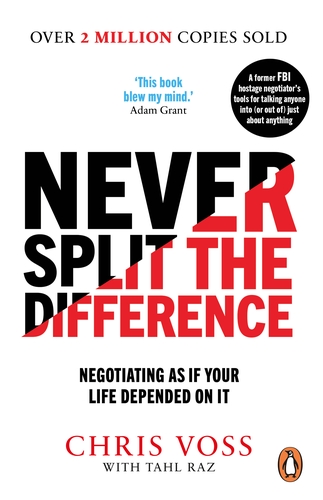
Author: Chris Voss
Category: Business
Published: 2016
Pages: 288
Key Takeaways
- **Emotion comes before calculation:** People evaluate proposals through fear, identity, fairness, loss, and the need to feel heard.
- **Practice tactical empathy:** Understand and articulate the other person’s worldview without confusing understanding with agreement.
- **Slow the conversation down:** A calm voice, deliberate pace, and useful silence reduce threat and create room for information.
- **Mirror selectively:** Repeat a few important words with genuine curiosity to invite clarification and uncover hidden constraints.
- **Label the dynamic:** Tentatively name feelings and concerns so they can be corrected, confirmed, and discussed.
- **Use an accusation audit:** Surface predictable negative perceptions before they become surprise attacks or unspoken resistance.
- **Do not fear no:** A genuine no can create safety, protect autonomy, and reveal obstacles that a counterfeit yes conceals.
- **Aim for “That’s right”:** Summarize facts and emotions accurately enough that the other person recognizes their world.
- **Ask calibrated questions:** Respectful what and how questions make constraints visible and invite the counterpart to help solve the problem.
- **Examine fairness and deadlines:** Clarify what “fair” means and what truly happens after a deadline before conceding under pressure.
- **Prepare bargaining moves:** Use researched targets, planned concessions, and reciprocal trades rather than improvising emotionally.
- **Test implementation:** Identify hidden stakeholders, confirm commitment in several forms, and assign owners, dates, and next steps.
- **Search for Black Swans:** Stay curious about unknown information that can change leverage, value, or the shape of the deal.
- **Use the tools ethically and contextually:** Long-term relationships, cultural differences, unequal power, and genuine opportunities for compromise may require a softer approach.
About This Summary
Never Split the Difference: Negotiation Through Tactical Empathy
Introduction: Negotiation Is Emotional Before It Is Rational
Chris Voss spent twenty-four years in the FBI, eventually serving as its lead international kidnapping negotiator. With journalist Tahl Raz, he turns lessons from hostage cases into a framework for business and everyday conflict. The dramatic stories give the book energy, but its core message is simple: people do not negotiate as perfectly rational calculators. They negotiate through fear, status, identity, fairness, loss, hope, and the need to feel heard.
Traditional negotiation advice often begins with interests, options, objective criteria, and mutually acceptable compromise. Voss believes that this approach can underestimate emotion and the leverage hidden inside conversation. Before someone can evaluate a proposal, the emotional environment must feel safe enough for honest information to emerge.
His central practice is tactical empathy: accurately recognizing another person's feelings and worldview, then demonstrating that recognition without necessarily agreeing. Empathy is not sympathy, surrender, or approval. It is a way of reducing threat and uncovering what is actually driving behavior.
The title attacks compromise for its own sake. If one person wants to wear a black shoe and another wants a brown shoe, splitting the difference produces two mismatched shoes. More seriously, a midpoint can be arbitrary, unfair, or unsafe. A good agreement should solve the underlying problem, not merely average two opening demands.
The book provides a toolkit—voice, mirroring, labels, no-oriented questions, calibrated questions, the Ackerman bargaining method, and the search for “Black Swans.” Its methods are powerful because they improve listening and information gathering. They also require ethical restraint; used mechanically, they can become manipulation rather than collaboration.
The New Rules: Slow Down and Listen
Voss learned that aggressive problem solving is often counterproductive in a crisis. The negotiator who rushes to give advice or issue demands may miss the facts that matter. The first task is to slow the interaction, lower emotional intensity, and make the other person willing to continue talking.
Listening in this framework is active and strategic. The negotiator pays attention to words, tone, pacing, inconsistencies, and what is avoided. The goal is not to wait politely for a turn. It is to build an increasingly accurate model of the other person's situation.
Voss recommends a calm, downward-inflecting tone he calls the late-night FM DJ voice. It communicates control without aggression. A warm, positive voice works for many ordinary exchanges, while a direct assertive voice should be used sparingly because it can trigger resistance.
Pace matters because urgency narrows thought. Silence after a good question can create space for reflection and additional information. People frequently answer once, feel the silence, and then reveal the more important answer. The negotiator's discomfort with quiet should not steal that opportunity.
The principle is counterintuitive: gaining influence begins with giving attention. When the other side feels accurately heard, defensiveness can fall and problem solving can begin.
Mirroring: Invite the Other Person to Expand
A mirror repeats the last one to three important words someone has said, usually with an upward, curious tone. If a colleague says, “We cannot approve this before the quarter closes,” the response might be, “Before the quarter closes?” The mirror encourages elaboration without introducing an argument.
Mirrors work partly because people are drawn to similarity and partly because an echo signals attention. The technique is especially useful when a statement is vague, surprising, or conceals a constraint. Instead of guessing what the speaker means, the negotiator invites them to explain it.
Voss suggests combining a mirror with silence. Repeat the key phrase, pause, and let the other person fill the space. This can reveal deadlines, decision makers, pressures, and emotional concerns that a series of rapid questions would miss.
The method becomes irritating when every sentence is echoed like a script. A mirror must be selective and sincere. Its ethical purpose is clarification, not tricking someone into disclosure. Good mirroring sounds like curiosity because curiosity is actually present.
Tactical Empathy, Labels, and the Accusation Audit
Tactical empathy begins by trying to see the situation as the other person sees it. That includes emotions you dislike and beliefs you think are wrong. Understanding is valuable even when agreement is impossible because behavior is driven by the person's perceived reality.
A label names an apparent feeling, dynamic, or concern. Common openings include “It seems like…,” “It sounds like…,” and “It looks like….” For example: “It sounds like reliability matters more than the lowest price,” or “It seems like you are worried this will create extra work for your team.”
Labels should be tentative. They are hypotheses offered for correction, not declarations about another person's inner life. If the label is wrong, the response often supplies better information. If it is right, the person feels recognized and may elaborate.
Voss recommends labeling negative emotions rather than avoiding them. Unnamed fear can dominate a conversation; naming it can reduce its intensity. Positive dynamics can also be reinforced: “It seems like we both want a solution that protects the relationship.”
An accusation audit lists the worst reasonable things the other side may be thinking about you before they say them. A salesperson might begin, “You may think this proposal is expensive, disruptive, and designed to lock you in.” Bringing objections into the open removes the shock of accusation and demonstrates awareness.
The audit is not an invitation to confess things that are untrue. It is preparation for predictable perceptions. Used well, it reduces defensiveness. Used theatrically, it sounds manipulative. Tone and accuracy matter as much as the wording.
Why “No” Can Be Safer Than “Yes”
Many negotiators chase yes because it appears to signal progress. Voss distinguishes three kinds of yes: counterfeit yes given to escape pressure, confirmation yes that acknowledges information, and commitment yes that actually supports action. Treating every yes as agreement creates fragile deals.
“No” can make people feel protected. It preserves autonomy, clarifies boundaries, and relieves the fear of being trapped. A no-oriented question invites that safety: “Would it be a bad idea to review the numbers together?” “Is it ridiculous to think we can solve this today?” or “Have you given up on the project?” The other person can reject the premise while remaining in conversation.
The technique should not disguise a demand. Questions engineered only to corner someone undermine trust. The deeper lesson is to stop fearing disagreement. A real no reveals a problem that a polite yes would hide.
Voss also uses no to re-engage silent counterparts. A message such as “Have you given up on this?” is easier to answer than repeated requests for an update because saying no feels like correcting a misunderstanding. In personal relationships, gentler wording is often wiser; urgency tactics can sound accusatory.
Trigger “That's Right,” Not “You're Right”
“You're right” often ends a conversation without creating agreement. People use it to dismiss advice or escape repetition. Voss instead aims for “That's right.” Those words indicate that the other person recognizes an accurate summary of their world.
To reach that point, the negotiator listens for facts, emotions, constraints, and meaning, then delivers a concise summary using the other person's perspective. A strong summary combines paraphrase and labels: what has happened, how it feels, what matters, and what seems to be at stake.
When the counterpart says “That's right,” they are not necessarily accepting your proposal. They are confirming that you understand the problem. This matters because advice offered before understanding is often resisted. Accurate understanding creates the foundation on which options can be evaluated.
The phrase should never become a trophy. If the summary is designed only to elicit exact words, attention shifts from the person to the tactic. The real objective is a model good enough that the person would endorse it.
Calibrated Questions: Give the Other Side the Problem
Calibrated questions usually begin with what or how. They cannot be answered with a simple yes or no, and they require the counterpart to think about the problem from your constraints. Examples include “What is the biggest obstacle here?”, “How would that work in practice?”, “What are we trying to accomplish?”, and “How am I supposed to do that?”
The last question is one of Voss's signature tools. Delivered respectfully, it communicates that a demand is unworkable without issuing a blunt refusal. The other person must either explain a path, modify the demand, or reveal that they do not care whether implementation is possible.
Calibrated questions create an illusion of control. The other side is doing the talking and may feel they are directing the conversation, while their answers supply information and invite them to solve your problem. Voss sees this as more effective than arguing.
Why questions require care because they can sound accusatory: “Why did you do that?” often implies wrongdoing. Reframing as “What led to that decision?” preserves curiosity. “Who,” “when,” and “where” questions are useful for concrete facts, but what and how produce broader explanations.
These questions are not magic phrases. A hostile tone can turn “How am I supposed to do that?” into sarcasm. The method depends on calm delivery, genuine listening, and willingness to hear an inconvenient answer.
Fairness, Deadlines, and Loss Aversion
Negotiations are shaped by emotional pressure around fairness, time, and loss. The word fair is particularly powerful. Someone may accuse you of being unfair to force a concession, claim they only want what is fair, or invite correction by saying, “If at any point this feels unfair, please stop me.”
Voss recommends recognizing the tactic rather than reacting automatically. Ask what the person means by fair and which facts support that judgment. A fairness claim can express a real concern, but it should not substitute for reasoning.
Deadlines also create pressure. Some are real; others are arbitrary or flexible. People often concede as a deadline approaches because the imagined cost of no deal becomes vivid. Voss advises discovering what actually happens after the date and remembering that the other side may face pressure too.
Loss aversion—the tendency to feel potential losses more strongly than comparable gains—can influence proposals. Describing what the counterpart risks losing may motivate action more than describing an equal benefit. Ethical use requires accuracy. Inventing scarcity, false deadlines, or exaggerated losses may win a transaction while damaging trust and reputation.
Bending Reality Without Breaking Trust
Voss argues that value is perceived relative to reference points. The first credible number in a negotiation can become an anchor, shaping how later offers feel. Non-round numbers may appear more calculated and therefore less flexible. Ranges can also influence expectations, though they may reveal a boundary.
Before discussing price, uncover nonfinancial terms. Timing, certainty, scope, status, risk, convenience, future work, and payment structure may matter more than the headline number. This is one reason splitting the difference can be wasteful: the parties may value different components and can trade across them.
Voss sometimes uses provocative framing language about “bending reality.” The ethical boundary is truth. Framing real information persuasively is ordinary negotiation; fabricating alternatives or hiding material facts is deception. Long-term value depends on agreements people can defend after the emotion of the conversation has passed.
The Ackerman Bargaining Method
For price bargaining, the book presents the Ackerman model, a planned sequence intended to prevent improvised concessions. First, research the market and set a target price. Then begin around 65 percent of the target, move to roughly 85 percent, then 95 percent, and finally 100 percent. Each increase becomes smaller.
Between offers, use calibrated questions, labels, and empathy rather than immediately raising the number. Show that movement is difficult. At the final number, use a precise figure and, where appropriate, add a nonmonetary item to signal that the financial limit has been reached.
The percentages are not universal. In some markets, an opening at 65 percent is normal; in others it is insulting and ends the conversation. Salary, procurement, real estate, and family negotiations have different norms and power structures. The valuable part is preparation: know the target, reservation point, evidence, concession pattern, and alternatives before emotion takes over.
A concession should usually receive something in return. Unreciprocated movement teaches the other side to wait for more. Reciprocity can involve price, scope, timing, risk, or information.
Ensure the Agreement Can Be Carried Out
A verbal agreement is not success if the people who must implement it cannot or will not comply. Voss urges negotiators to look beyond the person at the table. Who else has influence? Whose approval is needed? What hidden stakeholder can block execution?
The rule of three tests commitment by obtaining agreement in different forms. The negotiator may hear an initial yes, summarize the agreement and seek confirmation, then ask a calibrated implementation question. The repetition can expose a counterfeit yes without directly accusing anyone.
Questions such as “How will we know we are on track?”, “What happens if the deadline slips?”, and “Who owns the next step?” convert intention into a process. Attention to pronouns can also supply clues. A person who repeatedly says “they” may hold more authority than they admit; someone who emphasizes “I” may be compensating for limited influence. These are clues, not reliable lie detectors.
Implementation planning is one of the book's most transferable lessons. Clear owners, dates, conditions, and follow-up protect both sides better than enthusiasm alone.
Find the Black Swans
A Black Swan is an unknown or unrecognized piece of information that can transform the negotiation. It may be a hidden deadline, personal pressure, alternative source of authority, unusual constraint, or value the other side has not stated.
Voss separates known knowns, known unknowns, and unknown unknowns. Preparation handles the first two. Conversation, observation, and curiosity are needed for the third. Black Swans often appear in offhand remarks, inconsistencies, unexpected emotional reactions, or information shared outside the formal meeting.
Finding them requires resisting premature certainty. The negotiator who thinks the case is already understood stops listening. Labels, mirrors, summaries, and calibrated questions keep the information channel open.
Leverage changes once hidden information appears. Positive leverage is something the other side wants. Negative leverage is the ability to impose a loss, though threats can damage cooperation. Normative leverage uses standards, identity, or prior statements the counterpart wants to honor. Ethical negotiators use leverage to construct workable choices, not to exploit vulnerability recklessly.
Limits and Critique
Hostage negotiation provides powerful lessons about emotion and listening, but it is not identical to every relationship. A kidnapper negotiation is episodic and adversarial; a marriage, team, partnership, or community may require years of mutual trust and shared governance. Techniques that win one conversation can feel controlling when repeatedly used on close relationships.
The book sometimes packages ordinary listening skills in tactical language that encourages readers to perform empathy rather than feel it. Mirrors and labels delivered mechanically are easy to detect. Tactical empathy must remain empathy: an honest attempt to understand another person's experience and interests.
Power also matters. An employee may not be able to tell a manager, “How am I supposed to do that?” without risk. Cultural norms affect silence, directness, eye contact, emotional labeling, and bargaining. Trauma, discrimination, disability, and language differences may change how a technique lands.
Some popular claims associated with communication percentages, lie detection, and precise behavioral cues are more certain than the evidence warrants. Tone and body language matter, but they cannot reveal truth with mechanical accuracy.
Finally, “never split the difference” is not a universal rule. Fair compromise is often efficient when both sides have legitimate, comparable claims and the relationship matters. The warning is against lazy midpoint solutions, not against reciprocity or meeting halfway when halfway genuinely works.
A Practical Negotiation Checklist
Before an important conversation:
- Define the desired outcome, walk-away point, and strongest alternative.
- List what the other side may feel, fear, want, and accuse you of; prepare an accusation audit.
- Prepare several labels, mirrors, and no-oriented questions without scripting the entire exchange.
- Write calibrated what and how questions that expose constraints and implementation.
- Research market standards, decision makers, deadlines, and possible nonfinancial terms.
- If bargaining, choose a justified anchor, concession plan, and reservation point.
- During the conversation, slow down, summarize until the other person feels understood, and search for Black Swans.
- End with owners, dates, next steps, and a test of genuine commitment.
The checklist supports judgment; it does not replace it. The best line is the one that fits the person and the situation.
Conclusion: Curiosity Is the Real Advantage
Never Split the Difference appears to be a book about verbal tactics, but its deepest advantage is disciplined curiosity. Negotiators fail when they argue with an incomplete picture, chase superficial yeses, fear no, or assume the visible demand is the whole problem.
Voss's tools slow that failure. A calm voice lowers heat. Mirrors and silence invite detail. Labels make emotion discussable. Accurate summaries earn “That's right.” Calibrated questions shift the problem into joint view. Prepared bargaining limits impulsive concessions, implementation questions test whether the deal is real, and the search for Black Swans keeps certainty provisional.
These methods are strongest when they protect dignity and produce informed consent. Tactical empathy without ethics becomes manipulation; compromise without thought becomes laziness. Good negotiation does neither. It understands the human reality, reveals the constraints, and builds an agreement that can survive after everyone leaves the room.