Finance summary
Rich Dad Poor Dad Summary: Key Ideas and Takeaways
Read a practical summary of Rich Dad Poor Dad by Robert T. Kiyosaki, including key takeaways, lessons, and useful ideas.
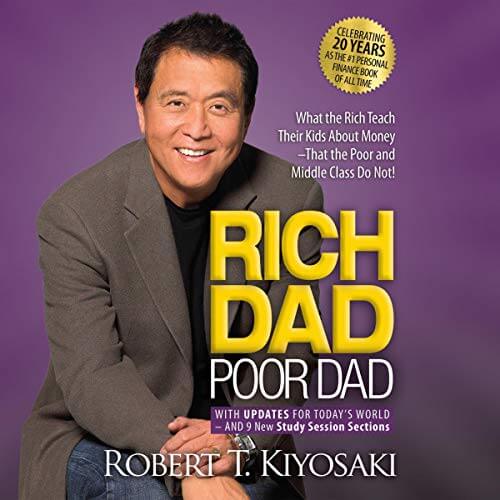
Author: Robert T. Kiyosaki
Category: Finance
Published: 1997
Key Takeaways
- The rich don't work for money - they create or acquire assets that generate money for them
- Know the difference: Assets put money in your pocket, liabilities take money out
- Your house is a liability, not an asset - it takes money out of your pocket monthly
- Mind your own business - use your job income to build your asset column systematically
- Corporations allow the rich to earn, spend, then pay taxes vs. employees who earn, pay taxes, then spend
- Financial IQ consists of accounting, investing, market understanding, and legal knowledge
- The rich invent money through financial intelligence and seeing opportunities others miss
- Work to learn valuable skills (sales, communication, leadership) not just for money
- Pay yourself first - invest in assets before paying bills to build wealth habits
- Overcome the five obstacles: fear, cynicism, laziness, bad habits, and arrogance
About This Summary
Rich Dad Poor Dad: A Transformative Guide to Financial Freedom
Robert Kiyosaki's "Rich Dad Poor Dad" has become a cornerstone of personal finance literature by fundamentally reframing the way millions approach money, work, and wealth. Through a compelling autobiographical narrative, Kiyosaki contrasts the financial philosophies of two father figures from his youth in Hawaii: his highly educated but financially struggling biological father ("Poor Dad") and his best friend's entrepreneurial and wealthy father ("Rich Dad"). This tale of two dads serves as the foundation for a revolutionary financial education framework that challenges conventional wisdom and provides a roadmap to financial independence.
The Core Narrative: A Tale of Two Dads
At the heart of the book is Kiyosaki's unique upbringing, shaped by two starkly different perspectives on money.[1] His "Poor Dad," a man with a Ph.D. who held a high position in the education system, believed in the traditional path to success: excel in school, secure a good job, and climb the corporate ladder.[1] He valued job security and a steady paycheck above all else. In contrast, his "Rich Dad," a high school dropout who became one of Hawaii's wealthiest men, championed entrepreneurship, savvy investing, and financial literacy.[2] This stark contrast in ideologies sets the stage for the book's central themes.
A pivotal moment in Kiyosaki's financial education came in his childhood when Rich Dad, after hiring a young Kiyosaki and his friend for a mere 10 cents an hour, abruptly cut their pay to zero. This wasn't an act of cruelty but a foundational lesson. Rich Dad wanted to break them out of the mindset of "working for money" and instead force them to think creatively about how to "make money work for them."[3] This experience ignited the entrepreneurial spark that would define Kiyosaki's future and serves as the book's most powerful parable.[3]
The Essential Financial Philosophy: A Paradigm Shift
The cornerstone of "Rich Dad Poor Dad" is a fundamental paradigm shift: the poor and middle class work for money, while the rich have money work for them.[4] This isn't just about income levels; it's a profound difference in financial strategy and mindset. Kiyosaki argues that traditional education prepares individuals to be good employees but fails to provide the financial literacy needed to achieve true wealth.[2]
The Asset vs. Liability Revolution
Kiyosaki's most revolutionary and widely quoted concept is his redefinition of assets and liabilities. In his simple yet profound framework:
- An asset is something that puts money in your pocket.[5][6]
- A liability is something that takes money out of your pocket.[5][6]
This seemingly simple distinction challenges the conventional financial wisdom that often classifies a primary residence or a car as an asset.[7] Kiyosaki argues that because these items typically incur ongoing expenses like mortgages, taxes, and maintenance, they are, in fact, liabilities that drain wealth.[7] True financial freedom, he contends, comes from relentlessly acquiring income-generating assets such as rental properties, dividend-paying stocks, and businesses that generate passive income.[6]
A Chapter-by-Chapter Journey to Financial Literacy
Chapter 1: Rich Dad, Poor Dad
This chapter introduces the two father figures and their opposing financial viewpoints, setting the stage for Kiyosaki's journey of financial discovery.[8]
Chapter 2: The Rich Don't Work for Money
Kiyosaki recounts the formative lesson from his youth where he and his friend worked for Rich Dad.[9] This chapter emphasizes the importance of moving beyond the employee mindset, which is often driven by fear and the desire for security, and instead focusing on creating opportunities for money to work for you.[10]
Chapter 3: Why Teach Financial Literacy?
Here, Kiyosaki highlights the critical gap in the education system regarding financial knowledge.[8] He explains the importance of understanding financial statements, even in a simplified form, to grasp the flow of money and the difference between assets that generate income and liabilities that create expenses.
Chapter 4: Mind Your Own Business
This chapter encourages readers to start building their own asset column, even while working a traditional job.[8] "Minding your own business" means focusing on acquiring assets that you are passionate about, whether it's real estate, stocks, or a side business, rather than spending your life making someone else rich.[11]
Chapter 5: The History of Taxes and the Power of Corporations
Kiyosaki delves into how the wealthy use corporate structures to their advantage, particularly in minimizing their tax burden.[8] This chapter underscores the importance of financial intelligence in understanding the legal and tax systems to protect and grow wealth.
Chapter 6: The Rich Invent Money
True wealth, according to this chapter, comes from the ability to recognize and create opportunities that others miss.[8] This requires financial creativity and the courage to take calculated risks. Kiyosaki explains that money is not a finite resource but can be "invented" through financial intelligence and problem-solving.[12]
Chapter 7: Work to Learn—Don't Work for Money
This lesson advises individuals to seek jobs for the skills they can acquire rather than just for the paycheck.[8] Kiyosaki advocates for gaining knowledge in areas like sales, marketing, and communication, as these skills are invaluable for entrepreneurship and investing.[1]
Chapter 8: Overcoming Obstacles
Kiyosaki addresses the common emotional and mental hurdles that prevent people from achieving financial success, such as fear, cynicism, laziness, and arrogance.[8][12]
Chapter 9 & 10: Getting Started and Still Want More?
These concluding chapters provide practical steps and encouragement for readers to begin their journey toward financial literacy and independence.[8] Kiyosaki emphasizes continuous learning, seeking mentorship, and taking action.[8]
Escaping the "Rat Race"
Woven throughout the book is the powerful metaphor of the "rat race"—the endless cycle of working harder to earn more, only to see that increased income consumed by higher taxes and expenses.[1][13] This leaves even high-earning professionals feeling financially insecure and trapped.
Kiyosaki's proposed escape route is the Cashflow Quadrant, a framework that categorizes how people earn income:
- E (Employee): You have a job.
- S (Self-Employed): You own a job.
- B (Business Owner): You own a system, and people work for you.
- I (Investor): Your money works for you.
The path to financial freedom lies in transitioning from the left side of the quadrant (E and S), where you trade your time for money, to the right side (B and I), where you generate passive income from your assets and systems.[14] This concept is so central to his philosophy that it inspired the "CASHFLOW" board game, designed to teach players how to get out of the rat race.[15][16]
Enduring Legacy and Impact
"Rich Dad Poor Dad" is more than just a personal finance book; it's a fundamental shift in mindset. It challenges readers to question the traditional narratives about work, money, and wealth. The book's enduring relevance lies in its practical principles of building assets, generating passive income, and prioritizing financial education, which are more critical than ever in an economy marked by job insecurity and inflation.
Kiyosaki's work demonstrates that financial success is not determined by how much you earn, but by how much you keep, how effectively that money works for you, and for how many generations that wealth can be sustained. It has sparked a global movement toward financial literacy and empowered millions to take control of their financial destinies.