Trading summary
The Daily Trading Coach Summary: Key Ideas and Takeaways
Read a practical summary of The Daily Trading Coach by Brett Steenbarger, including key takeaways, lessons, and useful ideas.
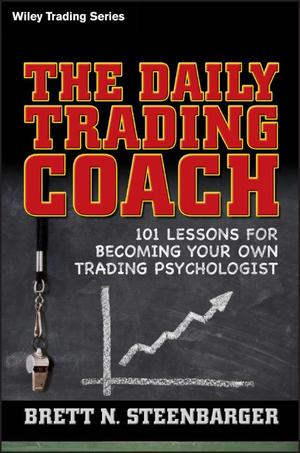
Author: Brett Steenbarger
Category: Trading
Published: 2009
Pages: 368
Key Takeaways
- **Become your own coach:** Observe decisions, identify patterns, practice an intervention, and evaluate the change.
- **Separate skill from psychology:** Emotional control supports a tested trading edge; it cannot rescue a method with no edge.
- **Design concrete behavioral goals:** Replace vague demands for discipline with observable actions.
- **Build an internal observer:** Use timely notes and planned pauses to monitor yourself while participating in markets.
- **Record context and process:** Capture the setup, reasoning, execution, risk, and emotional state before outcomes reshape memory.
- **Address the cause of distress:** Examine position size, expectations, business constraints, and interpretations.
- **Focus on controllable execution:** Judge adherence to valid plans alongside financial results.
- **Protect well-being:** Sleep, energy, relationships, and interests outside trading support sustained performance.
- **Build on effective behavior:** Study successful sessions and expand the routines that already work.
- **Test automatic thoughts:** Separate market events from unsupported conclusions about personal worth or future outcomes.
- **Interrupt reinforced habits:** Change triggers and consequences that reward impulsive actions with immediate relief.
- **Practice under manageable conditions:** Rehearsal and small exposure make alternative responses easier to repeat.
- **Measure the trading business:** Track costs, drawdowns, strategy results, and correlated exposure.
- **Research with skepticism:** Examine context, sample size, and out-of-sample performance before trusting historical patterns.
About This Summary
The Daily Trading Coach: Building a Repeatable Process for Improvement
Introduction: Become Both the Trader and the Coach
Brett Steenbarger's The Daily Trading Coach approaches trading as a demanding performance activity. Knowledge of markets matters, but knowing what to do and reliably doing it are different achievements. A trader can recognize a sound opportunity and still hesitate, enter too late, take excessive risk, or abandon a sensible exit plan. Improvement requires a process for studying these breakdowns and practicing alternatives.
The book organizes that process into 101 lessons. Each lesson addresses a problem or development opportunity and encourages action outside the act of placing trades. Its central invitation is to become your own trading psychologist: observe your decisions, identify patterns, select an intervention, and evaluate whether your behavior changes. Reading without practice leaves the essential work unfinished.
Steenbarger brings clinical psychology into contact with trading experience. Cognitive methods examine interpretations, behavioral methods change habits and their consequences, and psychodynamic methods explore recurring emotional relationships. These approaches offer different explanations for the same visible mistake. A trader who repeatedly moves a stop might be avoiding discomfort, protecting self-esteem, reacting to a learned relationship with authority, or following a strategy that never had clear invalidation criteria.
The book therefore resists a single explanation for poor performance. Psychology supports a trading edge; it cannot manufacture one from an unprofitable method. Self-coaching includes studying markets, business conditions, execution, and risk alongside emotions. The objective is a repeatable learning process rather than permanent confidence or a promise of profitable results.
Change Requires More Than Understanding
People often recognize a bad habit long before they stop repeating it. Awareness is necessary, but familiar responses remain easy, especially under pressure. Steenbarger treats change as an activity that must be practiced and reinforced.
Emotional motivation can start the process. Frustration with a repeated error may make a trader willing to do difficult work. Yet self-criticism alone is unstable fuel. When discomfort subsides, the old behavior returns unless the trader has built different routines.
A useful change target is concrete. “Become disciplined” is too broad to practice. “After two unplanned entries, stop trading and review the triggers before returning” defines an observable response. A small behavioral commitment can be tracked, rehearsed, and adjusted.
Environment also influences habits. Constant alerts, distracting conversations, oversized positions, and immediate access to additional leverage can make impulsive decisions easier. Removing a trigger or adding a pause may accomplish more than another promise to exercise willpower.
This suggests a practical distinction between intention and design. Intention describes the behavior you want. Design makes that behavior easier to repeat. Self-coaching combines both, using small changes that can survive the emotional conditions of a real session.
Build an Internal Observer
A trader needs enough immersion to read the market and enough distance to notice their own state. Steenbarger describes this capacity as self-observation. Without it, traders can spend hours analyzing price while overlooking the mental processes shaping their orders.
The observer does not constantly criticize. It asks what is happening: What am I feeling? What am I assuming? Does this trade match the plan? Has my attention narrowed after a loss? Am I acting on information or trying to change my mood?
Journaling gives this observer structure. Recording a trade should include more than its outcome. Note the intended setup, market context, planned risk, reasoning, execution, emotional state, and any departure from the plan. These details reveal relationships that an account balance cannot explain.
Contemporaneous notes are especially valuable because memory reconstructs events. After a loss, the trader may believe the warning signs were obvious. After a win, an impulsive decision may seem more intentional than it was. Notes written before the outcome preserve what was actually known.
Observation must occasionally interrupt participation. A brief scheduled pause can reveal fatigue or agitation before it becomes another order. Time away from the screen is part of the performance process, even when an opportunity is missed during that interval.
Understand Stress Before Trying to Eliminate It
Trading involves uncertainty, financial exposure, and continuous feedback. Some stress is unavoidable and can sharpen attention. Distress occurs when demands feel beyond the trader's resources or threaten something larger than the immediate decision.
Interpretation plays an important role. Losing on a planned trade is one event. Believing that the loss proves incompetence, destroys a future, or must be recovered immediately adds psychological weight. The market event and the story about it become entangled.
Steenbarger encourages traders to identify the assumptions generating distress. “I must make money every day” creates pressure to trade when no suitable opportunity exists. “A good trader should never miss a move” makes waiting feel like failure. These beliefs often conflict with the probabilistic nature of markets.
Risk size is another source of stress. If ordinary fluctuations create overwhelming fear, the issue may be excessive exposure rather than deficient courage. Reducing size can restore the capacity to evaluate information and follow a plan.
Coping should address the cause. Breathing exercises may reduce arousal, but they do not repair insufficient capital, an unclear strategy, or unrealistic income expectations. Effective self-coaching distinguishes a manageable emotional reaction from a structural problem in the trading business.
Performance Anxiety and the Pressure to Earn
Performance anxiety appears when attention shifts from the task to the implications of success or failure. The trader becomes preoccupied with the account, the need to recover a loss, or the judgment of other people. Execution becomes a test of personal worth.
Trying harder can then make performance worse. Monitoring every tick of unrealized profit may lead to premature exits. Urgently seeking a winning trade may produce entries outside the strategy. The effort to force an outcome disrupts the process intended to produce it.
The remedy is to redirect attention toward controllable actions. Define the conditions for a valid trade, execute the risk plan, and evaluate the quality of that execution. A session without trades can be successful if the market did not provide the required conditions.
Rehearsal and smaller exposure help separate practice from financial urgency. A trader can train one skill under manageable conditions before expecting it to hold during more demanding sessions. This is similar to other performance fields, where competitors practice components before testing them under full pressure.
Income expectations deserve particular scrutiny. Needing a specific dollar amount by a deadline can create incentives incompatible with available opportunities. The book's business perspective makes this a planning issue as well as a psychological one.
Well-Being Is a Performance Resource
The absence of distress is not the same as a strong psychological condition. Steenbarger emphasizes positive well-being: energy, engagement, confidence, purpose, and satisfying relationships. These resources help people recover and maintain effort.
Sleep, physical activity, and breaks affect attention and emotional tolerance. A trading journal that ignores fatigue may misclassify a predictable decline in functioning as a mysterious lack of discipline. Patterns should be examined across both market conditions and life conditions.
A life organized entirely around trading can also magnify every result. When markets provide the only source of achievement, community, or excitement, a losing session threatens several needs at once. Interests and relationships outside trading create a broader base of identity.
Confidence should come from evidence of preparation and skill. It is different from certainty that the next trade will win. A trader can be confident in executing a method while remaining uncertain about an individual outcome.
Flow, or absorbed engagement, becomes more likely when challenge and skill are reasonably matched. Too little challenge creates boredom and unnecessary trades; too much creates overwhelm. The coaching task includes choosing a trading style, pace, and level of exposure appropriate to present competence.
Create a Coaching Journal That Produces Action
A journal becomes useful when it changes tomorrow's behavior. Long descriptions of feelings may provide relief but fail to generate a testable intervention. The coaching cycle moves from observation to hypothesis to action to review.
Begin with a specific pattern. For example, a trader repeatedly exits winners during normal pullbacks. Examine when this occurs, what is feared, how the exit compares with the original plan, and whether the plan itself is reasonable.
Then select one experiment. The trader might rehearse the expected pullback before entry, reduce size, or use an alert rather than watching every tick. The appropriate action depends on the evidence rather than a universal instruction to hold longer.
Define a process measure. Did the trader follow the planned exit criteria? Did the intervention reduce impulsive decisions? Profit remains relevant, but a few profitable trades cannot establish that a psychological change worked.
Review both failures and successes. Successful sessions show the conditions under which existing strengths emerge. Studying these exceptions prevents the journal from becoming a catalog of defects and supplies behaviors worth repeating.
Goals, Strengths, and Relapse
Good goals focus attention and make progress visible. They should be challenging enough to require effort but narrow enough to evaluate. A trader attempting to repair ten behaviors at once may change none consistently.
Steenbarger's solution-focused approach asks when the problem is absent. What happens on days when the trader waits patiently? Which preparation produces clear decisions? What kinds of setups are executed most comfortably? Improvement can begin by expanding effective behavior rather than only suppressing ineffective behavior.
Strengths must still be tested against results. Enjoying a particular trading style does not prove that it has an edge. The objective is to combine personal fit with evidence of market effectiveness.
Relapse is part of habit change. A return to an old behavior signals a need to inspect triggers and practice, not necessarily a collapse of commitment. The trader should reconstruct the sequence and identify the point where a different response could have occurred.
Repeated rehearsal makes the desired response more accessible. Visualizing a losing trade, accepting the loss, and performing the next planned action can prepare the trader for a situation that otherwise arrives with surprise and emotional force.
Psychodynamic Coaching: Recognize Repeated Emotional Roles
Psychodynamic methods look for patterns that recur across relationships and settings. A trader may respond to the market as if it were an adversary to defeat, an authority to rebel against, or a source of approval.
These patterns are useful hypotheses, not automatic diagnoses. Their value lies in explaining why a particular situation evokes an unusually strong response. A minor loss may trigger feelings connected with failure or humiliation that extend beyond the actual financial amount.
Defenses can conceal the pattern. Blaming manipulation, changing methods after every setback, or intellectualizing an error may protect self-esteem while preventing learning. The goal is to tolerate the discomfort of looking directly at one's contribution.
A practical starting point is to compare trading reactions with reactions elsewhere. Does the same impatience appear in relationships? Does criticism produce similar defensiveness at work? A recurring pattern may require broader change than a revised entry rule.
Trusted coaching relationships can provide perspective. Self-observation has blind spots, and an outside person may notice the emotional role being repeated. Serious or persistent mental health difficulties fall beyond what a trading journal can resolve.
Cognitive Coaching: Test the Meaning You Assign
Cognitive approaches examine how thoughts shape emotions and actions. Traders often react to their interpretation of an event as much as to the event itself.
Common distortions include treating one loss as proof of permanent failure, assuming everyone else is succeeding, or interpreting a missed move as an opportunity that must be recovered. These thoughts can feel factual when they are really untested conclusions.
A cognitive journal separates the situation, automatic thought, emotion, action, and alternative interpretation. A failed breakout might become “My valid setup did not work this time” rather than “Nothing I do works.” The alternative should fit the evidence, not merely sound reassuring.
Behavioral experiments test revised beliefs. A trader who believes that skipping marginal setups will eliminate all opportunities can record what happens during a week of stricter selection. Evidence may challenge the belief more effectively than argument.
Positive thinking is therefore not pretending markets will cooperate. It means maintaining accurate, constructive interpretations that preserve the ability to act. Sometimes the accurate interpretation is that the method needs revision or that trading should be paused.
Behavioral Coaching: Change the Sequence Around the Trade
Behavioral methods examine triggers, actions, and consequences. A behavior may persist because it produces immediate relief, even if its longer-term result is harmful.
Exiting a trade too soon can reduce anxiety at once. Revenge trading can replace helplessness with a feeling of action. The short-term reward reinforces the pattern despite later losses.
The coaching task is to change that sequence. A pause, a written checklist, an automatic risk limit, or a different screen arrangement can interrupt the habitual response. Reinforcement should reward adherence to the process rather than only profitable outcomes.
Shaping develops a difficult behavior in manageable steps. Someone who cannot tolerate a planned pullback might begin with simulation or very small exposure and gradually practice staying with objective criteria. The point is controlled learning, not forcing larger risk.
Exposure methods require care. Repeatedly experiencing fear while abandoning the plan may strengthen avoidance. Practice should be structured so that the trader experiences the trigger and completes a deliberate alternative response under tolerable conditions.
Treat Trading as a Business
A trading business needs capital, a realistic plan, and methods for measuring performance. These requirements influence psychology directly. An undercapitalized trader may feel compelled to take risks that a sound operation would reject.
Performance records should distinguish strategies, market regimes, holding periods, and execution quality. An overall profit figure can hide a strong setup subsidizing several weak ones. It can also hide a favorable market that temporarily rewards poor decisions.
Useful measures include average gain, average loss, win rate, drawdown, transaction costs, and adherence to the plan. Their interpretation requires adequate samples and awareness of changing conditions.
Risk should reflect actual performance and uncertainty. Several positions that depend on the same market theme may provide much less diversification than their different ticker symbols suggest. Correlated exposures should be evaluated together.
Execution also matters. Entry timing, spread, slippage, and liquidity can change a theoretical edge into an unprofitable result. Psychological work should include the practical mechanics of turning an idea into a trade.
Research an Edge and Examine Context
The book closes much of the gap between psychology and market research by encouraging traders to investigate historical patterns. Confidence is stronger when it rests on tested observations rather than repeated affirmations.
Start with a clear hypothesis. Specify what conditions might predict a particular outcome, what data would test that relationship, and how results would be measured. Vague impressions are difficult to confirm or reject.
Context is essential. A pattern may behave differently in trending and range-bound markets, during high and low volatility, or across instruments. Aggregating unlike conditions can obscure the circumstances in which a method works.
Historical testing also creates risks. Trying many variations and retaining only the best can produce a pattern that fits noise. Small samples, survivorship bias, future information, and unrealistic execution assumptions distort conclusions.
The practical extension is to separate development from validation and monitor results after implementation. A historical finding is a hypothesis about future opportunity, not a guarantee. The trader's research process must be as capable of rejecting an idea as confirming it.
Limits and Critical Perspective
The Daily Trading Coach offers a broad toolkit, but its breadth can overwhelm readers. Choosing a relevant lesson and practicing it consistently may be more useful than moving rapidly through every technique.
Self-coaching also depends on honest observation. Traders may selectively record successes, reinterpret violations, or change measures to protect a preferred story. A structured review with another person can improve accountability.
Not every loss is psychological. A weak strategy, changing market, excessive costs, or unsuitable product can defeat excellent emotional control. Attributing all setbacks to mindset encourages endless self-repair while leaving the actual business problem untouched.
The therapeutic frameworks have different levels of evidence and suitability. They should be treated as tools for inquiry rather than proof that a trader has a particular clinical condition. Persistent distress, compulsive behavior, or serious financial harm calls for support beyond self-directed trading exercises.
The book also reflects the tools and market environment of its publication period. Its coaching principles remain adaptable, while specific research workflows require updating for current data quality, execution technology, and the markets being traded.
A Practical Daily Coaching Routine
Before the session, review market conditions, the permitted setups, risk limits, and one behavioral goal. Briefly rehearse the situation most likely to trigger a known mistake and the response you intend to practice.
During the session, record significant decisions and notice changes in attention, energy, and urgency. Use planned breaks and risk boundaries to make observation possible. Avoid turning the journal into a distraction that interferes with execution.
After the session, compare actual behavior with the plan. Select one effective action to repeat and one problem to investigate. Write a concrete experiment for the next session rather than a general promise to improve.
At the end of the week, inspect results across enough observations to detect patterns. Decide whether the issue concerns market selection, strategy, execution, risk, or psychological response. Keep the intervention focused on the category the evidence supports.
Conclusion: Improvement Is a Practiced Skill
Steenbarger's central contribution is making development an ongoing part of trading. The trader studies both market behavior and personal behavior, then creates experiments that connect insight with action.
The process combines realistic risk, evidence of an edge, constructive interpretation, repeated practice, and a life that supports sustained performance. It encourages responsibility without requiring self-condemnation and confidence without requiring certainty.
Becoming your own coach means retaining the capacity to learn while money, emotion, and uncertainty are present. No routine removes losses or guarantees success. A sound routine makes decisions more observable, mistakes more understandable, and changes more testable. That is the practical foundation on which professional growth can occur.