Self-Help summary
The Motivation Manifesto: 9 Declarations to Claim Your Personal Power Summary: Key Ideas and Takeaways
Read a practical summary of The Motivation Manifesto: 9 Declarations to Claim Your Personal Power by Brendon Burchard, including key takeaways, lessons, and useful ideas.
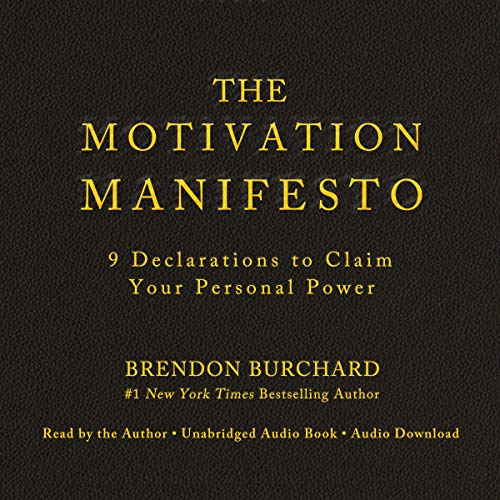
Author: Brendon Burchard
Category: Self-Help
Published: 2014
Pages: 256
Key Takeaways
- **Presence Is the Foundation**: You cannot direct energy toward great aims until you fully possess that energy—and possession requires being fully present in each moment.
- **Reclaim Your Agenda**: Your life is being colonized by others' priorities. Ruthlessly evaluate your commitments and guard time for what genuinely matters to you.
- **Defeat Your Demons Daily**: The war against fear and self-doubt is never finally won; it is a daily choice to act despite their presence, not after their absence.
- **Advance With Abandon**: Full commitment unlocks capacities that partial commitment never reveals. Holding back to protect yourself from failure guarantees mediocrity.
- **Practice Joy and Gratitude**: Emotional sovereignty—the ability to generate positive states from within—is a skill that must be practiced, not a personality trait you either have or don't.
- **Never Break Integrity**: Every compromise with your values creates an internal energy leak. A divided life cannot produce sustained motivation.
- **Honor Your Ambitions**: Suppressing your ambitions out of false modesty deprives the world of what only you can contribute. Your aspirations are a responsibility, not a luxury.
- **Stay Vigilant**: Freedom requires continuous attention and active defense. The greatest threat is often the slow, imperceptible drift into comfortable mediocrity.
- **Motivation Is a Daily Choice**: It cannot be stored, saved, or permanently achieved—it must be re-chosen in each moment, each morning.
- **True Motivation Serves Others**: Goals pursued purely for personal gain eventually lose their pull. Connect your ambitions to contribution and they gain inexhaustible energy.
About This Summary
The Motivation Manifesto: A Comprehensive Summary
Reclaiming Your Personal Power in an Age of Distraction
Opening Hook
There is a moment—perhaps you have felt it—when the weight of an unlived life presses against your chest with unbearable heaviness. You wake in the middle of the night, seized by a quiet terror that your days are slipping past like water through open fingers, that the person you were meant to become is fading further into impossibility with each passing hour. The dreams you once held have grown dusty in the corners of your mind. The fire that once burned in your belly has dimmed to embers. You have become, perhaps without noticing, a stranger to your own ambitions.
This is the crisis Brendon Burchard addresses with the urgency of a revolutionary manifesto and the tenderness of a counselor who has himself emerged from darkness. The Motivation Manifesto is not merely another self-help book to be consumed and forgotten. It is a battle cry—a declaration of independence from the forces, both internal and external, that conspire to keep human beings trapped in lives of quiet desperation.
Author Context
Brendon Burchard writes not from ivory-tower theory but from the trenches of personal transformation. A three-time New York Times bestselling author, his life's work was ignited by a near-fatal car accident at age nineteen. In those suspended moments, he confronted three questions that would become the foundation of everything: Did I live? Did I love? Did I matter?
He wrote this manifesto as a response to a crisis of human motivation in the modern world—a world where unprecedented comfort has paradoxically bred unprecedented apathy, and where the average person has surrendered their autonomy to fear, social expectation, and the numbing influence of constant distraction.
Central Thesis
At its core, The Motivation Manifesto advances a radical yet ancient claim: human beings are meant to be free, and the primary purpose of life is to reclaim, protect, and express that freedom through motivated action toward a meaningful existence. The problem is not a lack of information about how to live well. The problem is a deficit of will—a collective forgetting of what it means to be fully alive.
The solution Burchard proposes is not a technique but a transformation in self-understanding. Through nine declarations, he calls readers to wake from their slumber, recognize the forces that have caged them, and begin the daily practice of motivated living.
Chapter-by-Chapter Breakdown
The First Declaration: We Shall Meet Life with Full Presence and Power
Burchard establishes the foundational commitment: the decision to be fully present and engaged with life as it unfolds. Attention is the currency of life—where we place it is where we place our life energy. When attention is fractured and scattered, so too is our experience of being alive.
The practical takeaway is a daily commitment to catching oneself in moments of drift and deliberately returning to full engagement. Motivation begins with awareness. Before we can direct our energy toward great aims, we must first possess that energy fully—and possession requires presence.
The Second Declaration: We Shall Reclaim Our Agenda
Burchard uses the metaphor of colonization to describe how individual lives are claimed by outside interests—employers, advertisers, algorithms, family expectations. The reclamation of one's agenda is presented as an act of liberation.
The framework is the distinction between "social duty" (obligations others place upon us) and "personal truth" (the inner knowing of what our life is actually for). A motivated life requires aligning these two—and where alignment is impossible, having the courage to choose personal truth.
The Third Declaration: We Shall Defeat Our Demons
The greatest obstacles to a motivated life are not external but internal. "Demons" include fear, self-doubt, shame, and the gravitational pull of past failures. Burchard rejects superficial positivity, engaging seriously with psychological resistance.
The concept he develops is "the internal war"—the daily battle between the self that seeks growth and the self that seeks safety. There is no permanent victory over fear and doubt; there is only the daily choice to engage them courageously. Motivation is not a feeling to be waited for but a choice to be made, often in the face of profound internal resistance.
The Fourth Declaration: We Shall Advance with Abandon
Perhaps the most energizing chapter. Burchard argues against the timidity that characterizes most approaches to goal-pursuit—the hedged bets, the backup plans, the one-foot-in-one-foot-out approach that seems prudent but actually guarantees mediocrity.
"Abandon" means the full commitment of oneself to one's chosen path—the refusal to hold something back in case of failure. Full commitment unlocks capacities that partial commitment never reveals. We literally become more capable when we decide fully, because decision focuses energy in ways that ambivalence cannot.
The Fifth Declaration: We Shall Practice Joy and Gratitude
Burchard introduces the commitment to joy and gratitude as daily practices, arguing that motivation cannot be sustained on willpower and grit alone. He develops the concept of "emotional sovereignty"—the capacity to generate positive emotional states from within rather than depending on external conditions.
Joy and gratitude are not merely responses to favorable circumstances but choices available in nearly any situation. Sustainable motivation requires sustainable positive emotion.
The Sixth Declaration: We Shall Not Break Integrity
Nothing destroys motivation faster than the internal fracturing that occurs when we act against our own values. Each compromise with integrity creates a leak through which vital energy escapes. Integrity here extends beyond honesty to encompass wholeness—the alignment of values, words, and actions.
Integrity failures are accumulated debts that must eventually be paid. We cannot hack our way to a meaningful life while cutting corners on character.
The Seventh Declaration: We Shall Honor Our Ambitions
Burchard reclaims ambition as sacred. Our deepest desires for achievement and impact are not embarrassments to be hidden but gifts to be honored. "Ambition as responsibility" is the central concept: the unique gifts and visions we carry are not merely personal preferences but obligations to the world.
He introduces "magnitude"—the size of the impact we are willing to attempt. Most people dramatically under-aim, not from lack of ability but from lack of self-permission. Honoring one's ambitions is not selfish but generous—a form of serving the world by becoming all one is capable of becoming.
The Eighth Declaration: We Shall Be Vigilant
Motivation is not achieved once but must be maintained indefinitely. Vigilance is the ongoing, active monitoring of one's internal state and external environment for threats to one's freedom and vitality.
The threats include both obvious forces (unhealthy habits, negative relationships) and subtle ones: the gradual accumulation of small compromises, the slow drift into comfort zones. Freedom makes non-negotiable demands—it requires continuous attention, active defense, and periodic renewal.
The Ninth Declaration: We Shall Inspire Greatness
The final declaration expands focus from self to others. Fully motivated individuals have a responsibility not merely to achieve for themselves but to kindle motivation in others. Inspiration is not a special gift possessed by charismatic leaders but a basic human capacity that can be developed.
"Contribution" is the highest expression of motivation. The goals we pursue for ourselves alone eventually lose their power. It is only when our ambitions connect to the welfare of others that they gain the inexhaustible energy of meaning.
Major Themes
The Battle Between Fear and Freedom
Fear is cast as the primary enemy of the motivated life—not because it is bad in itself, but because it has grown beyond its proper role. Burchard's treatment is neither dismissive nor indulgent. Fear is an unruly servant that has become an illegitimate master. The work of motivation is, in large part, the work of putting fear back in its proper place.
The Reclamation of Sovereignty
Just as nations have fought for self-determination, individuals must fight for the right to determine their own values, goals, and modes of living. This political framing gives the manifesto its particular urgency and dignity.
Presence as the Foundation of Power
No external achievement can compensate for absence from one's own experience. A person might accumulate wealth, status, and accomplishment while remaining essentially absent—lost in rumination, regret, or future-focused anxiety. Before doing, there must be being.
The Moral Dimension of Self-Development
Unlike many personal development authors who treat self-improvement as morally neutral, Burchard insists on its ethical character. The failure to develop one's capacities is not merely unfortunate but wrong—a betrayal of the gift of life, a withholding of potential contribution to others.
Notable Insights
- "We are not victims of our circumstances but architects of them." However justified our grievances, they cannot be allowed to become our primary self-understanding.
- "Ambition is sacred, not selfish." The desire to achieve, impact, and excel is not something to be apologized for but celebrated.
- "Fear is the thief of full experience." Fear steals not only our achievements but our moments—causing us to withdraw from full presence.
- "Motivation is a daily choice, not a permanent achievement." It must be chosen again each morning and cannot be stored or saved.
- "We are not waiting for permission that is never coming." This permission has already been granted by virtue of being alive. The waiting must end.
- "Integrity is not a constraint on freedom but its foundation." Without the alignment of values and actions, we become divided against ourselves.
- "The highest motivation connects self to service." Goals pursued purely for personal gain eventually lose their power to compel.
Closing Reflection
The Motivation Manifesto is not a book to be read once and shelved. It is a declaration—something to be returned to in moments of weakness, read aloud in moments of determination, and ultimately embodied in a way of living.
The fundamental reframing Burchard offers is this: we are not seeking motivation as if it were something outside ourselves to be found. We are reclaiming what has always been ours—the birthright of agency, the gift of directed energy, the power to shape our own experience and contribute something of genuine value to the world.
The question the manifesto leaves us with is not "did you understand?" but "will you act?"