Business summary
The Science of Scaling Summary: Key Ideas and Takeaways
Read a practical summary of The Science of Scaling by Dr. Benjamin Hardy and Blake Erickson, including key takeaways, lessons, and useful ideas.
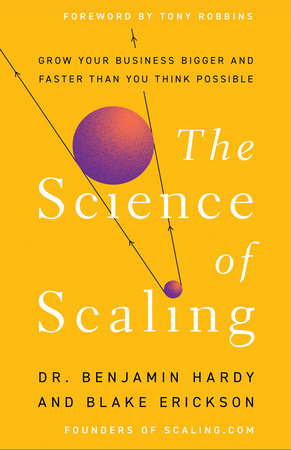
Author: Dr. Benjamin Hardy and Blake Erickson
Category: Business
Published: 2025
Pages: 256
Key Takeaways
- Scaling changes the system that produces results; it is not simply asking the existing system to work harder.
- Frame means choosing a future goal that changes how today's opportunities and constraints are evaluated.
- Use an ambitious goal to challenge assumptions, while keeping budgets and operating forecasts grounded in evidence.
- A shorter strategic horizon can reveal which pathways are too slow or too limited for the intended outcome.
- Floor means establishing clear minimum standards for the work, customers, and commitments the business accepts.
- Remove low-contribution complexity before adding more offers, tools, or projects.
- Focus resources on a coherent pathway rather than keeping every growth option open.
- Simplification should improve customer value as well as internal efficiency.
- Repeatable delivery processes make training, quality, and capacity easier to manage.
- Reduce founder dependency through clear outcomes, decision rights, and accountable ownership.
- Culture is shaped by the standards leaders enforce and the exceptions they tolerate.
- Measure margins, retention, capacity, and cash alongside revenue growth.
- Test major business-model assumptions and protect cash flow during the transition.
- Treat the framework as a strategic lens, not a guarantee of exponential growth in every industry.
About This Summary
Overview: Growth Requires a Different Business
The Science of Scaling argues that a much larger business needs a different operating model, not just more effort. Dr. Benjamin Hardy and Blake Erickson challenge the assumption that a substantially larger business is simply a busier version of the current one. A founder who wants a dramatically different outcome must reconsider what the company sells, whom it serves, how work gets delivered, and which responsibilities remain tied to the founder personally.
The book organizes this challenge around Frame, Floor, and Focus. Frame concerns the goal that shapes perception. Floor concerns what the business refuses to tolerate or pursue. Focus concerns the pathways and people capable of producing the intended outcome. This thematic summary explains that framework and adds original practical analysis. The examples below are illustrative, not stories attributed to the authors. The book's forceful growth claims should be understood as an entrepreneurial methodology, not a guarantee that every business can multiply revenue on schedule.
1. Distinguish Growth from Scaling
A company can grow while becoming less sustainable. Revenue may rise because employees work longer, the founder approves every decision, and delivery becomes increasingly customized. The larger numbers conceal a system that needs proportionately more attention for each additional customer. More demand then creates more emergencies rather than more freedom.
Scaling asks a different question: can the company increase valuable output without allowing complexity and resource requirements to expand at the same rate? This does not mean eliminating all costs or operating without people. It means improving the relationship between effort and results through a stronger business model.
For example, a consultancy might add clients by creating a unique service for every buyer. An alternative is to specialize in a repeatable problem, develop a consistent delivery process, and train a team to own that process. The second approach may initially turn away revenue, but it can create a clearer route to serving more customers. The important distinction is structural. Growth describes a larger result; scaling asks whether the mechanism producing that result is becoming more capable.
2. Frame: Let the Future Change the Present
A frame is the perspective through which choices become meaningful. A modest improvement target tends to make familiar activities look appropriate: sell a little harder, increase utilization, and adjust a few processes. A much larger target can reveal that those same activities cannot plausibly deliver the desired result.
The useful part of this idea is not positive thinking. It is the pressure a different destination places on current assumptions. If a founder wants a business that operates without constant personal intervention, the founder must examine today's decisions through that future requirement. Accepting another project that only the founder can deliver may be profitable now while moving the company away from its intended design.
An effective frame includes an outcome, a timeframe, and a reason that matters. It should describe more than prestige or a headline revenue figure. Customer benefit, profitability, founder independence, and organizational resilience can all clarify what successful expansion actually means. Without those distinctions, an ambitious goal can become permission to pursue size at the expense of the business itself.
3. The Role of an Apparently Impossible Goal
Hardy and Erickson use unusually ambitious goals to challenge incremental reasoning. The underlying insight is that a goal far beyond the current operating model can act as a filter. If an activity can produce only a small improvement, it cannot be the main pathway to an outcome that requires a structural leap.
Readers should separate this strategic exercise from literal forecasting. An impossible goal is useful when it encourages new questions, exposes constraints, and removes low-impact options. It is less useful when people treat its numerical size as evidence that success will occur. Confidence cannot replace customer demand, financing, competent execution, or legal obligations.
A practical way to work with the idea is to hold two documents: an ambitious destination and a realistic operating plan. The destination stretches the search for alternatives. The operating plan states current evidence, cash requirements, experiments, and decision points. This prevents aspiration from being mistaken for a budget. The goal should make the organization more discerning, not less accountable to the conditions under which it must operate.
4. Time Is a Strategic Constraint
A long deadline allows a business to preserve many options. When there seems to be enough time, almost any activity can be defended as something that might eventually help. A shorter horizon creates a stronger test: can this path produce the intended result within the period that actually matters?
This is different from declaring every task urgent. Constant urgency narrows attention and encourages reactive work. Strategic time pressure should instead improve selection. It asks which mechanisms can create substantial progress and which merely absorb calendar space.
Consider a founder choosing between years of individually selling small projects and building a partnership that provides access to a concentrated customer base. A shorter horizon may make the partnership worth investigating sooner. But investigation still requires diligence: distribution promises, economics, dependencies, and delivery capacity must be checked.
Readers can apply this principle by reviewing projects against their expected time to meaningful results. Something can be worthwhile in general while being unsuitable for the present goal. The ability to distinguish those two judgments is a major advantage over maintaining an indefinitely expanding list of opportunities.
5. Floor: Define What No Longer Belongs
A floor is the minimum standard beneath which the business will not operate. It can concern customer fit, margins, service quality, team performance, or how the founder's attention is used. Its practical value comes from turning vague preferences into enforceable choices.
Many companies say they want high-quality clients but accept almost anyone who can pay. They say ownership matters but allow essential decisions to remain unclear. They say focus matters but continue launching projects that compete for the same scarce resources. The actual standard is demonstrated by behavior, not by a statement on a wall.
Raising the floor requires identifying activities that cannot support the chosen future. Some work may be stopped; some may be redesigned, delegated, or priced differently. The responsible approach is to understand the consequences of each change before implementing it.
A higher standard should not mean contempt for existing customers or employees. Contracts, communication, transition support, and fair treatment still matter. Strategic selectivity is strongest when the company can explain what it does well, what it no longer does, and how it will honor commitments already made.
6. Why Subtraction Can Create Capacity
Businesses often respond to difficulty by adding things: another service, another meeting, another software tool, another customer segment. Each addition can appear reasonable in isolation. Together they produce an organization whose attention is divided among too many competing demands.
Subtraction creates room for the few activities that deserve exceptional execution. Removing an unprofitable offer can free delivery capacity. Eliminating redundant reporting can free managerial attention. Reducing customer variety can simplify onboarding and make service quality more consistent. These gains are not always visible in the revenue number immediately.
A useful analysis separates apparent productivity from contribution. An activity may keep people occupied without improving the economics or quality of the business. Conversely, a difficult decision to remove work may initially reduce visible activity while strengthening the system.
Before stopping an offer, examine its full contribution: direct margin, support burden, referrals, strategic learning, and contractual commitments. Some low-revenue activities have important supporting roles. The objective is not to remove everything small. It is to remove what consumes disproportionate resources without a persuasive relationship to the future the business is trying to build.
7. Focus: Choose the Pathway, Not Just the Goal
Ambition becomes operational only when the business chooses a pathway. Focus means concentrating attention and resources on a credible mechanism for reaching the goal, rather than keeping every possible route open. A destination can be inspirational while still leaving a company confused about what to do next.
A pathway might involve a more valuable customer problem, a repeatable offer, a distribution partnership, a stronger delivery system, or a different team structure. These possibilities should not be combined indiscriminately. Each has assumptions that require testing, and some are incompatible with one another.
The practical challenge is to connect choices. The target customer should fit the offer. The offer should fit the delivery model. The economics should support the team. Distribution should bring the customers the business can serve successfully. Focus emerges from this alignment.
A company with one coherent growth mechanism can learn more quickly because feedback has a clear meaning. A company pursuing six unrelated mechanisms may confuse activity with progress. Commitment does not forbid revision. It creates a sufficiently stable direction for the organization to discover whether its assumptions are actually working.
8. Simplification Must Preserve Customer Value
A simpler business is not automatically a better business. Removing features, reducing services, or narrowing the market helps only if the remaining offer solves a problem customers care enough about to pay for. Internal convenience cannot substitute for external value.
This distinction is essential when applying the scaling framework. A company should simplify around its strongest contribution, not merely around what is easiest to produce. Customer interviews, repeat purchasing, retention, complaints, and willingness to pay help determine where that contribution lies.
For example, a software company might remove a rarely used feature that creates frequent support issues. That could improve reliability and accelerate development. But removing a feature essential to its best customers would undermine the offer, even if the product became easier to maintain.
A strong simplification decision therefore answers two questions together: what becomes easier for the organization, and what becomes better for the customer? When both improve, simplification can increase capacity and differentiation simultaneously. When only internal convenience improves, the company may simply be transferring difficulty to the people it serves.
9. Build a Repeatable Delivery Model
Repeatability matters because inconsistent delivery creates hidden limits. If every customer engagement requires a fresh interpretation, senior people become permanent problem solvers. The business cannot predict capacity, train effectively, or maintain consistent quality as demand increases.
A repeatable model clarifies inputs, responsibilities, decision rights, quality standards, and exceptions. It does not require treating every customer as identical. Instead, it identifies which parts of the work can be standardized and which genuinely need judgment.
Imagine a specialist service business that maps its delivery process from qualification through completion. It defines the information required before work starts, the owner of each step, and what constitutes a finished outcome. New employees can then learn a recognizable system rather than rely entirely on informal guidance.
The benefit is not documentation for its own sake. It is reliable execution with less unnecessary coordination. The test is whether the process helps capable people produce results. A folder full of procedures that nobody uses has not created scale. A working system reduces avoidable variation while preserving the expertise that makes the service valuable.
10. The Founder Cannot Remain Every Bottleneck
An owner can become indispensable in ways that prevent the company from improving. If all sales, hiring, product decisions, and customer exceptions require the same person, the business inherits the limits of that person's time and attention.
Reducing this dependency requires more than handing out tasks. Delegation works when people understand outcomes, authority, constraints, and escalation rules. Someone asked to own a result but denied the information or decision rights to achieve it has not received meaningful ownership.
An illustrative transition is moving from founder approval of every proposal to a clearly defined commercial policy. The team can act within agreed boundaries, while unusual situations still receive appropriate review. This preserves judgment without making normal work wait for the owner.
The founder's role may then shift toward choosing direction, developing leaders, and addressing the few constraints that matter most. This is not an argument for disappearing from the business. It is an argument for using leadership where it creates the most leverage. Responsibility remains with the owner even when execution is distributed across a stronger organization.
11. People and Culture Are Part of the Model
A growth strategy is constrained by the people expected to execute it. Skills, incentives, trust, and clarity determine whether the organization can support a more ambitious design. A strategic plan that assumes capabilities the team does not possess is incomplete.
Raising standards should begin with defining the work. What outcomes does each role own? What capabilities are required? What resources and decisions does success depend on? Clear answers make hiring, training, and performance discussions more useful and fair.
Culture also appears in the handling of exceptions. If quality rules are repeatedly waived for short-term sales, employees learn that the real priority is closing business at any cost. If difficult information is punished, leaders receive optimistic reports while problems grow.
A scalable culture encourages honest feedback and reliable commitments. It can demand excellence without confusing intensity with exhaustion. For readers applying the framework, the important question is whether the organizational environment makes good execution repeatable. Talent helps, but an unclear system can waste talented people just as effectively as a weak business model wastes capital.
12. Measure the Mechanism Behind Revenue
Revenue is important, but it is an incomplete measure of progress. A company can increase sales while weakening margins, losing customers, extending collection periods, or depending on unsustainable effort. A larger business is not necessarily a healthier one.
Original practical analysis suggests pairing the headline goal with measures of the mechanism producing it. Relevant indicators might include customer retention, contribution margin, delivery capacity, sales conversion, time to collect payment, and the number of decisions requiring founder intervention. The right selection depends on the business.
The relationship between indicators matters too. Increasing acquisition is not valuable if delivery failure causes customers to leave. Improving margin by cutting essential support may damage retention. Scaling requires the whole model to work together. Measurement should reveal these connections rather than reward isolated departments for improving numbers that make the overall company worse.
13. Treat Major Changes as Testable Assumptions
A strong goal does not remove uncertainty. New offers, customer segments, partnerships, and operating models involve assumptions about demand and execution. Treating these assumptions as facts can turn an ambitious strategy into an expensive mistake.
A disciplined application of the book's ideas uses experiments. Before replacing the entire business model, test whether a narrower offer attracts the intended customers. Before expanding a partnership, verify the quality of the leads it supplies. Before withdrawing an existing service, assess cash flow and customer obligations.
An experiment needs a clear question, a limited investment, a decision date, and evidence that would change the plan. These boundaries distinguish learning from endless tinkering. The purpose is to make a meaningful choice with less avoidable uncertainty.
This approach also reconciles commitment with adaptation. A company can remain committed to its long-term direction while changing the path as evidence arrives. The danger is not changing tactics. It is changing them without understanding why, or continuing a failed approach merely because abandoning it feels inconsistent with the original ambition.
14. Protect the Transition, Not Just the Destination
Changing a business model creates a period in which the old system is being reduced and the new one is not yet fully productive. This transition deserves its own plan. Otherwise, a sound destination can be undermined by an unmanaged gap in cash, capability, or customer service.
Consider a company moving from broad project work to a specialized recurring offer. It may need to invest in product development and training while still fulfilling existing projects. The strategic logic can be attractive, but the sequencing determines whether the company survives long enough to benefit.
Practical questions include how much runway is available, which commitments cannot be interrupted, and what evidence justifies the next investment. Leaders should also identify reversible changes and irreversible ones. Testing new positioning is easier to reverse than entering a long lease or dismissing an essential team.
Ambition is more credible when the transition is protected. Cash discipline and contingency planning do not weaken a bold strategy. They prevent predictable operating risks from consuming the attention that should be devoted to building the new model.
15. A Practical Review for an Existing Business
Readers can begin with an inventory rather than a dramatic announcement. List the company's major offers, customer groups, delivery activities, partnerships, and founder responsibilities. Then examine how each contributes to the future business.
For every item, ask whether it produces attractive economics, meaningful customer value, and repeatable delivery. Ask whether it depends on a scarce individual and whether the dependency can be reduced. Finally, ask whether its upside is large enough to justify the attention it requires.
The result should be a small set of explicit decisions: continue, improve, delegate, test, or stop. Assign ownership and review dates. Without those details, a strategic conversation easily becomes an inspiring meeting that changes nothing afterward.
This review should include the people closest to customers and delivery. They often see constraints that leadership overlooks. A founder may believe an offer is simple because the founder does not experience its support burden. Grounding the review in operational evidence makes the scaling framework more useful than applying it through intuition alone.
16. What the Book Does Well, and Where to Be Careful
The book's strongest contribution is its challenge to indiscriminate effort. It encourages leaders to recognize that many acceptable opportunities are incompatible with a chosen future. Frame, Floor, and Focus offer a memorable vocabulary for examining that problem.
Its limitation is the risk of treating exceptional growth as a universal expectation. Businesses differ in capital needs, regulation, market size, customer behavior, and starting conditions. A model that can expand rapidly in one setting may require careful, slower development in another. Promotional success stories cannot establish that the framework alone caused the outcome.
The word science should therefore not discourage scrutiny. Readers should ask which claims are supported by research, which are entrepreneurial interpretation, and which depend on selected examples. The book is best used as a strategic lens rather than a substitute for industry knowledge.
The enduring lesson is demanding but practical: choose a future worth building, remove what prevents it, and concentrate on a coherent way to deliver value. Sustainable scale is not simply wanting more. It is constructing a business capable of producing more without becoming progressively harder to operate.
Sources and Reading Context
Edition and authors: [Penguin Random House / Hay House](https://www.penguinrandomhouse.com/books/719766/the-science-of-scaling-by-dr-benjamin-hardy-and-blake-erickson/). Framework context: [Scaling.com](https://scaling.com/scalingcom-home). This is an original thematic summary with editorial interpretation, not a chapter-by-chapter replacement for the book.