Psychology summary
Thinking, Fast and Slow Summary: Key Ideas and Takeaways
Read a practical summary of Thinking, Fast and Slow by Daniel Kahneman, including key takeaways, lessons, and useful ideas.
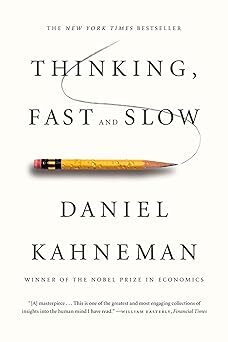
Author: Daniel Kahneman
Category: Psychology
Published: 2011
Key Takeaways
- Our minds operate using two systems: System 1 (fast, intuitive, automatic) and System 2 (slow, deliberate, effortful)
- System 1 generates impressions and intuitions that System 2 either endorses or corrects, but System 2 is often lazy
- Mental shortcuts (heuristics) like anchoring, availability, and representativeness lead to systematic cognitive biases
- The anchoring effect shows we're heavily influenced by initial information, even when it's completely irrelevant
- We judge probability by how easily examples come to mind (availability heuristic) rather than actual statistics
- We ignore base rates and judge based on stereotypes and similarity (representativeness heuristic)
- Loss aversion means the pain of losing is twice as powerful as the pleasure of gaining the same amount
- Prospect theory reveals we're risk-averse for gains but risk-seeking to avoid losses
- We suffer from overconfidence and the illusion of understanding due to 'What You See Is All There Is' (WYSIATI)
- The experiencing self lives in the moment while the remembering self evaluates experiences after they end
- Our memories are dominated by peak moments and endings (peak-end rule) rather than duration
- We can't eliminate cognitive biases but can learn to recognize when they're likely to occur
- Understanding System 1's strengths and weaknesses helps us know when to engage System 2's analytical thinking
- Hindsight bias makes past events seem more predictable than they actually were
- Expert predictions in low-validity fields are often no better than random guesses despite high confidence
About This Summary
The Two Minds Within: An In-Depth Summary of Daniel Kahneman's "Thinking, Fast and Slow"
In his landmark book, "Thinking, Fast and Slow," Nobel laureate Daniel Kahneman offers a revolutionary and profoundly insightful tour of the human mind, revealing the two fundamental systems that drive the way we think, judge, and decide. This is not merely a work of academic psychology; it is a masterful intellectual memoir that chronicles a lifetime of groundbreaking research, much of it conducted with his extraordinary long-time collaborator, Amos Tversky. Kahneman's work provides readers with a powerful and accessible vocabulary to understand the intricate machinery of thought, exposing the mind's astonishing capabilities alongside its predictable and systematic flaws. The result is a vivid, actionable, and deeply human guide to recognizing the sources of our mental errors and, ultimately, improving our own judgment in both our personal and professional lives.
Narrative and Structural Focus: The Two Systems at Work
Kahneman's central thesis, the elegant framework upon which the entire book is built, is that our minds operate using two distinct and often competing systems. This "two-system" model becomes the indispensable lens through which we can understand the complex and ceaseless dialogue between our intuition and our reason. He personifies these systems as characters in the drama of the mind, making their interactions both understandable and memorable.
System 1: The Impulsive Protagonist
System 1 is unequivocally the star of the show—it thinks fast. Operating automatically, intuitively, emotionally, and with little to no conscious effort, it is the powerful, silent engine of our everyday lives. System 1 is the part of your mind that recognizes the face of a friend in a crowd, reads the overt emotion on a billboard advertisement, effortlessly drives a car on an empty road, and instantly knows the answer to 2+2. It's the impulsive, associative, and often unconscious force that generates a constant stream of impressions, feelings, intuitions, and gut reactions. This system is a legacy of our evolutionary past, designed to make rapid assessments of situations—Is it a threat? Is it an opportunity?—to ensure survival. It operates on the principle of "cognitive ease," meaning it prefers things that are familiar, simple, and require the least mental strain. It is the origin of our snap judgments and, as Kahneman reveals, the source of many of our most significant cognitive biases.
System 2: The Deliberate, and Often Lazy, Adjudicator
System 2 is the story's supporting actor—it thinks slow. This is our conscious, reasoning self, the part of our mind we identify with as "us." Its operations are effortful, requiring focused attention and deliberate thought. System 2 is engaged when you are asked to solve a complex multiplication problem like 17 x 24, when you are consciously weighing the pros and cons of a major life decision like a career change, or when you are actively trying to exert self-control in a tense and emotionally charged situation. It is logical, analytical, and skeptical, and its primary job is to monitor, question, and ultimately endorse or reject the constant flow of suggestions coming from System 1.
Kahneman masterfully illustrates that while we may lionize our rational System 2, it is the automatic System 1 that is continuously and effortlessly shaping our thoughts and actions. The critical insight is that System 2 is inherently lazy. Its resources are finite, and mental effort is costly. Therefore, the division of labor between the two systems is highly efficient: System 1 handles the vast majority of routine tasks and immediate judgments, allowing System 2 to conserve its limited energy for the moments that truly require deep, analytical thought. The book invites us to view our daily lives—from the most mundane snap judgments to the most consequential decisions—as an ongoing interaction between these two systems. This dynamic reveals precisely why they so often push and pull our behavior in surprising, counterintuitive, and frequently irrational ways. Most of our errors in judgment occur when System 1 offers a flawed intuitive answer and the lazy System 2 fails to engage and correct it.
Core Themes and Psychological Insights: Unmasking the Flaws in Our Intuition
The narrative progresses from this foundational two-system model to a deep and fascinating exploration of the predictable errors in judgment—the cognitive biases—that arise from our over-reliance on the fast, intuitive, but often mistaken System 1. Kahneman and Tversky's genius was in identifying these systematic errors and designing ingenious experiments to reveal them.
Heuristics and Biases: The Mental Shortcuts That Lead Us Astray
Much of our intuitive thinking is governed by mental shortcuts, or heuristics, that allow for quick and efficient judgments. While these are indispensable for navigating a complex world, they often lead to systematic and predictable errors. Kahneman details a gallery of these biases, including several key ones:
The Anchoring Effect: This is our powerful tendency to be overly influenced by an initial, often completely irrelevant, piece of information (the "anchor") when making an estimate or decision. For example, when judges were asked to determine a sentence for a shoplifter after being primed with a roll of dice that showed either a high or low number, those who saw the high number gave significantly longer sentences. The number on the dice acted as a subconscious anchor, demonstrating the arbitrary power of suggestion on even expert judgment.
The Availability Heuristic: We judge the likelihood of an event not by its statistical probability but by how easily examples come to mind. Events that are recent, vivid, or emotionally charged are more "available" to our memory and are therefore perceived as being more common. This is why we often overestimate the risk of dramatic but rare events like shark attacks or airplane crashes—which receive heavy media coverage—while underestimating the risk of more mundane but statistically far more dangerous threats like diabetes or car accidents.
The Representativeness Heuristic: We assess situations and people based on stereotypes and how much they resemble a particular prototype, often ignoring critical statistical information known as base rates. In a famous experiment, subjects were given a description of a shy, detail-oriented man named Steve and asked whether he was more likely to be a librarian or a farmer. Because the description matched the stereotype of a librarian, most people chose that option, completely ignoring the fact that there are vastly more farmers than male librarians in the population. This "base-rate neglect" is a fundamental failure of our statistical intuition.
Prospect Theory and the Power of Loss Aversion
This is the Nobel Prize-winning core of Kahneman and Tversky's work, a theory that fundamentally overturned the long-held economic models of the "rational actor." They demonstrated through a series of ingenious experiments that people are not uniformly risk-averse or risk-seeking; their decisions about risk are profoundly influenced by a reference point, typically the status quo. The cornerstone of this groundbreaking theory is loss aversion: the pain of losing something is psychologically about twice as powerful as the pleasure of gaining the exact same thing.
This single, powerful insight explains a vast range of irrational economic behaviors. For example, because losses loom larger than gains, we are often risk-seeking when trying to avoid a sure loss (e.g., gambling to win back money) but are risk-averse when choosing between a sure gain and a gamble. Loss aversion also explains why penalty frames are often more effective motivators than rewards; the fear of a penalty (a loss) is a more powerful driver of behavior than the prospect of an equivalent reward (a gain). It is the reason golfers putt more accurately to avoid a bogey (a loss) than to achieve a birdie (a gain).
Overconfidence and the Pernicious Illusion of Understanding
System 1 excels at creating coherent and believable narratives from limited, and sometimes unreliable, information. Kahneman gives this powerful and problematic trait a memorable name: "What You See Is All There Is" (WYSIATI). Our minds work with the information presented to them and generally fail to consider the information that is missing. This leads to a pervasive and dangerous illusion of understanding and feeds our chronic overconfidence. We are wired to be storytellers, constructing simple, causal narratives of the past that make the world seem far more predictable and understandable than it actually is. This hindsight bias, or the "I-knew-it-all-along" effect, makes us believe that past events were foreseeable, leading us to overestimate our ability to predict the future.
Kahneman argues that we are prone to overestimate how much we understand the world and dramatically underestimate the role of chance in events. This leads to an illusion of validity in our judgments, where we feel confident in our predictions even in the face of evidence that they are no better than random guesses. This is particularly true for so-called "experts" in fields with low validity, such as stock picking or political punditry. We construct flawed, oversimplified stories of the past that shape our flawed and overly confident predictions of the future.
The Two Selves: A Tale of Experience and Memory
In one of the most profound and philosophically rich sections of the book, Kahneman distinguishes between two different selves that inhabit our bodies: the experiencing self and the remembering self.
The experiencing self is the one that lives in the continuous stream of the present moment. It is the self that answers the question, "Does it hurt now?" It is the sum total of our moment-to-moment feelings of pleasure or pain.
The remembering self is the storyteller, the part of us that evaluates an experience after it has concluded. It answers the question, "How was it, on the whole?"
The crucial and counterintuitive finding is that these two selves are often in conflict, and it is the remembering self that makes our decisions. Our memories of an experience are dominated not by its overall duration but by two key moments: the most intense point (the peak) and the very end of the experience. This "peak-end rule", combined with a phenomenon called duration neglect, explains a host of puzzling human behaviors. For example, in one experiment, patients undergoing a painful colonoscopy reported a better overall memory of the procedure if a few minutes of milder discomfort were added to the end, even though this increased the total duration of pain. The less painful ending created a more positive memory, a clear demonstration of the remembering self's tyranny over the experiencing self. This insight has profound implications for how we think about happiness, well-being, and how we choose to spend our time, as we often make decisions based on the anticipated memories we will create rather than the actual experiences we will have.
Overarching Narrative Arc and Enduring Impact
Throughout the book, Kahneman traces the exhilarating, challenging, and deeply collaborative journey of scientific discovery he shared with Amos Tversky. He illustrates each cognitive concept not with dry academic prose, but with the clever experiments they designed, the engaging stories they debated, and the real-world applications they uncovered. The narrative arc moves seamlessly from the foundational principles of cognitive science to deeply practical insights for investing, where overconfidence can be financially ruinous; for public policy, where the framing of a choice can dramatically alter public opinion; and for business and medicine, where unchecked intuitions can lead to catastrophic errors.
Ultimately, "Thinking, Fast and Slow" is far more than a book; it is a user's manual for the human mind and a toolkit for metacognition—the crucial act of thinking about your own thinking. It provides a richer, more nuanced vocabulary for identifying our own mental errors and understanding the cognitive traps that affect the judgments of others. Kahneman's conclusion is both humbling and deeply empowering: while we cannot simply will away our cognitive biases—they are a feature of our mental architecture, not a bug—we can learn to recognize the situations in which these biases are most likely to occur. By understanding the strengths and weaknesses of our intuitive System 1, we can learn when to distrust our gut feelings and deliberately engage the slower, more analytical, and more reliable System 2.
This transformative guide is essential reading not just for psychologists, economists, and policymakers, but for anyone who wishes to improve their judgment, reduce the insidious influence of bias, and develop a deeper, more compassionate understanding of the mind's incredible strengths and its most consequential pitfalls. It empowers readers to recognize the constant, intricate interplay of intuition and analysis in their own thinking, capturing a lifetime of groundbreaking science, brilliant storytelling, and timeless practical wisdom in an accessible, unforgettable, and profoundly human format.