Trading summary
Trading in the Zone Summary: Key Ideas and Takeaways
Read a practical summary of Trading in the Zone by Mark Douglas, including key takeaways, lessons, and useful ideas.
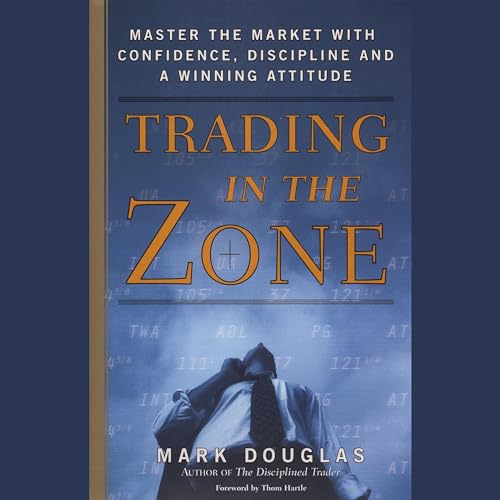
Author: Mark Douglas
Category: Trading
Published: 2000
Key Takeaways
- Trading success is 80% psychology and only 20% strategy - mastering your mindset is crucial
- The Five Fundamental Truths help traders accept uncertainty and think in probabilities
- Markets are never certain - anything can happen at any time
- You don't need to predict the market to be profitable; you need an edge
- Wins and losses are randomly distributed - focus on the process, not individual outcomes
- An edge is simply a higher probability of one outcome over another
- Every market moment is unique - avoid anchoring to past trades
- The three stages of trader development: mechanical, subjective, and intuitive
- The Seven Principles of Consistency provide a framework for disciplined trading
- True trading mastery comes from emotional detachment and process focus
About This Summary
Mastering the Inner Game of the Market
In the demanding and often unforgiving world of financial trading, where fortunes are made and lost in the blink of an eye, a single book has stood the test of time as the definitive guide to the most crucial and least understood aspect of success: trading psychology. Mark Douglas's seminal work, "Trading in the Zone: Master the Market with Confidence, Discipline, and a Winning Attitude," published in 2000, has become a veritable bible for traders of all levels. Its enduring power lies in its revolutionary and deeply resonant central thesis: that consistent profitability is not born from a "holy grail" indicator or a flawless analytical strategy, but from the cultivation of a specific, unwavering mindset. This is the story of how to trade not just with your head, but from a place of profound psychological mastery.
The Genesis of Insight: A Trader's Journey from Ruin to Revelation
To truly appreciate the depth of Douglas's teachings, one must first understand the crucible in which they were forged. Mark Douglas didn't begin his career as a trading guru. He was a highly successful professional in the commercial insurance industry, accustomed to achieving his goals through hard work and intellectual prowess. In 1978, he ventured into the world of trading, confident that his established success would translate seamlessly into this new arena. Within months, he had lost nearly everything.
This catastrophic failure became the catalyst for a profound journey of self-discovery. Douglas was confronted with a jarring paradox: he knew what a good trade looked like, he could analyze the markets, yet in the heat of the moment, he was unable to execute his plans consistently. He would hesitate, enter trades too late, exit too early, or hold on to losing positions, all while a voice in his head screamed the correct course of action. This painful disconnect between his analytical knowledge and his actual trading results led him to a groundbreaking realization. The problem wasn't the market; the problem was him. His deep-seated beliefs, his emotional reactions to wins and losses, and his fundamental misunderstanding of the nature of the market were sabotaging his every move.
The Psychological Foundation: Why Your Mind is Your Greatest Asset (or Liability)
Douglas's most provocative and enduring assertion is that trading success is 80% psychology and 20% strategy. For most aspiring traders, this is a revolutionary and often unsettling idea. They spend countless hours and vast sums of money searching for the perfect system, the flawless indicator, the secret to predicting the market's next move. Douglas argues that this quest is fundamentally misguided. While a sound methodology is necessary, even the most brilliant strategy is doomed to fail in the hands of a trader whose mind is not properly prepared.
The core of the problem lies in the fact that most of us are conditioned from a young age to think in ways that are completely counterproductive in the trading environment. In our everyday lives, we are taught to avoid mistakes, to seek certainty, and to equate being right with success. This mindset, while beneficial in many professions, is a recipe for disaster in the markets. Trading is an activity where uncertainty is the only certainty, and losses are an unavoidable part of the process.
The Bedrock of Probabilistic Thinking: The Five Fundamental Truths
At the heart of "Trading in the Zone" is a framework designed to rewire the trader's brain to think in probabilities, much like a casino operator. A casino doesn't know the outcome of any individual spin of the roulette wheel, but it knows that over thousands of spins, its statistical edge will ensure profitability. This is the mindset of a professional trader. Douglas articulates this through his Five Fundamental Truths, a set of beliefs that must be internalized at a deep, emotional level to form the foundation of a winning attitude.
- Anything can happen. This is the most fundamental truth of trading. No matter how perfect a setup looks, no matter how much analysis supports a particular outcome, there is always the possibility that the market will do the complete opposite. This is because the market is a reflection of the collective actions and beliefs of millions of human participants, making it an inherently unpredictable environment. Internalizing this truth helps to eliminate the shock and emotional pain of an unexpected loss. When you truly believe that anything can happen, you are less likely to be blindsided and more likely to have protective measures, like stop-losses, in place.
- You don't need to know what is going to happen next to make money. This truth directly challenges the novice trader's obsession with prediction. Profitability in trading does not come from being a market fortuneteller. It comes from having a trading "edge"—a system or methodology that, over a series of trades, has a higher probability of producing a profit than a loss. By consistently executing this edge, a trader can be profitable without knowing the outcome of any single trade. This shifts the focus from being "right" on one trade to being consistently profitable over time.
- There is a random distribution of wins and losses for any given set of variables that define an edge. Even with a proven edge, the sequence of winning and losing trades is random. A trader could experience a string of five losses in a row, followed by ten wins, or any other combination. The mistake most traders make is to attach meaning to this random distribution. After a few losses, they begin to doubt their edge and deviate from their plan. Conversely, after a few wins, they become overconfident and start taking bigger risks. Understanding that the distribution is random allows a trader to treat each trade as a statistically independent event, free from the emotional baggage of past results.
- An edge is nothing more than an indication of a higher probability of one thing happening over another. This truth demystifies the concept of a trading edge. It is not a guarantee of success on any given trade; it is simply a statistical advantage. When a trader's edge appears in the market, it's a signal that the odds are in their favor. The professional trader's job is to identify this edge and execute the trade according to their plan, without hesitation and without emotional attachment to the outcome. They accept that some trades with an edge will still be losers, and this is simply a cost of doing business.
- Every moment in the market is unique. Because the market is in a constant state of flux, with an ever-changing cast of participants, no two moments are ever exactly the same. A pattern that worked perfectly yesterday may fail today. This truth helps traders avoid the trap of assuming that because a setup looks identical to a previous winning trade, it will produce the same result. It encourages a mindset of being present and responsive to the "now moment opportunity flow," rather than being anchored to past experiences.
The Transformation Process: The Three Developmental Stages of a Trader
Douglas posits that the journey to becoming a consistently successful trader is a developmental process that unfolds in three distinct stages. Many traders fail because they try to jump to the more advanced stages without mastering the foundational skills of the first.
- The Mechanical Stage - This is the foundational stage where the primary goal is to build discipline and self-trust. In the mechanical stage, a trader follows a rigidly defined trading system with a clear set of rules for entry, exit, and risk management. The objective is not necessarily to make a lot of money, but to learn to execute the system flawlessly over a series of trades (Douglas suggests a sample size of at least 20).
- The Subjective Stage - Once a trader has built a foundation of discipline and self-trust in the mechanical stage, they can begin to move into the subjective stage. Here, the trader starts to incorporate their growing market knowledge and experience to make more discretionary decisions. They have internalized the rules and principles of their mechanical system to such an extent that they can now apply them with more flexibility, adapting to the nuances of the current market environment.
- The Intuitive Stage - This is the highest level of trading proficiency, the state of operating "in the zone." A trader in the intuitive stage has so fully integrated their methodology and the probabilistic mindset that their execution becomes effortless and automatic. They have moved beyond conscious, rule-based thinking and are now able to process a vast amount of market information intuitively, allowing them to flow with the market in a state of relaxed confidence.
Practical Application: The Seven Principles of Consistency
To translate the theoretical framework into actionable practice, Douglas provides the Seven Principles of Consistency. These principles serve as a daily mantra and a practical checklist for developing and maintaining the mindset of a professional trader:
- I objectively identify my edges - Having a clearly defined set of criteria for what constitutes a trading opportunity according to your system.
- I predefine the risk of every trade - Before entering a trade, you must know exactly where you will get out if it moves against you and how much you are willing to lose.
- I completely accept the risk or I am willing to let go of the trade - It's not enough to intellectually know the risk; you must fully accept it emotionally. If the potential loss makes you uncomfortable, you should reduce your position size or skip the trade.
- I act on my edges without reservation or hesitation - When your edge appears, you must execute the trade. Hesitation is a symptom of fear and a lack of trust in your system.
- I pay myself as the market makes money available to me - This involves having a predefined plan for taking profits, rather than letting greed dictate when you exit a winning trade.
- I continually monitor my susceptibility for making errors - This involves regular self-assessment, such as keeping a trading journal, to identify any patterns of psychological errors.
- I understand the absolute necessity of these principles of consistent success and, therefore, I never violate them - This is the commitment to discipline. A trader must treat their rules as sacred and inviolable.
The Ultimate Message: Detachment, Acceptance, and the Freedom to Execute
The revolutionary power of "Trading in the Zone" lies in its profound redefinition of what it means to be a successful trader. Mark Douglas's ultimate message is a paradox: the path to better results is paved with detachment from those very results. When a trader truly internalizes the probabilistic mindset, the emotional charge of "right" and "wrong," "win" and "loss," begins to dissipate.
A loss is no longer a personal failure; it is simply a statistical event, an expected cost of doing business. A win is not a reflection of genius; it is the outcome of a properly executed edge. This emotional neutrality is the holy grail that most traders seek in complex indicators, but which can only be found within their own minds.
By learning to accept risk and uncertainty at both an intellectual and an emotional level, traders free themselves from the psychological interference that causes the vast majority of their errors. They shift from an outcome-focused mindset, which is fraught with anxiety and fear, to a process-focused mindset, which is characterized by calm, confident, and disciplined execution.
"Trading in the Zone" is more than just a book about trading; it's a guide to mastering oneself in an environment of complete uncertainty. Its principles are timeless because they address the unchanging landscape of human psychology. For over two decades, it has remained the definitive text on the subject, not just because it explains what traders need to do, but because it provides a clear and actionable framework for why they struggle and how they can transform their minds to achieve a state of consistent, effortless, and profitable trading. Mark Douglas's legacy is the profound understanding that the consistency you seek is not in the markets; it is in your mind.