Economics summary
The Black Swan Summary: Key Ideas and Takeaways
Read a practical summary of The Black Swan by Nassim Nicholas Taleb, including key takeaways, lessons, and useful ideas.
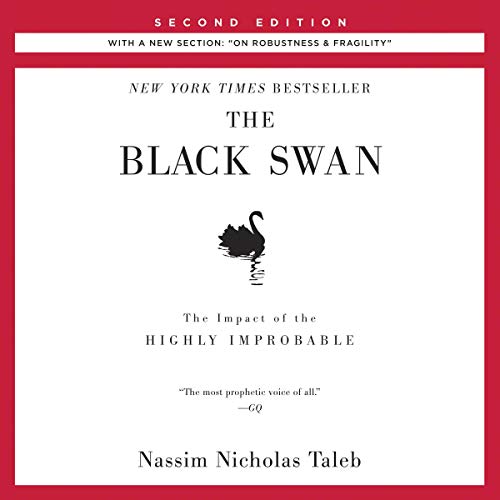
Author: Nassim Nicholas Taleb
Category: Economics
Published: 2007
Pages: 400
Key Takeaways
- **The Black Swan**: An event that is rare, has extreme impact, and is explained away after the fact.
- **Mediocristan vs. Extremistan**: Don't use tools for the average (Bell Curve) in the domain of the extreme (markets).
- **The Turkey Problem**: Past stability is not a guarantee of future safety. It can be a precursor to a crash.
- **Narrative Fallacy**: We fool ourselves with stories. Favor clinical records over journalists' explanations.
- **Ludic Fallacy**: Real life is not a casino with known odds. It is messy and unpredictable.
- **Barbell Strategy**: Be hyper-conservative with 90% of assets and hyper-aggressive with 10%. Avoid the middle.
- **Anti-Fragility**: Aim to benefit from volatility, not just survive it.
- **Silent Evidence**: Don't just look at winners; look at the graveyard of losers to understand true odds.
- **Skin in the Game**: Never trust an expert who doesn't lose anything when they are wrong.
- **Prediction is Impossible**: Stop trying to predict. Start preparing.
About This Summary
THE BLACK SWAN: The Impact of the Highly Improbable
Based on The Black Swan by Nassim Nicholas Taleb
INTRODUCTION: Defining the Highly Improbable
We live in a world dominated by the extreme, the unknown, and the highly improbable. Yet we spend our time engaged in small talk, focusing on the known and the repeated. This is a profound mistake.
Nassim Nicholas Taleb's The Black Swan is not just a book about probability and risk—it is a philosophical treatise on the nature of knowledge, the limits of prediction, and the hidden fragility of our most cherished institutions. It challenges the foundations of how we think about the world.
The Metaphor of the Black Swan
Before the discovery of Australia, people in the Old World were convinced that all swans were white. This belief was unassailable, confirmed by thousands of years of empirical evidence. Every swan ever seen was white. The phrase "black swan" was used to describe something that was impossible.
Then European explorers arrived in Australia and encountered black swans. In a single moment, millennia of accumulated "knowledge" was invalidated. One observation—one anomaly—destroyed a belief that had seemed rock-solid.
This is the essence of a Black Swan event:
- Rarity: It lies outside the realm of regular expectations. Nothing in the past can convincingly point to its possibility.
- Extreme Impact: It carries a disproportionate impact. A single Black Swan can reshape industries, topple governments, and rewrite history.
- Retrospective Predictability: Despite its outlier status, human nature compels us to concoct explanations for its occurrence after the fact, making it seem predictable in hindsight.
The tragedy is not that Black Swans happen. It's that we systematically underestimate their frequency and impact while overestimating our ability to predict them.
Why Black Swans Dominate History
Consider the major events of the past century: World War I, the rise of the Internet, the 9/11 attacks, the 2008 financial crisis, the COVID-19 pandemic. None of these were predicted by the experts who should have seen them coming. Each one fundamentally changed the world.
Now consider how much of your time you spend preparing for predictable, incremental change versus preparing for the unpredictable and extreme. The mismatch is staggering.
Taleb argues that Black Swans are becoming more frequent, not less. In an increasingly interconnected world, the potential for cascading, extreme events grows exponentially. Yet our institutions, models, and mental frameworks remain stubbornly rooted in the assumption of normalcy.
PART I: THE TWO DOMAINS - Mediocristan vs. Extremistan
One of Taleb's most powerful contributions is the distinction between two fundamentally different types of randomness.
Mediocristan: The Land of the Average
Mediocristan is the domain where the collective is not dominated by any single outlier. It is the world of physical measurements and biological constraints.
Examples of Mediocristan:
- Human height: The tallest person in history was not ten times taller than average
- Human weight: No individual weighs more than 1,000 pounds
- Caloric intake: You can only eat so much in a day
- Car accidents: A single accident can only cause so much damage
In Mediocristan, the average is meaningful. If you sample 1,000 people and measure their height, adding one more person—even the tallest in the world—will barely change the average. The law of large numbers works. The Bell Curve (Gaussian distribution) applies beautifully.
The Rules of Mediocristan:
- Single observations don't matter much
- Large numbers average out
- What you see is what you get
- Predictions are reliable
Extremistan: The Land of the Extreme
Extremistan is the domain where a single observation can disproportionately affect the total. It is the world of social, informational, and economic phenomena.
Examples of Extremistan:
- Wealth: Bill Gates's net worth skews the average of any room he enters
- Book sales: A handful of bestsellers dominate total sales
- City populations: A few mega-cities contain most of the world's urban population
- War casualties: A few conflicts account for most deaths in history
- Stock market returns: A few trading days generate most of the gains
In Extremistan, the average is meaningless or misleading. Sample 1,000 authors and measure their book sales. Now add J.K. Rowling. Suddenly, she represents 99% of the total. One observation dominates everything.
The Rules of Extremistan:
- Single observations can dominate the total
- Large numbers don't average out—they concentrate
- What you see is NOT what you get
- Predictions are unreliable or impossible
The Great Intellectual Fraud
Here is the scandal: we have been using tools designed for Mediocristan to make decisions in Extremistan.
The Bell Curve, portfolio theory, Value at Risk (VaR), econometric models—all of these are Mediocristan tools. They assume that extreme events are so rare as to be negligible. They assume the future will look like the past. They assume stability.
When we apply these tools to finance, economics, and social phenomena—domains that live in Extremistan—we are committing a dangerous fraud. We are blinding ourselves to the very risks that matter most.
The 2008 financial crisis was a Black Swan that VaR models said was virtually impossible. The models were wrong not because of bad data or poor implementation, but because they were fundamentally inappropriate for the domain.
PART II: THE PROBLEM OF BLINDNESS
Why do we fail to see Black Swans coming? Taleb identifies several cognitive and institutional failures.
The Turkey Problem (The Problem of Induction)
Consider a turkey that is fed every day. Each day of feeding confirms the turkey's belief that humans are friendly creatures who care for its welfare. The turkey's confidence grows with each data point.
Then comes the Wednesday before Thanksgiving.
The turkey's experience—1,000 days of consistent feeding—did nothing to prepare it for what was coming. In fact, the very consistency of the past created a false sense of security about the future.
This is the Problem of Induction, first articulated by philosopher David Hume and dramatized by Bertrand Russell. Past experience cannot prove future outcomes. The more stable the past, the more complacent we become—and potentially, the more vulnerable.
Implications for Investors and Leaders:
- Long periods of stability can mask growing risks
- "It's never happened before" is not a safety guarantee
- The absence of evidence is not evidence of absence
- The longer a system appears stable, the more catastrophic its eventual failure may be
The Ludic Fallacy
The Ludic Fallacy (from Latin ludus, meaning "game") is the mistake of applying the rules of well-defined games to the messy, uncertain real world.
In a casino, the odds are known. The rules are explicit. The number of possible outcomes is finite and calculable. You can compute your expected return with precision.
In real life, the rules are unknown, shifting, and often hidden. The number of possible outcomes is infinite. You cannot compute probabilities because you don't even know what variables matter.
Casino vs. Real World:
- Casino: Known unknowns (you know the dice have 6 sides)
- Real World: Unknown unknowns (you don't know what you don't know)
The Ludic Fallacy is everywhere in finance and economics. Economists build models with precisely defined variables and probability distributions, then act as if the models represent reality. But reality is not a game with known rules.
The Narrative Fallacy
Humans are storytelling animals. We cannot help but weave facts into coherent narratives. This helps us make sense of the world, remember information, and communicate with others.
But it also blinds us to randomness and complexity. After every major event, we construct a story explaining why it happened. The story makes the event seem predictable, even inevitable.
Examples:
- After 9/11, we constructed narratives about intelligence failures—as if anyone could have connected the dots beforehand
- After the 2008 crisis, we blamed greedy bankers—ignoring that the same behavior had been praised as innovation before the crash
- After COVID-19, we blamed various failures—ignoring that novel pathogens are inherently unpredictable
The Narrative Fallacy gives us the illusion of understanding. We mistake a plausible story for a causal explanation. We confuse "making sense of the past" with "predicting the future."
Silent Evidence
We see the winners and survivors. We don't see the losers and the dead.
Consider motivational success stories: "I dropped out of college and became a billionaire!" For every dropout billionaire, there are thousands of dropouts who failed. But we never hear their stories. They are silent evidence.
This survivorship bias systematically distorts our understanding of risk and success. We overestimate the probability of success because we only see those who succeeded. We underestimate risk because those who failed catastrophically are no longer around to warn us.
The Graveyard Problem:
- We visit the tombs of great explorers, not those who died trying
- We study successful companies, not the thousands that went bankrupt
- We admire bold risk-takers who won, not those who lost everything
To understand true probabilities, you must visit the graveyard. You must count the silent evidence.
PART III: THE LIMITS OF PREDICTION
Taleb is relentlessly skeptical of experts and forecasters. His critique is not personal—it is structural. The very nature of Extremistan makes reliable prediction impossible.
The Scandal of Prediction
Studies consistently show that expert predictions are barely better than random chance—and often worse. Economists fail to predict recessions. Political scientists fail to predict revolutions. Security experts fail to predict attacks.
Yet experts remain confident. They are not humbled by their failures. They construct narratives explaining why "this time was different" and continue making predictions with undiminished certainty.
Why Experts Fail:
- They are trained in Mediocristan tools
- They are rewarded for confidence, not accuracy
- They have no skin in the game (they don't suffer when wrong)
- They mistake complexity for knowledge
The Inverse Problem
Even if we knew the exact rules governing a system, we often cannot work backward from outcomes to causes. This is the "inverse problem."
We can easily compute what happens if you throw a die. But if someone tells you the die landed on 4, you cannot determine how it was thrown. The forward calculation is easy; the inverse is impossible.
In complex systems—markets, economies, societies—we see outcomes and try to infer causes. But the inverse problem means this is fundamentally unreliable. Many different causes could produce the same outcome.
PART IV: ACTION IN EXTREMISTAN - The Art of Robustness
If prediction is impossible, what should we do? Taleb's answer is both practical and profound: stop trying to predict and start building robustness.
Robustness vs. Anti-Fragility
Robustness means the ability to withstand shock without damage. A robust system survives adversity.
Anti-fragility means the ability to benefit from shock. An anti-fragile system gets stronger from adversity.
Most of our systems are fragile—they break under stress. A few are robust—they survive stress. Almost none are anti-fragile—designed to benefit from stress.
The goal is to move from fragility through robustness toward anti-fragility.
The Barbell Strategy
The Barbell Strategy is Taleb's practical solution for navigating Extremistan. It involves extreme risk avoidance combined with extreme risk-taking, with nothing in the middle.
The Structure:
- 90% Hyper-Conservative: Treasury bills, cash, inflation-protected securities. Assets that cannot be destroyed by any Black Swan.
- 10% Hyper-Aggressive: Venture capital, speculative options, high-risk/high-reward bets. Assets that benefit enormously from positive Black Swans.
- 0% in the Middle: No "balanced" portfolios, no moderate risks. The middle is where you get killed—modest returns with hidden tail risks.
Why It Works:
- You cannot lose more than 10%
- Your upside is unlimited
- You are exposed to positive Black Swans
- You are protected from negative Black Swans
This strategy can be applied to careers (secure base job + speculative side projects), health (avoid major risks + occasional fasting/exercise stress), and life decisions generally.
The Seven Rules for the Black Swan Hunter
- Distinguish Domains: Always ask whether you are in Mediocristan or Extremistan. Use appropriate tools.
- Beware Precision: The more precise a forecast, the more suspicious you should be. Real knowledge acknowledges uncertainty.
- Seek Positive Asymmetry: Structure situations where you have small losses and huge potential gains. Avoid the reverse.
- Don't Be a Turkey: Question stability. Ask what could go wrong that has never happened before.
- Respect Silent Evidence: Always look at the graveyard. Count the losers, not just the winners.
- Avoid Debt: Debt creates fragility. It turns minor setbacks into catastrophic failures.
- Skin in the Game: Only trust those who suffer when they are wrong. Beware of advisors with no downside.
CONCLUSION: Living in a Black Swan World
Taleb's message is ultimately hopeful, though it requires intellectual humility and practical action.
We cannot eliminate Black Swans. We cannot predict them. But we can position ourselves to survive the negative ones and benefit from the positive ones.
The Path Forward:
- Accept that prediction is largely impossible in domains that matter
- Build systems that are robust or anti-fragile
- Use the Barbell Strategy to limit downside and maximize upside
- Maintain skin in the game
- Question experts, models, and certainty
- Look for silent evidence
- Stay humble about what you know
The world is becoming more extreme, more interconnected, and more prone to Black Swans. Those who cling to the illusion of predictability will be repeatedly surprised and damaged.
Those who embrace uncertainty, build robustness, and position for asymmetric opportunities will thrive.