Self-Help summary
The Subtle Art of Not Giving a F*ck Summary: Key Ideas and Takeaways
Read a practical summary of The Subtle Art of Not Giving a F*ck by Mark Manson, including key takeaways, lessons, and useful ideas.
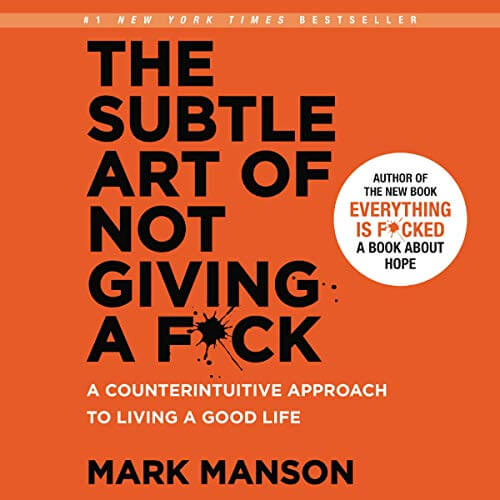
Author: Mark Manson
Category: Self-Help
Published: 2016
Pages: 224
Key Takeaways
- **The Feedback Loop from Hell:** Caring too much about feeling good creates anxiety about not feeling good, which creates more negativity. Break the cycle by accepting negative emotions.
- **The Backwards Law:** The desire for positive experience is itself negative; the acceptance of negative experience is itself positive. Stop chasing happiness.
- **Choose Your Struggle:** Don't ask 'What do I want?' Ask 'What pain am I willing to sustain?' The quality of your life is determined by how you handle negative experiences.
- **You Are Not Special:** Accepting your averageness frees you to fail, learn, and improve without ego destruction. Entitlement (narcissism or victimhood) is toxic.
- **Fault vs. Responsibility:** Fault is past tense (who caused it); Responsibility is present tense (who fixes it). Take responsibility for everything—it gives you power.
- **Certainty is the Enemy:** Growth requires doubt. Ask 'What if I'm wrong?' The more you cling to being right, the more fragile you become.
- **The Do Something Principle:** Action causes motivation, not the other way around. Don't wait for inspiration—do something, anything, and momentum follows.
- **Good Values are Internal:** Value honesty, creativity, humility, curiosity. Bad values (pleasure, status, being liked) depend on external factors you can't control.
- **Rejection Creates Meaning:** Saying 'No' defines what you stand for. Boundaries are necessary. If you can't reject, your acceptance means nothing.
- **Memento Mori:** Confronting death clarifies what truly matters. Use mortality as a filter—does this issue matter if you die tomorrow?
About This Summary
The Subtle Art of Not Giving a F*ck: The Definitive Masterclass
Role: Philosophical Mentor / Contrarian Critic Tone: Direct, Irreverent, Challenging Subject: Emotional Freedom via Better Values
Introduction: The Feedback Loop from Hell
Let's get one thing straight before we start: This is not a guide about how to stop caring. If you stopped caring about everything, you wouldn't be "chill" or "enlightened"—you'd be a sociopath.
The human mind is an evolutionarily designed worry-machine. You are wired to give a fck. It is a biological imperative. The problem isn't that you care; the problem is that you are caring about too many things, and usually, they are the wrong things.
Welcome to the Feedback Loop from Hell.
Here is the modern condition: You get anxious about confronting your boss. That anxiety makes you wonder why you're such a coward. Now you're anxious about being anxious. You get angry that you did something stupid in traffic. Then you get angry at yourself for being angry. You feel sad that you're alone on a Friday night, and then you feel sad that you're the kind of loser who feels sad on a Friday night.
Do you see the cycle? It is a spiral of mental excrement.
Society loves this loop. Consumer culture relies on it. Marketing works by making you feel like shit for not having a specific car, a specific body, or a specific lifestyle. They sell you a cure for a disease they invented. They scream at you that you must be happy, healthy, rich, and popular 24/7. And because you are a human being with flaws, you inevitably fall short of this impossible standard.
When you care too much about feeling good all the time, the lack of feeling good becomes a new source of negativity.
The "Subtle Art" is the skill of calibration. It is the ability to look at your limited amount of "f*cks" (your time, energy, and emotional bandwidth) and distribute them like a precious currency only to the things that truly matter. It is about accepting that life is inherently kind of sucky, and that's okay.
Real emotional freedom doesn't come from fixing everything that's wrong. It comes from realizing that struggle is inevitable, and you need to find the struggle that you're willing to sustain.
Part I: The Danger of Positive Thinking (The Anti-Self-Help)
The Scam of Conventional Self-Help
Conventional self-help is intellectual fast food. It tastes good going down, but it creates a nutrient-deficient soul. The industry is built on "affirmations" and "positive thinking."
Here's the rub: Happy people don't stand in front of a mirror and chant "I am happy." Rich people don't chant "I am rich." They just are.
When you force positivity, you are reinforcing the signal to your subconscious that you lack that very thing. This brings us to the Backwards Law (adapted from Alan Watts):
The desire for more positive experience is itself a negative experience.
>
Conversely, the acceptance of one's negative experience is itself a positive experience.
Think about it. The moment you accept that you are anxious, you are no longer anxious about being anxious. You are just… anxious. And that is manageable. The moment you accept that your relationship is failing, you stop fighting the reality and start dealing with the breakup. That is progress.
This is the Anti-Self-Help philosophy. We aren't trying to run away from the pain. We are trying to build the calluses necessary to endure it.
The Value of Suffering: Happiness is a Problem to be Solved
Here is a hard pill to swallow: Suffering is biologically useful. Nature is the ultimate pragmatist. It doesn't care if you are smiling; it cares if you are surviving. Pain is the body's way of telling you that something is wrong and needs to be fixed. Stubbing your toe hurts so you stop walking into furniture. Loneliness hurts so you don't starve to death in isolation.
The modern obsession with "positivity" tries to anesthetize this feedback mechanism. We numb ourselves with distractions, social media, shopping, and substances because we view suffering as a bug in the system.
It is not a bug. It is the feature.
True happiness occurs only when you find the problems you enjoy having and enjoy solving.
- The CEO loves the stress of the boardroom.
- The athlete loves the burn of the muscles.
- The parent loves the exhaustion of raising a child.
If you want the "result" (the money, the gold medal, the happy family) without the "process" (the risk, the sweat, the poop-filled diapers), you are hallucinating. You don't actually want the success; you want the fantasy.
Ask yourself: What pain do you want in your life? Everyone wants the good life. That's easy. That's boring. The interesting question, the one that actually determines your trajectory, is: What are you willing to struggle for?
If you aren't willing to suffer for your art, you aren't an artist; you're just someone who likes the idea of being an artist. The quality of your life is not determined by the quality of your positive experiences but by the quality of your negative experiences. To get good at handling the negative experiences is to get good at dealing with life.
Exceptionalism & Entitlement: The Tyranny of the "Special"
We live in an age of High-Definition Exceptionalism.
Every time you open your phone, you are bombarded with the top 0.001% of the human experience. The funniest jokes, the hottest bodies, the richest teenagers, the most tragic news. The internet acts as a relentless filter that removes the "average" and leaves only the extremes.
Because our brains are not evolved to handle a global sample size, we instinctively compare ourselves to these extremes. The result? We feel like garbage. We feel that if we aren't changing the world, launching a billion-dollar startup, or looking like a supermodel, we are failures.
This breeds Entitlement. Entitlement comes in two flavors, and they are both toxic:
- "I'm awesome and the rest of you are idiots." (Delusional Narcissism)
- "I'm a victim and the rest of you owe me." (Victim Narcissism)
Both mindsets rely on the belief that you are inherently "special" and therefore the rules of the universe shouldn't apply to you.
Here is the liberation you need: You are not special. You are probably average at almost everything you do. And that is okay.
Once you accept that you are average, that you are not "destined for greatness" just by existing, the pressure lifts. You no longer have to prove you are a god. You can just be a person. You can work on getting better at things because you enjoy them, not because you need to validate your existence. The acceptance of your own mundane existence is actually the first step toward becoming truly excellent at anything, because it allows you to endure the boredom and failure required to improve.
The Inevitability of Being Wrong: Architecting Your Own Beliefs
Growth is an iterative process. When we learn something, we don't go from "Wrong" to "Right." We go from Wrong to Slightly Less Wrong. Then, with more experience, we become Slightly Less Wrong Than That.
You will never be "Right." We are hairless apes trying to understand quantum mechanics and macroeconomics; we are barely functional.
The problem arises when we attach our identity to being "Right." When you define yourself by your beliefs ("I am a smart person," "I am a victim," "I am a conservative/liberal"), any evidence that contradicts those beliefs feels like a death threat. So, you avoid it. This is Manson's Law of Avoidance: The more something threatens your identity, the more you will avoid it.
If you believe you are a "nice guy who never gets the girl," you will subconsciously sabotage relationships to protect that identity, because knowing who you are (even if it sucks) is safer than the unknown.
To grow, you must be willing to murder your current self. You must be willing to ask, "What if I'm wrong?"
- What if I'm not unlovable, but just socially lazy?
- What if my boss isn't an asshole, and I'm just bad at communicating?
- What if my values are trash?
Certainty is the enemy of growth. Doubt is the tool of the master.
Part II: The Solution — Choosing Better Values
The central premise of the Subtle Art is this: You are always choosing. Even if you don't realize it, you are constantly choosing what to value. If you are miserable, it is likely because you are valuing things that are outside of your control.
Values are the operating system of your mind. If you value "Money," your metric for success is your bank account. If the market crashes, your self-worth crashes. If you value "Popularity," your metric is other people's opinions. If someone ignores you, you are crushed.
We need to upgrade your operating system. We need to delete the bloatware (bad values) and install a Linux kernel of stoic resilience (good values).
The Criteria: Good vs. Bad Values
How do you know if a value is screwing you over? Use this diagnostic table.
| Feature | GOOD / HEALTHY VALUES | POOR / UNHEALTHY VALUES | |---------|----------------------|------------------------| | Source | Internal. Based on things you can control. | External. Based on events or people outside your control. | | Reliability | Immediate. Can be experienced right now. | Deferred. Relies on a future outcome that may never happen. | | Nature | Constructive. Engages with reality as it is. | Destructive. Requires denying or distorting reality (escapism). | | Examples | Honesty, Creativity, Humility, Curiosity | Pleasure, Material Success, Being Right, Being Liked |
If your values are poor, your problems will be insoluble. If your values are good, your problems will still exist, but they will be better problems. And life is about solving better problems.
The Four Pillars of the Subtle Art
To dismantle the feedback loop from hell, you must adopt these four counter-intuitive values.
1. Radical Responsibility: You Are Always Choosing
There is a massive distinction that most people miss, and it ruins their lives: The difference between Fault and Responsibility.
- Fault is past tense. It is about who caused the mess.
- Responsibility is present tense. It is about who has to fix the mess.
If someone leaves a baby on your doorstep, it is not your fault. You didn't put it there. But it is now your responsibility. You have to choose what to do (call the police, take it in, ignore it). Standing there screaming "This isn't my fault!" doesn't change the reality that there is a baby on your porch.
Life dumps babies on your porch constantly.
- Your partner cheating on you? Not your fault. Your responsibility to handle your emotional recovery.
- Getting fired? Maybe not your fault. Your responsibility to find a new job.
- Trauma from childhood? Definitely not your fault. But it is your responsibility to heal it, or you will remain a child forever.
The "Responsibility/Fault" Fallacy: People hesitate to take responsibility because they think it admits fault. No. Taking responsibility is an act of power. It is reclaiming your agency.
The Great Power Flip: Spider-Man taught us: "With great power comes great responsibility." The Subtle Art teaches the inverse: "With great responsibility comes great power." The more you accept responsibility for everything in your life, the more power you have to change your life. If you blame the government, the economy, or your parents, you have outsourced your power to them. You are a passenger. Grab the wheel.
2. Uncertainty: The Value of Doubt
We crave certainty. We want to know the "Right Answer." We want to know that our political party is the good one, that our religion is the true one, and that our career path is the safe one.
But certainty is the mind-killer. Certainty closes the door to learning.
If you think you know everything, you learn nothing. To grow, you must value Uncertainty. You must cultivate the ability to look at your own convictions and ask, "Is it possible I'm full of sh*t?"
(Hint: The answer is usually yes.)
The Law of Inversion: The more you try to be certain about something, the more uncertain and insecure you will feel.
- The man who is certain he is brilliant gets angry when corrected. He is fragile.
- The man who admits he doesn't know much is open to correction. He is antifragile.
Stop trying to find yourself. "Finding yourself" implies there is a frozen, perfect version of "You" hidden under a rock somewhere. There isn't. You are a process. You are creating yourself every day. Never knowing exactly who you are gives you the freedom to change.
3. Failure: The "Do Something" Principle
Most people view the relationship between inspiration and action like this:
Inspiration → Motivation → Action
"I need to get inspired so I can feel motivated to go to the gym." This is garbage. This relies on an emotional state (inspiration) that you cannot control. If you wait for inspiration, you will die waiting.
The true mechanic of human psychology is a loop:
Action → Inspiration → Motivation → Action
This is the "Do Something" Principle. Action is not just the effect of motivation; it is also the cause of it.
If you are stuck on a problem, don't sit there thinking. Do something. Anything. Even if it's the wrong thing. The simple act of doing something generates a reaction, which generates inspiration, which generates the motivation to keep going.
Redefine Failure: If your value is "Success," then failure is the enemy. If your value is "Growth," then failure is the raw material. Massive success is built on a mountain of small failures. If you are avoiding failure, you are avoiding success. You must be willing to be the idiot in the room. You must be willing to ship the bad draft. You must be willing to get rejected.
4. Rejection: The Importance of Saying (and Hearing) "No"
We live in a culture of "Yes." We want to keep our options open. We want to be liked by everyone. This is a path to a hollow life.
To value something means you must reject what is NOT that thing.
- If you value your marriage, you must reject other sexual partners.
- If you value your health, you must reject junk food.
- If you value your time, you must reject people who waste it.
Boundaries are the application of Rejection. A boundary is simply the line where your responsibility ends and another person's begins.
- Bad Boundaries: You take responsibility for other people's emotions ("I can't tell her the truth, she'll be sad") or you demand they take responsibility for yours ("You made me angry!").
- Good Boundaries: "I am responsible for my actions; you are responsible for your reactions."
You cannot have a deep, meaningful relationship without rejection. If you can't say "No," your "Yes" means nothing. If you are accepting of everything, you stand for nothing.
Part III: The Application — Confronting Legacy
We have dismantled your bad habits. We have installed better values. Now, we face the final boss. The one thing that makes all of this "Subtle Art" necessary.
Death.
The fear of death is the background noise of everything you do. Why do you want your name on a building? Why do you want to be famous? Why do you care what people think of you? Because you are terrified that you will die and your existence will have meant nothing.
Ernest Becker, in his masterpiece The Denial of Death, argued that human civilization is basically an elaborate defense mechanism against the knowledge of our own mortality. We build "Immortality Projects"—careers, families, statues, religions—things that we hope will outlast us, granting us a symbolic immortality.
The problem is, when we are obsessed with our Immortality Projects, we lose touch with the present. We treat people as tools to build our legacy rather than humans to connect with. We endure miserable lives in the hope of a glorious obituary.
The Final Value: Mortality. The Stoics called it Memento Mori (Remember you will die). This sounds depressing. It is actually the most life-affirming tool you possess.
When you truly accept—viscerally accept—that you are going to die, and it could be soon, the superficial bullshit evaporates.
- Do you really give a f*ck that your coworker was rude to you? You're going to die.
- Do you really give a f*ck that you aren't famous? You're going to die.
- Do you really give a f*ck about embarrassing yourself? You're going to die.
Death is the light by which the shadow of all of life's meaning is measured. Without death, everything would feel inconsequential. Scarcity creates value. Gold is valuable because it is rare. Your life is valuable because it is temporary.
The "Sunny Side of Death"
If you remove the "legacy" aspect—the desperate need to put your name on a hospital wing—and simply focus on the fact that your time is running out, you are left with a singular, clarifying question:
If I died tomorrow, would I be happy with how I spent today?
This isn't about doing cocaine on a yacht because "YOLO." It's about asking if you acted according to your values. Did you treat people well? Did you pursue something meaningful? Did you stand up for yourself?
When you become comfortable with the reality of your own death, you become comfortable with the reality of your own life. You stop sweating the small stuff because you realize—viscerally—that it is all small stuff.
There is no "right" way to leave a legacy. The only legacy that matters is the one you leave in the minds of the people you touched while you were here. Did you make their suffering slightly more bearable? Did you help them solve a problem? Did you love them honestly?
That's it. That's the game. Everything else is just ego jerking itself off.
The 10 Non-Negotiable Rules for Emotional Freedom
We have stripped away the delusions. We have burned down the "Positive Vibes Only" banner. What remains is a pile of ashes and the foundation for a life of substance.
1. Own Your Sh*t (Radical Responsibility)
The Rule: You are responsible for everything that happens in your life, regardless of who is at fault. Stop saying "He made me feel..." or "I can't because..." If you are miserable, it is your responsibility to change it.
2. Kill Your "Specialness"
The Rule: You are not extraordinary, and you are not entitled to anything. Drop the ego. When you accept you are average, you are free to fail without it destroying your identity.
3. The "Do Something" Principle
The Rule: Action isn't the effect of motivation; it is the cause of it. Never wait for inspiration. If you are stuck, do the smallest possible action related to your goal.
4. Choose Your Struggle
The Rule: Happiness requires struggle. Choose what you are willing to suffer for. Stop asking "What do I want to enjoy?" and start asking "What pain can I sustain?"
5. Embrace Uncertainty (Be Wrong)
The Rule: Certainty is the enemy of growth. Always assume you are missing information. Hold your beliefs loosely. Be willing to look foolish.
6. Establish "Good" Values
The Rule: Value only what you can control. Pursue Honesty, Innovation, Vulnerability, Self-Respect, Curiosity, Charity. Avoid Pleasure, Material Success, Being Right, Positive Attention.
7. Rejection is Freedom
The Rule: You must say "No" to the good to make room for the great. Boundaries are not mean; they are necessary. You are defined by what you reject.
8. Fail Forward
The Rule: Failure is just data. The magnitude of your success is based on how many times you have failed at that thing. Avoidance of failure is avoidance of success.
9. Accept the Mundane
The Rule: Life is mostly boring. That is a feature, not a bug. Real life happens in the quiet moments. If you can't find peace in the boredom, you will never find peace on a yacht.
10. Memento Mori (Remember Death)
The Rule: You are going to die. This is the only thing that gives your life meaning. Use death as your prioritization tool. Does this really matter if you die next week?
Final Word
You now have the roadmap. You understand that the "Subtle Art" is not about indifference; it is about precision.
You have a limited amount of fcks to give.** Do not spend them on traffic. Do not spend them on strangers on the internet. Do not spend them on trying to impress people you don't even like.
Spend them on your craft. Spend them on your family. Spend them on your own integrity.
The world is noisy. It is designed to distract you. It wants you to care about everything, all the time, forever. Don't let it.
Choose your struggle. Accept your average-ness. Confront your death.
Now, put this guide away. Go do something.