Finance summary
The Little Book of Common Sense Investing Summary: Key Ideas and Takeaways
Read a practical summary of The Little Book of Common Sense Investing by John C. Bogle, including key takeaways, lessons, and useful ideas.
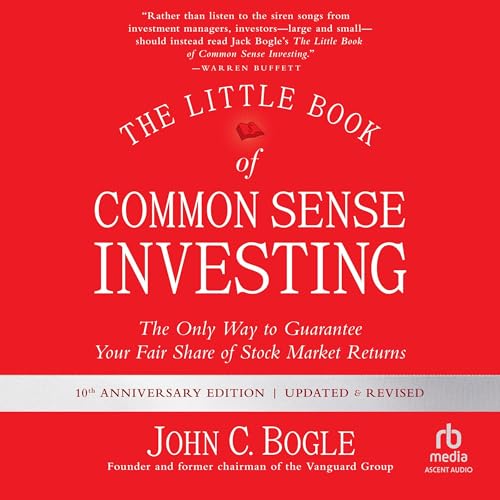
Author: John C. Bogle
Category: Finance
Published: 2007
Pages: 304
Key Takeaways
- The Iron Law: Gross Market Return - Cost of Investing = Net Investor Return. Minimize costs to maximize your share.
- Before costs, investing is zero-sum. After costs, it's a loser's game - aggregate investors must trail the market by their fees.
- The Tyranny of Compounding Costs: A 2% annual fee can consume 65% of your potential wealth over 50 years.
- Over 15-year periods, approximately 90% of actively managed funds fail to beat their benchmark index (SPIVA data).
- Low costs are the ONLY reliable predictor of future relative performance - not past returns, not star ratings.
- Buy the haystack, not the needle: Own a Total Stock Market Index Fund with expense ratio under 0.10%.
- Index funds are self-cleansing: winners automatically grow in weight, losers shrink, no prediction needed.
- Investment success is 20% knowledge and 80% behavior - your emotions are your greatest enemy.
- Dollar-Cost Averaging automates discipline: invest fixed amounts at regular intervals regardless of market level.
- Stay the Course: volatility is not risk, it's the price of admission. Doing nothing is often the highest form of intelligence.
About This Summary
The Common Sense Manifesto: The Definitive Guide to Indexing
By Your Mentor in Common Sense (In the Spirit of John C. Bogle)
Introduction: The Iron Law & The Tyranny of Costs
Investing is not nearly as difficult as it looks. Successful investing involves doing a few things right and avoiding serious mistakes. It is about the triumph of real business returns over the illusion of speculative market returns. It is about the victory of the long term over the short term. But, above all, it is about the Iron Law of the Investment Return.
This guide is not a collection of hot tips. It is a sanctuary of logic in a world of noise. To understand why you must abandon the folly of stock picking, you must first understand the fundamental mathematical reality of the financial markets.
The Gotrocks Parable and the Zero-Sum Game
Imagine, if you will, a wealthy family named the Gotrocks. They own 100% of every stock in the United States. Each year, they reap the rewards of investing: the earnings growth of the corporations and the dividends paid by them. As a group, the Gotrocks family grows wealthy at the pace of corporate America. If American business grows 8%, the Gotrocks family wealth grows 8%. This is the Gross Market Return.
But, eventually, a few Fast-Talking Helpers (financial intermediaries) arrive. They convince some cousins in the Gotrocks family that they can earn more than the others by trading shares. The Helpers charge a fee for this service. Suddenly, the family's total wealth no longer grows at the rate of American business. It grows at the rate of business minus the fees paid to the Helpers.
This brings us to the Iron Law:
$\text{Gross Market Return} - \text{Cost of Investing} = \text{Net Investor Return}$
Before costs, investing is a zero-sum game. For every investor who beats the market by 1%, another investor must trail the market by 1%. The weighted average of all investors is the market.
However, after costs, investing becomes a loser's game. Because of the fees paid to brokers, managers, and the taxman, the aggregate return of all investors must—by mathematical necessity—fall short of the market return.
The Tyranny of Compounding Costs
You have likely heard of the "Magic of Compounding Returns." It is the miracle that turns modest savings into a fortune over time. But there is a dark mirror to this magic: The Tyranny of Compounding Costs.
The financial industry works tirelessly to make fees look small. "It's only 1%," they say. "It's only 2%." Do not be deceived by the smallness of the number. You must not look at the fee as a percentage of your capital; you must look at it as a percentage of your potential return.
If the market returns 7% and you pay a fund manager 2% (in expense ratios, sales loads, and hidden turnover costs), you have not given up 2% of your money. You have given up nearly 30% of your earnings.
Over an investment lifetime of 50 years, the tyranny of compounding costs is catastrophic:
- Scenario A: You invest in a low-cost index fund and capture the market return of 7%. $10,000 grows to roughly $294,000.
- Scenario B: You invest in an active fund charging 2%, netting a 5% return. $10,000 grows to roughly $114,000.
The active fund didn't just cost you a little. The financial system consumed nearly 65% of your potential final wealth. The miracle of compounding returns was overwhelmed by the tyranny of compounding costs. This is not opinion; this is humble arithmetic. The croupiers in the casino of Wall Street always win, but you do not have to play their game.
Pillar I: The Market as a Loser's Game
We must now methodically dismantle the idea that you, or a manager you hire, can consistently beat the market. The industry tells you that you can pick winners. They tell you "You get what you pay for." In every other aspect of life—cars, wine, clothes—paying more often yields higher quality. In investing, you get what you don't pay for.
The Mathematical Certainty of Underperformance
The premise of active management—that smart professionals can use research to select stocks that will outperform the averages—is seductive. It appeals to our ego. However, the data proves it is a lie.
Let us look at the "Bell Curve" of returns. In a given year, some managers will beat the index, and some will lose to it. This distribution suggests skill. But when you extend the timeline to 10, 15, or 20 years, the bell curve shifts drastically to the left (underperformance) due to the weight of fees.
Standard & Poor's publishes the SPIVA (S&P Indices Versus Active) scorecard. Year after year, the data is relentless. Over a 15-year period, approximately 90% of actively managed funds fail to beat their benchmark index.
Think about that failure rate. If a car manufacturer told you that 90% of their cars would fail to reach their destination, would you buy one? Yet, investors pour billions into active funds hoping to find the 10% that survive.
Why is the failure rate so high? It is not because the managers are stupid. It is because they are competing against each other. The market pricing is set by millions of smart, ambitious investors analyzing every piece of data. The price of a stock incorporates all known information instantly. To beat the market, a manager must not only be right; they must be right before everyone else, and they must be right often enough to cover their high fees. The math forbids this from happening for the group as a whole.
The Folly of Prediction and Reversion to the Mean
"But," you say, "I will simply pick the winning managers! I will look at the 5-star funds from Morningstar."
This is the Folly of Prediction. In the mutual fund industry, past performance is not just imperfect; it is often a reverse indicator. This is due to a powerful force called Reversion to the Mean.
In the financial markets, trends do not last forever.
- The Stars: Funds that are at the top of the heap today often attract massive inflows of capital. As the fund gets bigger, it becomes harder to manage. The manager can no longer buy small, nimble companies. They become the market. Their performance reverts to the average.
- The Comets: Other funds take massive risks to achieve high returns. Eventually, the risk manifests, and the returns crash.
Morningstar's own data has shown that 5-star ratings have little predictive power for future outperformance. In fact, low costs are the only reliable predictor of future relative performance. The winners of yesterday are the losers of tomorrow. By chasing past performance, you are skating to where the puck was, not where it is going.
The Illusion of Alpha
Wall Street sells "Alpha" (returns above the benchmark). They sell complexity. They sell hedge funds, private equity, and smart-beta strategies. They wrap simple concepts in jargon to justify exorbitant fees.
This is the Agency Problem. The interests of the fund manager are not aligned with the interests of the client.
- The Manager's Goal: Gather assets (AUM) to maximize management fees.
- The Investor's Goal: Maximize return on capital.
To gather assets, managers must market themselves. They launch incubators, shut down failing funds (survivorship bias), and advertise the few that got lucky. This marketing machine creates an illusion that Alpha is abundant. It is not. Alpha is a zero-sum game, and after fees, it is negative-sum.
Complexity is the enemy. Complex strategies incur higher trading costs, higher taxes, and higher management fees. Simplicity is the ultimate sophistication. The most successful investment strategy is to own American business in its entirety and hold it forever. By doing so, you eliminate the risk of stock picking, you eliminate the risk of manager selection, and you minimize the certainty of excessive costs.
Pillar II: The Index Solution
If active management is a loser's game, what is the winner's game? It is simple: Buy the haystack. Do not look for the needle.
The Bogle Strategy
The strategy I advocate is the ultimate expression of common sense. It involves buying a single fund that owns a tiny slice of every business in the United States (or the world) and holding it forever.
The Instrument: The Total Stock Market Index Fund.
This fund tracks the entire market—large caps, mid-caps, and small caps. It is weighted by market capitalization, meaning you own companies in proportion to their value as determined by the collective wisdom of all market participants.
Why is this the optimal vehicle?
- Self-Cleansing: The index naturally incorporates the winners and discards the losers. When a company fails, its weight in the index drops to zero. When a new company (like Amazon or Google in their early days) grows, its weight increases. You automatically own the winners of the future without having to predict them.
- Broadest Diversification: You eliminate "unsystematic risk" (the risk of a specific company or sector failing). You are left only with "market risk," which is the price you pay for the reward of equity returns.
- Maximum Tax Efficiency: Because the index fund rarely trades (low turnover), it generates very few capital gains taxes compared to active funds.
The Three Non-Negotiable Criteria
When selecting your index fund, you must adhere to three rigid criteria. Do not compromise on these.
1. Low Expense Ratio (TER)
This is the single most important metric. You should aim for an expense ratio of 0.10% or less. There are funds available today at 0.04% or even lower. Every basis point (0.01%) you save is a basis point added to your return. Do not pay 0.50% for an index fund when you can pay 0.05%. Price is the only feature of a fund where you can predict the outcome: lower costs equal higher relative returns.
2. Broad Diversification
Avoid narrow indices. Do not buy a "Tech Sector ETF" or a "Gold Miners ETF." These are bets, not investments. They reintroduce the risks of stock picking. Stick to the Total Stock Market or the S&P 500. These represent the broad economy. If you wish to include the world, a Total International Stock Market fund is a rational addition, but the U.S. market alone is sufficient for many, as American companies derive a massive portion of their revenue globally.
3. Buy-and-Hold Strategy
The fund itself must be passively managed. But you must also be passive. You do not trade the index fund. You buy it, and you hold it. You do not sell when the market drops. You do not sell when the market soars. The index fund is a vehicle for a lifetime, not a trade for a season.
The Cost Matters Hypothesis: The Evidence
Let us strip away the marketing and look at the raw numbers. Below is a comparison of two investors. Both invest $50,000 upfront and add $1,000 monthly for 30 years. The market provides a gross return of 8%.
| Variable | The Index Investor | The Active Investor | |----------|-------------------|---------------------| | Gross Market Return | 8.00% | 8.00% | | Expense Ratio | 0.04% | 1.50% | | Transaction/Turnover Costs | 0.00% (Negligible) | 0.50% | | Total Cost | 0.04% | 2.00% | | Net Return | 7.96% | 6.00% | | Ending Balance (30 Years) | $1,745,200 | $1,176,500 | | Wealth Lost to Fees | $16,000 (approx) | $568,000 (approx) |
Analysis:
Look at that difference. The Active Investor did not just lose "a little bit." They lost over half a million dollars. That is the price of a house. That is a fully funded retirement for a spouse. That is the legacy for your grandchildren.
Where did that half-million dollars go? It went to the manager's BMW. It went to the brokerage's marketing budget. It went to the "croupiers." The Index Investor, by simply refusing to play the game, kept that wealth.
The difference in costs creates a gap that widens exponentially over time. This is not speculation. This is the Cost Matters Hypothesis. Logic suggests, and data confirms, that the surest way to increase your net return is to decrease your cost.
Pillar III: The Investor's Temperament
We have established the math. We have established the vehicle. Now we must address the most fragile component of the investment machine: You.
The greatest enemy of the investor is not the market crash, nor inflation, nor the economy. It is the face staring back at you in the mirror. Investment success is 20% knowledge and 80% behavior.
Patience and Discipline: The Ultimate Challenge
"Stay the Course." These are the three most difficult words in investing.
When the market drops 40%—and it will—your instincts will scream at you to sell. You will feel fear. You will watch the talking heads on television telling you that "this time is different," that "capitalism is ending," that you must "move to cash."
Ignore the noise.
The stock market is a giant distraction to the business of investing. If you own a farm, do you check the price of your land every day? No. You look at the crops. You look at the harvest.
The stock market is the same. The prices on the screen are merely the noise of speculators bidding back and forth. The reality is the dividends and earnings of the businesses you own. Over the long run, stock prices must follow corporate earnings.
To succeed, you must cultivate emotional detachment. You must understand that volatility is not risk. Volatility is the price of admission. If you cannot handle a 20% decline in your portfolio, you are not entitled to the 8% gains of the long term.
The impulse to "do something" is the source of all failure. In investing, doing nothing is often the highest form of intelligence. Benign neglect is a superpower.
Dollar-Cost Averaging: The Automation of Discipline
How do you defeat your emotions? You automate them.
You must adopt the practice of Dollar-Cost Averaging (DCA). This means investing a fixed amount of money at regular intervals (monthly, bi-weekly) regardless of the market's level.
- When the market is high, your fixed amount buys fewer shares.
- When the market crashes, your fixed amount buys more shares.
You become a bargain hunter automatically. You remove the question "Is now a good time to buy?" The answer is always yes, because you are buying for a horizon of decades, not days.
This routine creates a psychological barrier against timing the market. You are not betting on the market; you are accumulating shares. By making the process automatic, you remove the choice, and by removing the choice, you remove the possibility of error.
The Common Sense Checklist: 10 Non-Negotiable Rules
1. REMEMBER THE IRON LAW
Gross Return minus Cost equals Net Return. Always minimize the cost to maximize the share of the return that you keep.
2. BUY THE HAYSTACK
Never try to pick winning stocks. Own the entire market through a low-cost Total Stock Market Index Fund.
3. KEEP COSTS TO THE BONE
Never pay more than 0.10% in expense ratios. Reject sales loads, 12b-1 fees, and high-turnover funds.
4. TIME IS YOUR BEST FRIEND
Compound interest takes time. Start as early as possible. The greatest returns come in the final years of the compounding period.
5. IMPULSE IS YOUR ENEMY
Eliminate emotion from your financial life. Never make an investment decision based on fear, greed, or the headlines of the day.
6. AUTOMATE YOUR VIRTUE
Use Dollar-Cost Averaging. Invest consistently every month. Make it a habit as routine as paying your mortgage.
7. TUNE OUT THE NOISE
Stop watching financial news. Stop looking at your account balance daily. The daily fluctuations are meaningless noise. Focus on the long-term signal.
8. STAY THE COURSE
No matter what happens in the markets—inflation, recession, war, or boom—stick to your asset allocation. Do not try to time the market. You will be wrong.
9. BEWARE THE SALESMAN
If someone is trying to sell you a complex financial product, run. Good investing is bought, not sold. Complexity is a tool to extract fees from your pocket.
10. KEEP IT SIMPLE
Simplicity is the master key to financial success. A simple portfolio of index funds, held for a lifetime, will outperform almost every sophisticated strategy ever devised.
Implementation Addendum: Understanding the Vehicles
The Total U.S. Stock Market Index
- What it is: A portfolio comprising nearly 100% of the investable U.S. equity market.
- Coverage: Large Cap (e.g., Apple, Microsoft), Mid Cap, and Small Cap.
- Goal: To track the CRSP US Total Market Index or similar.
- Why: It provides the ultimate diversification within the U.S. economy.
The Total International Stock Market Index
- What it is: A portfolio covering the developed and emerging markets outside the U.S.
- Why: To hedge against the decline of the dollar and participate in global growth.
The Total Bond Market Index
- What it is: A broad exposure to U.S. investment-grade bonds (Government and Corporate).
- Why: To provide ballast. Bonds reduce the volatility of your portfolio. As you age, you increase your bond allocation to preserve capital, not necessarily to grow it.
Asset Allocation: The Only Real Decision
Your only true decision is the split between Stocks (Growth) and Bonds (Safety).
- Young/Aggressive: 90% Stock Index / 10% Bond Index.
- Middle Age: 70% Stock Index / 30% Bond Index.
- Retirement: 50% Stock Index / 50% Bond Index.
Set this ratio. Rebalance once a year to maintain it. Do nothing else.
Final Thoughts
The path I have laid out for you is not exciting. It will not make you rich overnight. It will not give you bragging rights at a cocktail party about the "killer stock" you found.
But it is the path of mathematical truth. It is the path of dignity. It guarantees that you will get your fair share of the wealth created by our great capitalist system.
Don't let the "Helpers" steal your financial future. Own the market. Keep your costs low. Stay the course.
That, my friends, is common sense.
Stay the Course.
— The Ghost of Common Sense