Finance summary
The Intelligent Investor Summary: Key Ideas and Takeaways
Read a practical summary of The Intelligent Investor by Benjamin Graham, including key takeaways, lessons, and useful ideas.
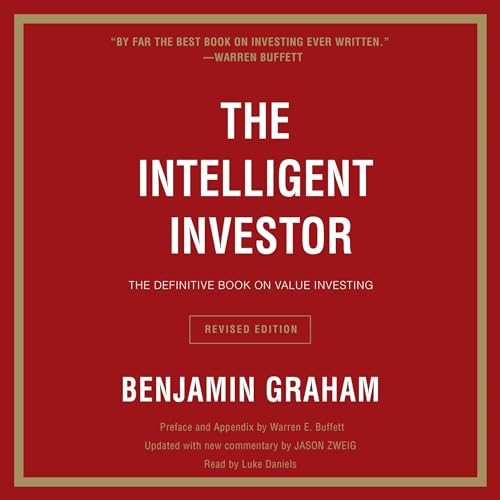
Author: Benjamin Graham
Category: Finance
Published: 1949
Pages: 640
Key Takeaways
- Investing vs. Speculating: Investment requires thorough analysis, promises safety of principal, and seeks adequate returns
- Mr. Market is your servant, not your instructor - exploit his emotional mood swings for profit
- The Margin of Safety is the cornerstone principle - buy securities at significant discount to intrinsic value
- Choose your investor type: Defensive (simple, diversified, minimal effort) or Enterprising (active analysis, higher effort)
- Defensive investors should maintain a 50/50 stock-bond split with broad diversification and dollar-cost averaging
- Focus on large, conservative companies with long histories of profitability and dividend payments
- Enterprising investors can pursue bargain issues, unpopular large companies, and special situations
- Analyze average earnings over 7-10 years, not single-year results, to assess true earning power
- Strong balance sheets with low debt and healthy current ratios are non-negotiable
- Market fluctuations are opportunities - bear markets offer buying chances, bull markets signal danger
- Bonds serve as 'dry powder' to fund stock purchases during market crashes
- Rebalancing forces you to systematically sell high and buy low
- Your chief enemy is yourself - master your emotions to make rational decisions
- Don't try to predict the future - focus on sound analysis and adequate margin of safety
- Value comes from business fundamentals, not price charts or market forecasts
- Graham's principles remain timeless because human nature (greed and fear) never changes
- The goal is not to get rich quickly, but to invest sanely and avoid permanent capital loss
About This Summary
Part 1: Introduction - The Cornerstone of Value Investing To approach The Intelligent Investor is to approach the very bedrock of a sound investment philosophy. It is a book born from the crucible of the Great Depression, a period that taught Graham the brutal difference between market speculation and business-like investing. His experience, both professional and personal, forged a deep-seated belief that financial success stems not from brilliance or esoteric knowledge, but from a sound intellectual framework and unwavering emotional discipline.
The book's title is deliberate. Graham is not writing for the "brilliant" or the "clairvoyant" investor, but for the "intelligent" one. For him, intelligence in this context had little to do with IQ or academic pedigree. It was a matter of character. An intelligent investor is patient, disciplined, eager to learn, and, above all, capable of harnessing their emotions and thinking for themselves.
The central promise of Graham's work is elegantly simple: to arm the reader with the principles needed to avoid the speculative manias that periodically seize Wall Street and to pursue a safe and sane investment policy. He sought to create a complete system of thought that would protect investors from the market's volatility and, more critically, from their own worst impulses. He famously wrote, "The investor's chief problem—and even his worst enemy—is likely to be himself." This single sentence captures the essence of the book. It is less a manual on analyzing securities and more a treatise on mastering one's own psychology to make rational decisions when everyone else is losing their heads. For this reason, legendary investor Warren Buffett, Graham's most famous student, has called it "by far the best book on investing ever written."
Part 2: The Foundational Philosophy - The Three Pillars of Intelligent Investing Graham's entire philosophy can be distilled into three powerful, interconnected concepts. They are not merely suggestions but the unshakeable pillars upon which a lifetime of successful investing can be built. Understanding them is not optional; it is the prerequisite for becoming a truly intelligent investor.
- Investing vs. Speculating: A Crucial Distinction
Before one can even begin, Graham demands a clear understanding of what one is actually doing with their capital. He draws a bright, unambiguous line between two fundamentally different activities: investing and speculating. His definition is precise and has stood the test of time:
"An investment operation is one which, upon thorough analysis, promises safety of principal and an adequate return. Operations not meeting these requirements are speculative."
Let's break down the three key components of this definition:
Upon Thorough Analysis: An investment is not based on a whim, a hot tip, or a market forecast. It is grounded in a deep, fact-based, and business-like examination of the underlying company. The investor studies financial statements, assesses management, evaluates the industry, and calculates a conservative estimate of the business's worth. A speculator, by contrast, focuses primarily on the stock's price chart, betting on short-term movements without a deep understanding of the business itself.
Promises Safety of Principal: This is not a guarantee against any loss. It is a calculated assurance against permanent loss of capital over a reasonable holding period. The investor's analysis must lead them to the rational conclusion that, even if things go moderately wrong, their initial capital is not likely to be permanently impaired. The speculator, chasing quick profits, often takes on risks where the permanent loss of capital is a very real and significant possibility.
An Adequate Return: Graham was a realist. He did not promise market-beating returns. The goal is a "satisfactory" or "adequate" return—one that is reasonable for the risk taken and meets the investor's financial goals. The investor seeks a solid, business-like profit. The speculator dreams of lottery-ticket payoffs, often confusing hope with strategy.
In today's hyper-fast markets, this distinction is more critical than ever. The rise of day trading, meme stocks, and volatile cryptocurrencies has blurred the line, making speculation feel like a legitimate form of investing. Graham's stern definition serves as a vital anchor. If you are buying an asset simply because its price has been going up, with the hope of selling it to someone else at a higher price without regard for its underlying value, you are not investing. You are speculating. The intelligent investor knows the difference and acts accordingly.
- The Allegory of "Mr. Market"
This is perhaps Graham's most brilliant and enduring contribution to investment psychology. To help investors detach their emotions from the market's chaotic fluctuations, he created a powerful allegory: the parable of Mr. Market.
Imagine that you own a share in a private business. You have a partner, Mr. Market, who is a classic manic-depressive. Every single day, without fail, he shows up at your door and offers to either buy your share or sell you his share at a specific price.
On some days, Mr. Market is euphoric. He sees nothing but blue skies ahead for the business and the economy. On these days, he quotes a ridiculously high price for your share.
On other days, he is utterly despondent. He is consumed by pessimism, convinced the business is doomed and the world is ending. On these days, he quotes a pathetically low price.
Mr. Market has one other crucial characteristic: he doesn't mind being ignored. If you don't like his price today, he'll be back tomorrow with a new one.
The lesson of this allegory is profound. The intelligent investor understands that Mr. Market is there to serve you, not to instruct you. His daily quotes are not a measure of the business's true value; they are a reflection of his emotional state. You should never let his mood dictate your own. Instead, you should exploit it.
When he shows up in a panic, offering you shares for far less than they are worth, you should happily buy from him.
When he arrives in a state of giddy optimism, offering to buy your shares at an absurdly high price, you should consider selling to him.
And on all the other days, when his price makes no sense, you should simply ignore him and focus on running the business.
This simple metaphor completely reframes the investor's relationship with the market. It transforms market volatility from a source of fear and anxiety into a source of opportunity. A stock market crash is not a disaster; it is Mr. Market having a breakdown and offering you bargains. A roaring bull market is not a time for celebration; it is Mr. Market getting dangerously euphoric, a time for caution. The intelligent investor never asks the market for its opinion; they form their own and wait for the market to offer a price that suits their purpose.
- The Central Concept of "Margin of Safety"
If investing is distinct from speculating, and Mr. Market is a tool to be exploited, then the Margin of Safety is the principle that makes it all work. It is the bedrock of Graham's entire approach—the three most important words in investing.
The concept is beautifully simple: purchase a security at a significant discount to its underlying intrinsic value.
Intrinsic value is an estimate of a business's real worth, based on its assets, earnings power, and future prospects. It is independent of the stock's current market price. The margin of safety is the cushion, or the gap, between that intrinsic value and the price you pay.
Graham illustrated this with a powerful analogy. If you are building a bridge, you don't design it to hold the exact weight of the trucks that will cross it. If you expect 10,000-pound trucks, you build a bridge that can hold 30,000 pounds. That extra 20,000 pounds of capacity is the margin of safety. It protects you from unexpected events: a heavier-than-expected truck, a flaw in your calculations, or a structural weakness that develops over time.
In investing, the margin of safety serves the same purpose. Your calculation of a company's intrinsic value will never be perfect. The future is inherently uncertain. A margin of safety protects you from:
Errors in Judgment: Your analysis might be flawed.
Bad Luck: An unexpected recession or a new competitor could harm the business.
Market Volatility: The irrational whims of Mr. Market can drive prices down even further.
By buying a business you believe is worth $1 per share for only 60 cents, you have a 40-cent margin of safety. This buffer not only provides downside protection but also offers upside potential. The price is more likely to eventually rise toward its intrinsic value, delivering a handsome profit. For Graham, the wider this margin, the safer and more attractive the investment. It is the ultimate defense against the unknowable future.
Part 3: The Two Investor Archetypes - Defensive and Enterprising Graham understood that not everyone has the same amount of time, skill, or interest to dedicate to investing. He therefore divided the world of intelligent investors into two distinct categories, each with its own appropriate strategy and set of expectations. He was adamant that an investor must decide which path they belong to and stick to it, as the greatest danger lay in attempting the strategies of one without possessing the requisite temperament and dedication.
The Defensive Investor The Defensive Investor is one whose primary goal is the avoidance of serious mistakes or losses. They seek freedom from effort, annoyance, and the need for frequent decision-making. Their aim is not to beat the market, but to achieve average, satisfactory returns with minimal fuss. This path is suitable for the vast majority of people.
Graham's prescription for the defensive investor is a masterpiece of simplicity and discipline:
A Balanced Portfolio: The cornerstone of the defensive strategy is a simple, consistent split between high-grade bonds and a diversified basket of common stocks. Graham famously suggested a permanent 50/50 split as the default. This allocation acts as a powerful stabilizer. When stocks fall, the bonds hold their value, providing a cushion. When stocks soar, the bond component tames the portfolio's overall volatility. He did allow for some tactical adjustment—never having less than 25% or more than 75% in stocks—based on the general level of the market, but the core idea is unwavering balance.
Broad Diversification: The defensive investor should not try to pick individual winners. Instead, they should own a wide range of stocks to minimize the impact of any single company failing. Graham suggested owning between 10 and 30 different stocks. In the modern era, this is easily and cheaply achieved through low-cost index funds, a tool Graham would have surely championed.
Focus on Large, Conservative Companies: The stocks selected should be from large, prominent companies with a long history of continuous profitability and dividend payments. These are financially sound businesses that have proven their resilience across various economic cycles. The goal is to own sturdy, reliable enterprises, not speculative high-flyers.
Systematic Investing (Dollar-Cost Averaging): To remove emotion and timing from the equation, the defensive investor should invest a fixed amount of money at regular intervals (e.g., monthly). This practice, known as dollar-cost averaging, automatically leads to buying more shares when prices are low and fewer shares when prices are high. It is a simple, powerful discipline.
The defensive approach is a "set it and forget it" strategy built on rules and automation. Its beauty lies in its simplicity, which protects the investor from their own worst enemy: themselves.
The Enterprising (or Aggressive) Investor The Enterprising Investor is a rarer breed. This is an individual who is willing and able to devote significant time, effort, and intellectual energy to security analysis in the hope of achieving better-than-average returns. Graham issues stern warnings throughout the book that this path is far more demanding and psychologically taxing. It requires a level of business acumen and emotional control that few possess.
For those who fit the description, Graham outlined several specific, more complex strategies:
Buying Unpopular Large Companies: This involves identifying large, well-established companies that are temporarily out of favor with the market due to disappointing recent results or negative sentiment. The enterprising investor conducts a thorough analysis to determine if the company's long-term prospects remain intact, allowing them to buy at a price that offers a significant margin of safety.
Investing in "Bargain Issues": This is the classic "Graham-style" investment. He looked for companies trading at a deep discount to their intrinsic value, often focusing on tangible assets. His most famous technique was finding "net-nets"—stocks trading for less than their net current asset value (current assets minus all liabilities). In this scenario, the investor is essentially buying the company's liquid assets for less than they are worth and getting the entire operating business (factories, brands, etc.) for free.
Analyzing Special Situations ("Workouts"): This highly specialized field involves investing in securities tied to corporate events like mergers, acquisitions, spin-offs, or reorganizations. The outcome of these investments depends on the successful completion of the corporate action, not on the general direction of the stock market. This requires a deep, almost legalistic understanding of the transactions involved.
Graham was clear: the activities of the enterprising investor must be "thoroughly business-like." They are not speculating on trends or narratives. They are engaging in deep, quantitative analysis to uncover specific situations where price and value have diverged significantly.
Part 4: Graham's Toolkit - The Practice of Security Analysis While philosophy is the foundation, Graham also provided a practical toolkit for implementing his ideas. His approach to security analysis was quantitative, conservative, and focused relentlessly on what could be known and measured, rather than what had to be forecasted.
Analyzing a Company Graham believed that a stock was not a squiggly line on a chart but a piece of ownership in a real business. Therefore, analyzing a stock meant analyzing the business itself, with a heavy emphasis on its financial statements. His criteria were designed to identify stable, predictable, and conservatively financed enterprises.
Earnings Power: He was skeptical of a single year's earnings. Instead, he advocated for analyzing average earnings over a multi-year period (e.g., seven to ten years) to smooth out the effects of the business cycle and get a more reliable picture of a company's true earning capacity.
Financial Strength: A strong balance sheet was non-negotiable. He looked for companies with low debt levels, particularly relative to their equity, and a healthy current ratio (current assets divided by current liabilities, ideally 2-to-1 or better), indicating the company could easily meet its short-term obligations.
History of Performance: He placed great weight on a long, uninterrupted record of dividend payments and a history of consistent profitability. This was evidence of a durable business model and a management team that was friendly to shareholders.
Valuation: The final step was to ensure the price was right. He used simple but effective valuation metrics, seeking moderate Price-to-Earnings (P/E) ratios (e.g., no more than 15-20x average earnings) and moderate Price-to-Book (P/B) ratios. The goal was never to buy the fastest-growing company, but to buy a solid company at a demonstrably cheap price.
Portfolio Policy and Attitude Graham's toolkit extended beyond individual security selection to encompass the investor's overall policy and mindset.
Diversification and Rebalancing: Diversification was essential to mitigate the risk of being wrong about a single company. Rebalancing—periodically selling assets that have grown and buying those that have shrunk to maintain a target allocation (like 50/50)—was a crucial discipline. It forces the investor to systematically sell high and buy low, turning market volatility into an advantage.
The Role of Bonds: Bonds were not just a "safe" asset; they were a strategic tool. They provided stability during stock market declines and, more importantly, acted as "dry powder." When the stock market crashed and bargains were plentiful, the investor could sell their stable bonds to fund the purchase of cheap stocks.
Market Fluctuations as Opportunities: This directly connects back to the Mr. Market allegory. The intelligent investor's attitude toward market fluctuations is the polar opposite of the speculator's. A bear market is not a crisis; it is a buying opportunity. It is the time when Mr. Market is panicked, and the margin of safety is at its widest. Conversely, a roaring bull market is a time of maximum danger, when margins of safety shrink and the risk of permanent loss is highest. The intelligent investor welcomes volatility, for it is what creates the disconnect between price and value that their entire strategy depends on.
Part 5: The Enduring Legacy and Modern Relevance It is reasonable to ask why a book written in the Truman administration remains the definitive text on investing in the 21st century—a world of algorithms, cryptocurrencies, and instantaneous global information. The answer is simple: markets change, technology evolves, but human nature is constant. The twin emotions of greed and fear that drove markets in 1949 are the very same emotions that drive them today. Graham's work is not about a specific market environment; it is a timeless operating system for the human mind.
The book's influence is immeasurable, most famously shaping the career of Warren Buffett. Buffett encountered The Intelligent Investor as a young man and described it as a life-changing event, like "seeing the light." He later studied under Graham at Columbia University and worked for his firm, Graham-Newman. While Buffett would later evolve Graham's ideas—shifting from buying "fair companies at wonderful prices" (Graham's bargain issues) to buying "wonderful companies at fair prices" (focusing more on quality and long-term growth)—the core DNA of his philosophy remains pure Graham. The concepts of the market as your servant (Mr. Market) and the absolute necessity of a margin of safety are the bedrock upon which the entire Berkshire Hathaway empire was built.
Beyond Buffett, Graham's principles gave birth to the entire field of value investing, influencing generations of successful investors like Seth Klarman, Irving Kahn, and Walter Schloss.
More importantly, Graham's philosophy acts as the perfect antidote to modern speculative manias.
During the dot-com bubble of the late 1990s, investors abandoned Graham's principles, paying infinite prices for companies with no earnings and no assets, based on a narrative of a "new era." The subsequent crash was a brutal reminder of the importance of valuation and margin of safety.
In the lead-up to the 2008 financial crisis, complex derivatives were bought and sold with no margin of safety, leading to a near-collapse of the global financial system.
In the recent meme stock and crypto frenzies, legions of new speculators have chased prices skyward with little to no analysis of underlying value, often with predictable and painful results.
In an age of information overload, where investors are bombarded with 24/7 financial news, social media hype, and endless expert predictions, Graham's call to ignore the noise and focus on the cold, hard facts of the business is more valuable than ever. His framework is a filter for nonsense, a shield against the siren song of speculation.
Part 6: Conclusion - The Timeless Wisdom of Benjamin Graham The Intelligent Investor is not a book to be read once, but a manual to be studied and returned to throughout one's life. Its most critical message is that successful investing has surprisingly little to do with IQ, complex algorithms, or predicting the future. It is a matter of temperament. The traits of an intelligent investor are patience, discipline, independence of thought, and emotional control.
The book's true genius lies in its profound understanding of human psychology. Graham provides a complete intellectual framework that, if followed, makes it almost impossible for your emotions to lead you astray. By distinguishing investing from speculating, you know what game you are playing. By personifying the market as the manic Mr. Market, you are immunized against its mood swings. And by demanding a margin of safety in every transaction, you build a fortress around your capital that can withstand the inevitable storms of error, luck, and volatility.
Ultimately, The Intelligent Investor does not offer a map showing where financial treasure is buried. It provides something far more valuable: a compass. It is a tool for navigation, a set of immutable principles that allows you to chart a safe and successful course through the treacherous and unpredictable waters of the financial markets. Its ultimate promise is not to make you rich, but to make you sane. And in the world of finance, sanity is the surest path to lasting success.