Trading summary
The PlayBook Summary: Key Ideas and Takeaways
Read a practical summary of The PlayBook by Mike Bellafiore, including key takeaways, lessons, and useful ideas.
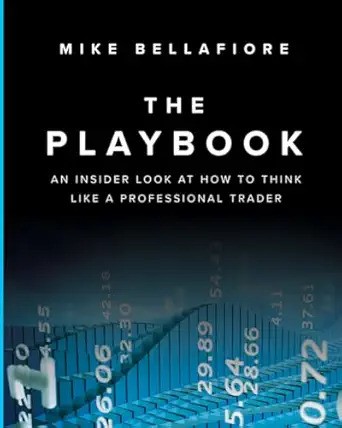
Author: Mike Bellafiore
Category: Trading
Published: 2014
Pages: 272
Key Takeaways
- **Your A-Game is replicable:** Document the exact conditions that created your best performance to recreate them systematically.
- **The Pareto Principle governs trading:** 20% of your setups generate 80% of your profits. Focus only on your highest-probability plays.
- **Adopt If-Then Boolean Logic:** Transform ambiguous observations into binary decisions to eliminate hesitation and decision fatigue.
- **Every Playbook entry needs 4 components:** Entry Protocol (trigger), Invalidation Point (stop-loss), Profit Target (exit), and Risk Management (position sizing).
- **Build Chart Memory:** Include annotated visual charts in your Playbook to train your brain to recognize patterns subconsciously.
- **Manage the Trinity of Errors:** Fear, Greed, and Boredom cause deviation from your plan. Use specific techniques to counter each.
- **Process Over Outcome:** A losing trade executed correctly is a 'good trade.' A winning trade outside your Playbook is a 'bad trade.'
- **The Daily Scorecard:** Grade yourself on Playbook adherence, not P&L. Did you wait for the trigger? Did you respect the stop? Did you size correctly?
- **Your Playbook is a living document:** Cut strategies that lose for 3 consecutive months. Scale winners that hit 70%+ win rate.
- **The 10 Non-Negotiable Rules:** No setup = no trade. Never enter without a stop-loss. Hope is not a strategy. Defense first, offense second.
About This Summary
The Architect of Alpha: A Strategic Blueprint for The Playbook
Introduction: The Power of Systematization
The Gap Between Potential and Performance
In the arena of high-stakes performance—whether in financial markets, elite athletics, or corporate strategy—there exists a graveyard filled with talented individuals who failed to sustain success. These individuals possessed intellect, intuition, and drive. What they lacked was not skill, but a mechanism to contain and channel that skill. They lacked a Playbook.
The difference between a frantic amateur and a disciplined professional is the presence of an externalized system of logic. The amateur relies on "gut feel," reacting emotionally to the shifting tides of the environment. They are susceptible to the chemical storms of the brain: dopamine loops, fear responses, and cognitive fatigue. The professional, conversely, operates as an executioner of a pre-defined plan. They do not think in the heat of battle; they execute what they have already thought out in the calm of preparation.
The "A-Game" Standard
Every high performer knows the feeling of their "A-Game." It is that state of flow where the market or the environment seems to slow down, decisions are effortless, and outcomes align with intentions. Most people view this state as fleeting—a stroke of luck or a "good day."
The philosophy of The Playbook rejects this passivity. It asserts that your "A-Game" is not a mystical state; it is a replicable set of variables. It is a specific data set comprising market conditions, internal psychology, and technical setups. If you can document the exact conditions that created your A-Game, you can recreate them.
Documentation is the Anchor
Why do we document? We do not document to create a history lesson. We document to create a forward-looking algorithm. The human memory is flawed; it engages in revisionist history, smoothing over mistakes and inflating successes. A written Playbook is an objective source of truth. It acts as the ultimate authority when your emotions try to hijack your decision-making process.
This Masterclass is not about "working harder." It is about working rigidly. It is about building a distinct, proprietary business plan for every single action you take. It is about moving from being a reactive participant to a proactive architect of your own edge.
Pillar I: Identification & The Edge
Defining the Probability Vector
The first step in building a Playbook is admitting that you cannot be good at everything. In fact, attempting to capture every opportunity is the fastest route to ruin. The foundation of high performance is Selectivity. You must identify the specific scenarios where the odds are mathematically stacked in your favor. This is known as your "Edge."
The Filter: The Pareto Principle in Action
The Pareto Principle (the 80/20 Rule) is the governing law of The Playbook. In any performance domain, 20% of your setups will generate 80% of your profits. The vast majority of your actions are likely noise—breakeven trades, wasted energy, or marginal wins that drain your cognitive capital.
To build your Playbook, you must perform a forensic audit of your past performance. You are looking for the "Fat Pitch."
- Identify the Outliers: Look at your top 10 most successful executions of the last year.
- Find the Common Denominator: What did they share? Was it a specific time of day? A specific asset class? A specific catalyst (e.g., earnings release, geopolitical shift)?
- Discard the Rest: The goal of The Playbook is to authorize you to ignore 90% of the market information. If a setup does not match the criteria of your top 20%, it is not a Playbook trade. It is gambling.
Scenario Mapping: The Anatomy of a Setup
Once you have identified a high-probability setup, you must map it. A setup is not a feeling; it is a convergence of verifiable facts. You must break down the setup into three distinct layers:
1. The Big Picture (The Context)
Context is king. A technical pattern means nothing in a vacuum. You must define the environment in which the setup lives.
- Trend: Is the broader market bullish, bearish, or range-bound?
- Sector Flow: Is money flowing into or out of this specific sector?
- Timeframe: Is this a multi-day swing or a micro-scalp?
2. The Catalyst (The Why)
Why is this happening now? A Playbook trade requires urgency.
- News Catalyst: Earnings beat, FDA approval, leadership change.
- Technical Catalyst: Breakout from a multi-year consolidation, failure of a key support level.
- Proprietary Criteria: "I only trade this setup when Relative Volume is > 300%."
3. The Intraday Price Action (The Trigger)
This is the microscopic view.
- Consolidation: Tightening of price action indicating stored energy.
- The Tape: Reading the order flow. Is the bid holding up against selling pressure?
The "If-Then" Mentality: Algorithmizing the Brain
The ultimate goal of Pillar I is to translate ambiguous observation into binary action. Ambiguity is the enemy of execution. Ambiguity breeds hesitation, and hesitation kills momentum.
You must adopt Boolean Logic for your decision-making. Your brain must function like a computer script:
IF [Condition A: Gap up > 2%] AND [Condition B: Hold above VWAP for 30 mins] AND [Condition C: Volume > 1M shares]... THEN [Action: Enter Long]. ELSE [Action: Do Nothing].
This "If-Then" framework removes the burden of choice in the moment. You are not deciding whether to act; you are simply recognizing that a pre-decided condition has been met. This dramatically reduces "Decision Fatigue," preserving your mental energy for managing the trade rather than agonizing over the entry.
The Edge Definition Statement
For every Playbook entry, you must be able to complete this sentence:
"I have an edge in this specific scenario because historically, when X, Y, and Z occur simultaneously, the asset moves in direction A with a probability of B%."
If you cannot articulate this, you do not have an edge; you have a guess.
Pillar II: Documentation & The Template
The Rigor of the Written Word
Pillar II is the engine room of this strategy. This is where you transform the concepts from Pillar I into a tangible, repeatable manual. A Playbook is not a mental checklist. It is a physical or digital document (a slide deck, a PDF, a binder) that contains your proprietary business logic.
Each entry in your Playbook represents a distinct "Play." Just as an NFL coach has a specific play for "3rd and Long," you must have a specific play for "Earnings Gap Up" or "Mean Reversion Short."
The Rule Set: Non-Negotiable Parameters
For every single Playbook entry, you must define the Rules of Engagement. These rules are not suggestions; they are mandates.
1. The Entry Protocol (The Trigger)
You must define exactly where you get in. Vague entries lead to vague results.
- Bad: "Buy when it looks strong."
- Good: "Buy on a break of the opening 15-minute high, provided the previous candle closed in the upper quartile."
2. The Invalidation Point (The Stop-Loss)
Before you enter, you must know where you are wrong. This is the most critical component of risk management. The stop-loss is not determined by how much money you want to lose; it is determined by the technical structure of the chart.
- The Technical Stop: "If price drops below the consolidation low of $150.50, the thesis is flawed, and I must exit immediately."
3. The Profit Target (The Exit)
Greed causes traders to hold too long; fear causes them to sell too soon. You need a mechanical target.
- The Technical Target: "I will sell 50% of the position at the pre-market high and the remaining 50% at a 2.0 Fibonacci extension."
4. Risk Management (Position Sizing)
Not all setups are created equal. Your Playbook must dictate how heavy you swing.
- A+ Setup: Max size (e.g., 2% of capital risk).
- B Setup: Standard size (e.g., 1% of capital risk).
- C Setup: Starter size (e.g., 0.5% of capital risk).
The Visual Component: Chart Memory
Humans are visual creatures. We recognize patterns faster than we process text. Every Playbook entry must include Annotated Charts.
- The Clean Chart: Show the setup as it looked before execution.
- The Annotated Chart: Mark the Entry, the Stop, the Target, and crucial indicators (VWAP, Moving Averages).
- The Context Chart: A higher timeframe view (Daily/Weekly) to show where this intraday move fits in the larger trend.
You are building a database of "Chart Memory." By reviewing these visuals daily, you are training your Reticular Activating System (RAS) to subconsciously scan the market for these specific patterns.
The Psychological Anchor: The Mantra
Every trade carries an emotional weight. Your Playbook must include a script to counter the specific emotional vulnerability of that trade.
For a Trend Following Trade: The fear is giving back profits during a pullback.
- Mantra: "I am not paid to be right every minute; I am paid to ride the trend. I will hold until the trend bends."
For a Counter-Trend Trade: The fear is catching a falling knife.
- Mantra: "I am a sniper. I wait for the confirmable reversal. If it does not bounce, I do not touch."
The Template: Standardized Playbook Entry
| Component | Description & Rules | |-----------|---------------------| | Strategy Name | The "Morning Drive" Breakout | | Setup Category | Momentum / Trend Continuation | | Why This Works (Logic) | Captures institutional order flow entering a stock with a fresh news catalyst, forcing shorts to cover. | | The Catalyst (Context) | 1. Stock must have "Fresh News" (Earnings beat, Guidance raise). 2. Relative Volume (RVOL) must be > 200% pre-market. 3. Stock is gapping up > 3% but < 10%. | | Entry Trigger | 1. Wait for the first 5-minute candle to close. 2. Entry is a buy stop 5 cents above the High of the Day (HOD) established in the first 5-15 mins. 3. Volume on the breakout candle must surge. | | Stop Loss (Invalidation) | Hard stop below the VWAP (Volume Weighted Average Price) or the low of the breakout candle. If it falls back into the range, the momentum is fake. | | Profit Targets | Target 1: Sell 1/3 at 1:1 Risk/Reward. Target 2: Sell 1/3 at High of Day retest or psychological whole number. Target 3: Trailing stop on the 9 EMA (Exponential Moving Average) until trend break. | | Risk Sizing | A-Grade Setup. Risk 1.5% of total Account Equity. | | Time Constraint | This trade must be executed between 9:30 AM and 10:30 AM. If the setup occurs after 11:00 AM, ignore it (momentum fades). | | Psychological Note | "Hesitation is the enemy. The odds are in my favor. If the trigger hits, I click. If I stop out, it was a good trade with a bad result." |
Pillar III: Execution & Discipline
The Void Between Plan and Action
You have identified the edge. You have documented the plan. Now, you face the hardest challenge: Execution. This is the physical act of clicking the mouse, making the call, or signing the contract.
The gap between knowing what to do and actually doing it is where performance dies. This section details how to bridge that gap.
Minimizing Deviation: Managing the Trinity of Errors
Traders and performers deviate from their Playbook due to three primary emotional drivers: Fear, Greed, and Boredom.
1. Managing Fear (The hesitation to pull the trigger)
Fear comes from a lack of trust in the numbers. You solve this through "Sizing Down to Sleeping Levels."
- Technique: If you are afraid to enter a Playbook trade, your position size is too big. Reduce the size until the emotional attachment to the money vanishes, leaving only the execution of the process.
- Technique: Visualization. Before the market opens, visualize the setup occurring. Visualize yourself executing without hesitation. Visualize taking a loss and remaining calm.
2. Managing Greed (Holding too long or ignoring targets)
Greed is the belief that the market owes you more.
- Technique: The "Automated Take-Profit." Place limit orders immediately after entering the trade. Do not rely on your willpower to sell when the candle is green and euphoria is high. Let the machine take the profit for you.
3. Managing Boredom (Overtrading)
This is the silent killer. When the market is slow, the brain craves dopamine. You invent trades that are not in the Playbook.
- Technique: The "Hands-Off" Rule. If there is no Playbook setup, physically remove your hands from the keyboard. Walk away. Define your "No-Trade Zones" (e.g., 12:00 PM to 1:30 PM lunchtime lull).
Process Over Outcome: The Scorecard
Society judges you on your results (Money). You must judge yourself on your Process (Compliance).
- If you take a trade that is not in your Playbook and you make money, you should feel bad. You have reinforced a bad habit. You were "rewarded" for reckless behavior.
- If you take a trade that is in your Playbook and you lose money, you should feel proud. You executed your business plan. The loss is simply the cost of doing business—an operating expense.
The Daily Scorecard:
At the end of every session, grade yourself on a scale of 1-10, not on P&L, but on Playbook Adherence.
- Did I wait for the trigger?
- Did I respect the stop loss?
- Did I size correctly?
If the answer is yes, you won the day, regardless of the bank balance.
Pillar IV: Review & Refinement
The Feedback Loop
A Playbook is a living document. The market changes, volatility shifts, and algorithms evolve. If your Playbook is static, it will eventually become obsolete. You must engage in rigorous Post-Action Review.
Journaling: The Data Warehouse
Journaling is not writing "Dear Diary, I felt sad today." Journaling is data collection.
For every trade, record:
- The Setup Name: (From your Playbook).
- The Result: (Win/Loss/Breakeven).
- The Execution Grade: (Did you follow the rules?).
- Notes: What subtle nuance did you miss? Was the volume lighter than usual?
Iterative Refinement
Every month, review your database.
- Cut the Losers: If a specific Playbook strategy has lost money for 3 consecutive months, it is "On Probation." If it fails for a 4th, it is removed from the Playbook.
- Scale the Winners: If a strategy is winning 70% of the time, increase the standard risk size for that specific setup.
Errors as Data Points
Do not hide your errors. Highlight them. A loss is a tuition payment to the market. If you lose the money but don't learn the lesson (by reviewing the trade), you have wasted the tuition.
The Master Checklist: 10 Non-Negotiable Rules
To build and execute your Playbook, you must commit to these ten commandments. Print them out. Post them on your wall.
- The "No Setup, No Trade" Mandate: If the market condition does not match a documented Playbook page, I do not act. I am a sniper, not a machine gunner.
- The One-Trade Focus: I will not focus on the money; I will focus on executing one good trade at a time. The money is a byproduct of the execution.
- The Stop-Loss Contract: I will never enter a trade without a pre-defined, hard stop-loss. I will never move my stop to accommodate a losing position.
- The A-Game Standard: I will assess my physical and mental state before the session. If I am sick, distracted, or emotionally compromised, I will reduce my size or not trade at all.
- The Visual Confirmation: I will screenshot every trade I take. I will review these screenshots to imprint the pattern into my subconscious.
- The Size Rule: I will earn the right to trade bigger. I will only increase my position size after a period of documented consistency, not after a lucky win.
- The Review Ritual: I will not leave my desk until I have journaled my trades for the day. The day is not over when the market closes; it is over when the review is done.
- The Protection of Capital: My first job is not to make money; it is to protect what I have. Defense first, Offense second.
- The Ban on Hope: "Hope" is not a strategy. If I find myself "hoping" a position turns around, I must exit immediately.
- The Evolution Clause: I will remain a student. I will continuously study my winners to find new setups and study my losers to plug leaks. My Playbook will improve every single month.
Final Strategic Note
The Playbook is the ultimate tool for accountability. It removes the excuses. When you have a written plan, you can no longer say, "I didn't know." You can only say, "I didn't execute."
This level of honesty is painful, but it is the fire in which elite performers are forged.
Build your Playbook. Trust your Rules. Execute with Violence.
End of Masterclass.