Self-Help summary
The Miracle Morning Summary: Key Ideas and Takeaways
Read a practical summary of The Miracle Morning by Hal Elrod, including key takeaways, lessons, and useful ideas.
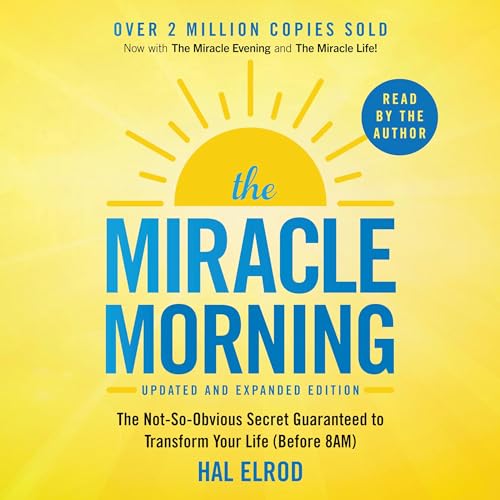
Author: Hal Elrod
Category: Self-Help
Published: 2012
Pages: 172
Key Takeaways
- **The 95% Reality:** Most people never achieve Level 10 success because their personal development is at Level 2 or 3. You must become the person who deserves what you want.
- **S.A.V.E.R.S. Framework:** Six practices—Silence, Affirmations, Visualization, Exercise, Reading, Scribing—form the complete morning routine for transformation.
- **Silence (Meditation):** Start proactively, not reactively. Center yourself before the world's demands rush in through meditation, deep breathing, or prayer.
- **Affirmations Must Be Specific:** Include what you want, why you want it, who you must become, and what actions you're committed to taking daily.
- **Visualize Both Outcome AND Process:** Don't just see the finish line—visualize yourself doing the hard work required to get there.
- **Exercise Creates Energy:** Moving your body first thing boosts BDNF, wakes your metabolism, and builds self-trust before 8 AM.
- **Read 10 Pages Daily:** This equals 18+ books per year. Knowledge compounds—download decades of expertise into your brain.
- **Scribing Brings Clarity:** Journal to brain dump anxieties, track gratitude, and shift focus from the 'Gap' to the 'Gain.'
- **The 30-Day Challenge:** Days 1-10 are unbearable, 11-20 uncomfortable, 21-30 unstoppable. Push through the resistance.
- **The 6-Minute Miracle:** Even on your worst days, never skip the routine entirely. A shortened version preserves the habit and your identity.
About This Summary
The Miracle Morning Masterclass: Wake Up to Your Full Potential
The Definitive Blueprint to The Level 10 Life
Welcome to the first day of the rest of your life.
If you are reading this, it is because you suspect there is more to you than what you are currently displaying to the world. You feel that potential bubbling beneath the surface, but you are trapped in the gravitational pull of mediocrity. Today, we break that cycle. Today, we stop hitting the snooze button on your life.
This is not just a routine; it is a fundamental restructuring of your psychology. We are going to take the principles of The Miracle Morning and expand them into a comprehensive masterclass designed to bulletproof your mind, energize your body, and ignite your spirit.
Let's get to work.
Part 1: The Philosophy of the 1%
Escaping the 95% Trap & The Level 10 Life
Here is the brutal truth that most people are too afraid to face: 95% of society will never live the life they want.
They will settle for less than they want, struggle financially, struggle physically, and struggle emotionally. They will live in a state of perpetual "rearview mirror syndrome"—constantly reliving their past mistakes and limitations, projecting them into the future. This is the epidemic of mediocrity. It isn't about being "average" in a statistical sense; it's about being average compared to your potential.
Why does this happen? It happens because of a fundamental disconnect between who we are and who we need to be to achieve what we want.
The Law of Success states: Your level of success will rarely exceed your level of personal development, because success is something you attract by the person you become.
Most people want Level 10 Success (in health, wealth, love, and happiness), but their Personal Development is hovering at a Level 2 or 3. They are stressed, overwhelmed, and stagnant because they are trying to force Level 10 results with a Level 3 operating system. It is physically impossible. To achieve the Level 10 Life, you must dedicate time every single day to becoming a Level 10 person.
The Wake-Up Call
How you wake up each day and your morning routine (or lack thereof) dramatically affects your levels of success in every single area of your life. Focused, productive, successful mornings generate focused, productive, successful days—which inevitably create a successful life.
The 5-Minute Rule: Emotional Mastery
Before we dive into the routine, we must address the emotional baggage you carry. When things go wrong, or when you wake up feeling heavy, you apply the 5-Minute Rule.
It's okay to be negative when things go wrong, but not for more than five minutes. Set a timer on your phone. For five minutes, you can bitch, moan, complain, cry, and vent. Feel the emotion fully. But when the timer hits zero, you say three powerful words: "Can't Change It."
You acknowledge that you cannot change the past (even if the past was five minutes ago). You accept it, and you move forward. This prevents you from spiraling. This clears the emotional deck so you can execute the S.A.V.E.R.S.
Part 2: The Life S.A.V.E.R.S.
S - SILENCE (Meditation & Peace)
#### The Problem: The Noise of Life Most of us wake up and immediately surrender our minds to chaos. We check our phones, we check the news, we react to emails, or we immediately start stressing about the to-do list. We start the day in a reactive state of high cortisol. This is a recipe for burnout.
#### The Solution: Purposeful Silence Silence is the first S.A.V.E.R.S. practice because it is the gatekeeper. It allows you to center yourself before the demands of the world rush in. Silence reduces stress, increases self-awareness, and gives you the clarity to maintain focus on your goals.
How to Execute Silence (3 Methods):
1. Meditation (The Mind Calmer)
Meditation is not about "thinking nothing." It is about noticing your thoughts and letting them go. It is the practice of focus.
- The Method: Sit upright in a comfortable position. Close your eyes. Focus entirely on your breath. Inhale for a count of 3, exhale for a count of 3.
- The Trap: Your mind will wander. You will think about breakfast or that email. This is not failure; this is the practice. The moment you notice your mind wandering and bring it back to the breath, that is the "rep." That is the bicep curl for your brain.
- Action: Start with 5 minutes. If you struggle with silence, use a guided meditation app (Headspace, Calm, or YouTube).
2. Deep Breathing (The Nervous System Reset)
If meditation feels too abstract, focus on physiology.
- Box Breathing: Inhale for 4 seconds, hold for 4 seconds, exhale for 4 seconds, hold for 4 seconds. Repeat.
- The Science: This creates a specific physiological response that lowers blood pressure and tells your parasympathetic nervous system (rest and digest) to take over from the sympathetic nervous system (fight or flight). It oxygenates the brain, preparing you for high-level thinking.
3. Prayer (The Spiritual Connection)
For those who are spiritual, this is the time to connect with a higher power.
- The Shift: Instead of asking for things to be easier, ask for the strength to be better. Move from a prayer of "wants" to a prayer of "gratitude and guidance."
- The Script: "Grant me the wisdom to see the opportunities today, the strength to overcome the challenges, and the peace to handle whatever comes my way."
The Goal of Silence:
You are not trying to reach nirvana. You are simply trying to start your day proactively rather than reactively. When you emerge from Silence, you are calm, centered, and ready to program your mind.
A - AFFIRMATIONS (Reprogramming the Mind)
#### The Problem: The Internal Saboteur Every one of us has an internal dialogue running 24/7. For most, this dialogue is unconscious and largely negative. "I'm so tired," "I'm not good at sales," "I always quit." Your subconscious mind has no sense of humor; it believes whatever you tell it most often. If you don't consciously program your mind, society and your past trauma will program it for you.
#### The Solution: Strategic Affirmations Affirmations are not "woo-woo" magic. They are a tool for neuroplasticity. They allow you to design and then develop the mindset (thoughts, beliefs, focus) that you need to take any area of your life to the next level.
The 5-Step Formula for Bulletproof Affirmations:
Step 1: What do you want?
Be specific. Don't say "I want to be rich." Say "I am committed to earning $200,000 this year."
Step 2: Why do you want it?
The "Why" gives the affirmation its power. "Because I want to provide freedom for my family and donate to my favorite charity."
Step 3: Who must you be to achieve it?
This is where most people fail. You must affirm the identity required. "I must be disciplined, consistent, and a relentless prospector."
Step 4: What are you committed to DOING to get it?
Affirmations without action are delusions. "I am committed to making 20 cold calls every single morning, no matter how I feel."
Step 5: Add inspirational quotes and philosophies.
Incorporate wisdom that resonates with you to reinforce the mindset.
The Anti-Cheesy Affirmation Script:
Forget the "I am a money magnet" fluff if you don't believe it. Use this template which relies on truth and commitment:
"I am 100% committed to becoming the person I need to be to create the Level 10 life I truly desire. I am committed to [Specific Goal] by [Date] because [Deep Reason]. To ensure this happens, I will [Specific Action] every single day at [Time], no matter how I feel, because I know that discipline creates freedom."
How to Practice:
- Read Aloud: You must speak them. Hearing your own voice reinforces the neural pathway.
- Engage Emotion: Do not robotically read the paper. Generate the feelings of determination and excitement while you read. Tap into the emotion of the "Why."
- Update Frequently: As you grow, your affirmations must grow.
V - VISUALIZATION (Mental Rehearsal)
#### The Problem: Visualizing the Past Most people visualize constantly—they just call it "worrying." They vividly imagine everything that could go wrong, or they replay past failures. This primes the brain to spot danger and failure.
#### The Solution: Creative Visualization Visualization, or mental rehearsal, is a technique used by the world's top athletes (like Tiger Woods and Michael Phelps) to optimize performance. It is the process of imagining exactly what you want to achieve or attain, and then mentally rehearsing what you'll need to do to achieve or attain it.
The 3-Step Process:
1. Visualize the Outcome (The "What")
Close your eyes and see yourself at the finish line.
- See the bank account balance.
- See the fit body looking back in the mirror.
- See yourself holding the award.
- Critical: You must feel the emotion. Smile. Pump your fist. Feel the relief, the pride, the joy. This triggers dopamine and makes the goal attractive to your brain.
2. Visualize the Process (The "How")
This is the step most people miss. You must visualize the work.
- See yourself waking up when the alarm goes off, even though it's cold.
- See yourself putting on your running shoes.
- See yourself smiling while you dial the phone for a sales call.
- See yourself eating the salad instead of the pizza.
- Why? You are training your nervous system to handle the resistance. When you actually face the hard task later in the day, your brain will say, "We've already been here. We know what to do."
3. Vision Boards vs. Mental Movies
- Vision Boards: Great for general inspiration, but static.
- Mental Movies: Better for behavioral change. Create a short mental movie of your perfect day. Watch yourself moving through the day with energy, confidence, and kindness.
The Power of Priming:
Visualization acts as a filter for your Reticular Activating System (RAS). By visualizing your goals, you are programming your RAS to spot resources, opportunities, and people that can help you achieve them—things you would have otherwise walked right past.
E - EXERCISE (Energy & Health)
#### The Problem: Sedentary Mornings When you wake up, your body is in a state of inertia. Your heart rate is low, your metabolism is slow, and your brain is foggy. If you sit straight down at a computer, you are asking a cold engine to run a race.
#### The Solution: Ignite the Body We are not talking about a 2-hour gym session (though if you have time, great). We are talking about getting your heart rate up and oxygenating your brain immediately. This is a non-negotiable state change.
The Benefits:
- Mental Clarity: Exercise boosts BDNF (Brain-Derived Neurotrophic Factor), which acts like fertilizer for your brain cells. It helps you think faster and learn better.
- Energy: It sounds counterintuitive, but expending energy creates energy. It wakes up your metabolism.
- Confidence: Keeping the promise to move your body builds self-trust before 8:00 AM.
Practical Implementations (No Gym Required):
1. The 7-Minute Workout
Use an app or a timer. 30 seconds of high intensity, 10 seconds rest.
- Jumping Jacks
- Wall Sit
- Push-ups
- Crunches
- Step-ups
- Squats
- Plank
Why it works: It hits every muscle group and spikes the heart rate in minimal time.
2. Yoga / Stretching
If high impact isn't for you, focus on flow. Sun Salutations are designed specifically for the morning. They stretch the spine, open the chest, and synchronize breath with movement.
3. The "Get Moving" Basics
- Do 50 jumping jacks.
- Do 20 burpees.
- Go for a brisk walk around the block.
The Rule:
You do not need to be an athlete. You just need to move until you sweat or breathe heavy. Earn your shower. When you change your physiology, you change your psychology. You cannot feel sluggish and depressed when you are jumping up and down and breathing deep.
R - READING (Knowledge & Ideas)
#### The Problem: Reinventing the Wheel Most people try to figure out life on their own through trial and error. This is the slow lane. Whatever problem you are facing—marriage, money, parenting, happiness—someone else has already solved it and written a book about it.
#### The Solution: Modeling Success Reading is the fastest way to transform your life because it allows you to download decades of someone else's expertise into your brain in a few days.
The Strategy: 10 Pages Per Day
- If you read 10 pages a day, that is 3,650 pages a year.
- That is approximately 18 personal development books a year.
- The average person reads less than one.
- This one habit alone will separate you from 95% of the competition.
How to Read for Impact:
1. Be Selective
Read non-fiction, self-help, biography, or strategy. Save the fiction for bedtime (if you want). In the morning, you want fuel for your growth.
2. Don't Just Read—Interact
Do not preserve the book. Treat it like a workbook.
- Underline key concepts.
- Circle ideas you need to revisit.
- Fold the corners of pages that blew your mind.
- Write notes in the margins—arguing with or agreeing with the author.
3. The Implementation Rule
Knowledge is only potential power. It becomes real power when you use it.
- After reading your 10 pages, ask: "What is the ONE idea from today's reading that I can implement immediately?"
- Write that action step down.
Recommended Starting List:
- The Miracle Morning (obviously—re-read it to master it).
- Think and Grow Rich by Napoleon Hill.
- Atomic Habits by James Clear.
- The Compound Effect by Darren Hardy.
S - SCRIBING (Journaling & Clarity)
#### The Problem: Mental Clutter Your brain is for having ideas, not for holding them. When you keep your worries, ideas, and gratitudes bottled up in your head, they create noise. You lose perspective.
#### The Solution: Scribing Scribing (writing/journaling) forces you to articulate your thoughts. It brings clarity to the chaos. It allows you to document your life, learn from your patterns, and celebrate your wins.
2 Powerful Journaling Methods:
1. The 5-Minute Journal Format (Structure)
This is great for beginners. Write down:
- 3 Things I am Grateful For: (Be specific. Not just "my family," but "the way my son smiled at me yesterday.")
- 3 Things That Would Make Today Great: (Actionable items).
- Daily Affirmations: (One sentence regarding who you are).
- At night: 3 Amazing things that happened today and how I could have made today better.
2. Stream of Consciousness (Therapy)
Just write. Put pen to paper and do not lift it.
- "I'm feeling anxious about this meeting because I don't feel prepared..."
- As you write, you will often find the solution appearing on the page. It is a way to "brain dump" your anxieties so you don't carry them into your day.
The Gap vs. The Gain:
Use your journal to shift your focus from the "Gap" (where you are vs. where you want to be) to the "Gain" (where you are vs. where you started).
Every morning, write down 3 wins from the previous day. This trains your brain to look for success, which builds confidence.
Part 3: Implementation & Habit Formation
The Strategy for Unstoppable Momentum
Knowing the S.A.V.E.R.S. is not enough. You must do them. And you must do them consistently.
The 30-Day Life Transformation Challenge
Habits are not built in a day. It takes time to rewire your neural pathways. We break the 30 days down into three phases:
Days 1-10: The Unbearable Phase.
This is where you will want to quit. Your body will fight you. You will hate the alarm clock. You will feel tired.
- The Mindset: "This is temporary. This is the price of admission for the life I want." Do not give in.
Days 11-20: The Uncomfortable Phase.
It's not unbearable anymore, but it's still not easy. You might get overconfident and skip a day.
- The Mindset: Discipline is required here. Stick to the routine.
Days 21-30: The Unstoppable Phase.
Your new identity is solidifying. You start to feel proud of yourself. You actually look forward to waking up.
Customizing Your Routine: The Time Tables
You are busy. I get it. But "I don't have time" is a lie. It is a lack of priority. Here is how you can fit the Miracle Morning into any schedule.
| S.A.V.E.R.S. Component | The 60-Minute Routine (Ideal) | The 30-Minute Routine (Fast) | The 6-Minute Miracle (Emergency) | |------------------------|-------------------------------|------------------------------|----------------------------------| | Silence | 10 Minutes | 5 Minutes | 1 Minute (Deep Breathing) | | Affirmations | 10 Minutes | 5 Minutes | 1 Minute (Read aloud with passion) | | Visualization | 5 Minutes | 5 Minutes | 1 Minute (Visualize the day's biggest win) | | Exercise | 20 Minutes | 10 Minutes | 1 Minute (Jumping Jacks) | | Reading | 10 Minutes | 5 Minutes | 1 Minute (One page or a summary) | | Scribing | 5 Minutes | 5 Minutes | 1 Minute (3 things you are grateful for) | | TOTAL TIME | 60 Minutes | 35 Minutes | 6 Minutes |
The 6-Minute Miracle:
On days when everything goes wrong, or you overslept, or you have an early flight—do NOT skip the routine. Do the 6-Minute version. It preserves the habit. It proves to yourself that you are a person who keeps their commitments.
Final Action Steps
- Set Your Alarm: Move your alarm clock across the room. You must physically get out of bed to turn it off.
- Drink Water: Put a full glass of water next to the alarm. Drink it immediately to rehydrate and wake up.
- Brush Your Teeth: Do a mindless task to give your body time to wake up.
- Dress for Success: Put on your workout clothes immediately.
- Execute S.A.V.E.R.S.: Find a quiet spot and begin.
The Conclusion
You now have the blueprint. You understand the philosophy. You have the tools.
The only variable left is YOU.
Are you going to settle for the life you have, or are you going to create the life you deserve? The alarm is set. Your potential is waiting.