Business summary
$100M Offers Summary: Key Ideas and Takeaways
Read a practical summary of $100M Offers by Alex Hormozi, including key takeaways, lessons, and useful ideas.
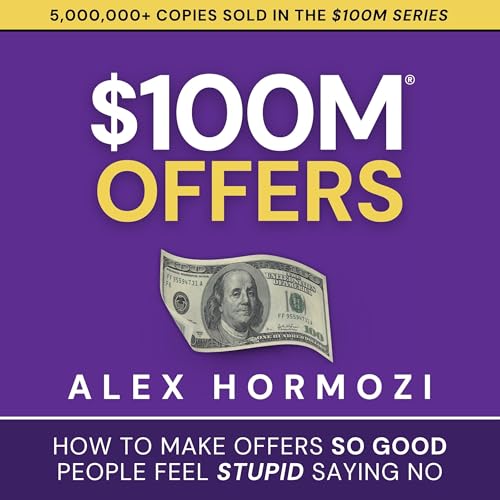
Author: Alex Hormozi
Category: Business
Published: 2021
Pages: 224
Key Takeaways
- **The Grand Slam Offer**: Create an offer so good people feel stupid saying no. Make it incomparable to alternatives by stacking massive value.
- **The Value Equation**: Value = (Dream Outcome × Perceived Likelihood) / (Time Delay × Effort). Maximize the top, minimize the bottom.
- **Stop Competing on Price**: The race to the bottom is a death spiral. Create a 'Category of One' by selling transformations, not commodities.
- **The Starving Crowd**: Find a market with massive pain, purchasing power, easy targeting, and growth. The right market makes selling effortless.
- **Charge Premium Prices**: Higher prices attract better clients who are more committed. Low prices attract high-maintenance customers.
- **Scarcity & Urgency**: Use limited quantity (scarcity) and limited time (urgency) to force immediate action. Always be 'sold out.'
- **Stack Bonuses**: A single offer is easy to compare. A stack of bonuses creates a unique bundle that can't be price-shopped.
- **Reverse the Risk**: Use guarantees to transfer risk from buyer to seller. A bold guarantee removes the primary barrier to purchase.
- **The MAGIC Naming Formula**: Magnet + Avatar + Goal + Interval + Container. Turn 'Weight Loss Coaching' into 'The 6-Week Beach Body Blueprint for New Moms.'
- **Deliver on Your Promise**: A great offer with a bad product is a scam. The offer gets them in; the product keeps them there.
About This Summary
Masterclass Summary: $100M Offers by Alex Hormozi
1. Executive Thesis (The "Big Idea")
The Core Problem:
Most businesses fail or stagnate because they are trapped in a "race to the bottom." They compete on price, selling commoditized goods or services that look identical to their competitors'. This leads to low margins, low customer retention, and an inability to afford the cost of customer acquisition (CAC). Entrepreneurs mistakenly believe their problem is a "traffic" or "sales" issue, when in reality, it is a product and offer issue. They are selling things that are difficult to sell because the value proposition is weak and the risk is entirely on the buyer.
The Central Argument:
Alex Hormozi argues that the single strongest lever for business success is the Grand Slam Offer. A Grand Slam Offer is a product or service packaged in such a way that it becomes incomparable to alternatives in the marketplace. By combining high pricing (premium) with a value stack that disproportionately outweighs the cost, businesses can break the constraints of supply and demand. The goal is to create an offer "so good people feel stupid saying no." When you get the offer right, marketing becomes easy, sales cycles shorten, and you generate the cash flow necessary to outspend everyone else on acquisition, effectively dominating your market.
Target Audience:
This book is explicitly designed for entrepreneurs, service providers, coaches, consultants, and brick-and-mortar business owners who are struggling to scale beyond the initial "hustle" phase. It is for business owners tired of competing on price and looking to transition from selling "commodities" to selling "transformations."
2. The Comprehensive Chapter-by-Chapter Deep Dive
Section I: How We Got Here
#### Chapter 1: How We Got Here (The Gym Launch Story) The Main Argument: Hormozi opens with a raw, detailed account of his own failure to establish credibility. The argument here is that "learning what to do" often comes from "learning what not to do." Success is rarely a straight line; it is usually the result of a desperate pivot.
Case Study (The Gym Launch Pivot): Hormozi details the chaotic period where he owned six gyms but was hemorrhaging money due to a partner swindling him. He was effectively homeless, sleeping on the floor of a new gym location, with his credit cards maxed out. In a moment of desperation, he decided to sell his "secrets" (how to fill a gym) rather than just selling gym memberships. He flew to a struggling gym owner's location, ran his "Grand Slam Offer" play, and generated massive revenue in days. This validated the concept: the offer (turnaround consulting) was worth infinitely more than the service (standard gym access).
Tactical Nuance: The pivot point wasn't just changing the product; it was changing the billing model and the guarantee. He moved from low-ticket recurring (hard to sell) to high-ticket upfront with a performance guarantee (easy to sell because risk was removed).
Section II: Pricing
#### Chapter 2: Grand Slam Offers Key Concept (The Grand Slam Offer): Hormozi defines this as an offer that is unique to the marketplace, cannot be compared to any other product available, and offers a value proposition so high that price becomes a trivial objection.
The Main Argument: If you sell a commodity, you are forced to compete on price. If you sell a Grand Slam Offer, you are in a "Category of One."
Tactical Nuance: Hormozi distinguishes between a "commodity" (potatoes, standard internet service, generic coaching) and a "Grand Slam Offer" (a specific outcome bundled with unique delivery mechanisms). The goal is to move from "I sell gym memberships" to "I help busy dads lose 20lbs in 6 weeks without giving up pizza."
#### Chapter 3: Pricing: The Commodity Problem The Main Argument: Price is not just a math problem; it is a psychological signal. Low prices attract low-quality customers who are high-maintenance (the "PITA" factor—Pain In The Ass).
Key Concept (Price vs. Value): The book posits that price is what you pay, but value is what you get. The wider the gap between price and value, the more irresistible the offer. However, most businesses try to widen this gap by lowering the price. Hormozi argues you must widen the gap by raising the value, which allows you to subsequently raise the price.
Tactical Nuance:
- The Downward Spiral: Lower Price → Lower Margins → Less money for marketing/staff → Poorer Product → Even Lower Price needed to sell.
- The Upward Spiral: Higher Price → Higher Margins → More money for Better Service/Acquisition → Better Results → Success Stories → Even Higher Prices.
#### Chapter 4: Pricing: Finding the Right Market (Starving Crowd) The Main Argument: You can have the best offer in the world, but if you present it to the wrong audience, it will fail. Hormozi uses the "Hot Dog Stand" analogy: The most important variable for a hot dog stand isn't the quality of the meat or the price; it is a starving crowd.
The 4 Indicators of a Great Market:
- Massive Pain: The market must have an urgent problem they want solved now.
- Purchasing Power: They must have the money to pay for the solution. (e.g., Don't target unemployed students for high-ticket consulting).
- Easy to Target: You must be able to find them easily on ad platforms or lists.
- Growing: Ideally, the market is expanding (e.g., crypto in 2021, AI in 2024), not shrinking (e.g., newspapers).
Tactical Nuance: Hormozi advises "niching down" until you can speak directly to a specific avatar. "Fitness coaching" is too broad. "Fitness coaching for nurses who work night shifts" is a specific market with specific pain points you can exploit in your copy.
#### Chapter 5: Pricing: Charge What It's Worth The Main Argument: People do not buy products; they buy certainty of an outcome. Higher prices actually increase the likelihood of success because the customer is more emotionally invested.
Key Concept (Investment = Commitment): If a client pays $50 for a course, they likely won't finish it. If they pay $5,000, they will show up to every call and do the work. Therefore, charging more is a moral imperative to help the client get results.
Tactical Nuance: Never lower your price to get a sale. Instead, increase the value (bonuses, guarantees, speed) until the price seems small by comparison.
Section III: Value – Create Your Offer
#### Chapter 6: The Value Equation (CRITICAL CHAPTER) The Main Argument: This is the heart of the book. Value can be quantified using a specific formula. To create a Grand Slam Offer, you must maximize the top half of the equation and minimize the bottom half.
The Equation:
``` Value = (Dream Outcome × Perceived Likelihood of Achievement) / (Time Delay × Effort & Sacrifice) ```
- Dream Outcome (Top): What the client wants to be true. (e.g., "A ripped body," "Financial freedom").
- Tactic: Describe the outcome in vivid, emotional detail. It's not about losing 5lbs; it's about "feeling confident taking your shirt off at the beach."
- Perceived Likelihood of Achievement (Top): How likely the client thinks they are to succeed with you.
- Tactic: Increase this via social proof, testimonials, and guarantees. If they believe it's 100% certain, the value approaches infinity.
- Time Delay (Bottom): How long between buying and receiving the benefit.
- Tactic: Shorten this. If the main result takes time (e.g., weight loss), provide an immediate win (e.g., a grocery shopping list or a 'quick start' call). The closer the feedback loop is to zero, the higher the value.
- Effort & Sacrifice (Bottom): What the client has to endure or give up.
- Tactic: Decrease this. If they have to count calories, value goes down. If you provide a meal delivery service, effort goes down, and value goes up. "Done For You" is always more valuable than "Do It Yourself" because effort is lower.
#### Chapter 7: Free Goodwill The Main Argument: Hormozi discusses the power of giving value upfront to build trust.
Tactical Nuance: This chapter serves as a bridge, reminding readers that the goal is to make the offer so good that the transaction feels like a natural next step, not a hard sell.
#### Chapter 8: Thought Process (Convergent & Divergent Thinking) The Main Argument: Creating an offer requires two distinct phases of thinking.
Key Concept (Divergent Thinking): Brainstorming without judgment. Thinking of every possible way to solve the problem (e.g., fly to their house, cook their food, text them daily).
Key Concept (Convergent Thinking): Filtering those ideas down to what is operationally feasible and profitable.
The Exercise: Hormozi asks the reader to list every single step a customer must take to achieve the result, then list every problem they might encounter at each step, and then brainstorm solutions for every single problem.
#### Chapter 9: The Offer Building Process (Part 1: Problems & Solutions) The Main Argument: Your product is simply a collection of solutions to the problems that stand between your customer and their Dream Outcome.
Tactical Step-by-Step:
- Identify the Dream Outcome.
- List the Obstacles: Write down every reason they haven't achieved it yet. (e.g., "I don't like cooking," "I don't have time to shop," "I get hungry at night").
- List the Solutions: Turn obstacles into solutions. (e.g., "I don't like cooking" → "Meal prep service" or "5-minute shake recipes").
#### Chapter 10: The Offer Building Process (Part 2: Trim & Stack) The Main Argument: Not all solutions are created equal. You must select the highest value, lowest cost solutions to include in your core offer.
The Delivery Vehicle Matrix: For every solution, ask: How can I deliver this?
- One-to-One: Coaching calls (High cost, High value).
- Small Group: Workshops (Medium cost, High value).
- One-to-Many: Courses, Live events (Low cost, Scalable).
- DIY: PDF checklists, Calculators (Zero marginal cost).
Tactical Nuance: The "Grand Slam" move is to solve a high-effort problem using a low-cost delivery vehicle.
Example: Instead of teaching a client how to calculate macros (high effort for them, high coaching time for you), give them a "Macro Calculator" spreadsheet (low effort for them, zero cost for you once built).
The Stack: Combine the Core Offer with the highest value "bonuses" (the solutions to the smaller obstacles) to create an overwhelming stack of value.
Section IV: Enhancing The Offer
#### Chapter 11: Scarcity, Urgency, Bonuses, Guarantees, and Naming The Main Argument: Once the core offer is built (The Value Equation), you must wrap it in psychological triggers to force action now. These are not features of the product; they are features of the offer.
#### Chapter 12: Scarcity (The Reason to Buy Now) The Main Argument: Scarcity is a function of quantity. It relies on the fear of missing out (FOMO). If there is an infinite supply, there is no rush to buy.
Types of Scarcity:
- Supply Scarcity: "Only selling 100 units." (Works for physical goods).
- Seat Scarcity: "Only taking 5 new clients this month." (Works for services/coaching).
- Hardware Scarcity: "We only have 10 machines left."
Tactical Nuance: Always be "sold out." If you can handle 10 clients, say you only have 5 spots. When those 5 sell, you are "sold out" of the current allocation. This builds massive social proof and desire. Never lie; create honest limitations based on your capacity to deliver quality.
#### Chapter 13: Urgency (The Reason to Buy Now... based on Time) The Main Argument: Urgency is a function of time. Scarcity says "limited amount"; Urgency says "limited time."
Types of Urgency:
- Cohort-Based: "The program starts on Monday. If you don't join by Sunday night, you wait until the next round."
- Rolling Urgency: "This pricing expires at midnight." or "The bonus disappears in 24 hours."
Tactical Nuance: Hormozi suggests using "Exploding Bonuses." The core offer remains available, but if they don't buy on the call, they lose the $1,000 worth of bonuses. This forces a decision without rejecting the customer.
#### Chapter 14: Bonuses (The Multiplier) The Main Argument: A single offer is easy to price-shop. A "stack" of bonuses creates a unique bundle that cannot be compared.
Key Concept: Often, the bonuses are more desirable than the core product.
Tactical Nuance:
- Present the bonuses after the price is revealed (or right before) to break price resistance.
- Each bonus must have a tangible price tag attached to it. "I'm also going to throw in my $497 Nutrition Guide."
- Bonuses should address the next problem the user will have. (e.g., If you sell a house, a bonus could be a "Moving Checklist" or "Discounted Movers").
- Advanced Tactic: Partner with other businesses to get their products as bonuses for your offer (free for you, valuable for the client).
#### Chapter 15: Guarantees (Risk Reversal) The Main Argument: The biggest friction point in a sale is risk. The customer thinks, "What if this doesn't work?" You must transfer the risk from the buyer to the seller (you).
Key Concept: A strong guarantee allows you to charge premium prices.
Types of Guarantees:
- Unconditional: "30-day no questions asked refund." (High trust, but higher refund rate).
- Conditional (The Winner): "If you do X, Y, and Z, and don't get the result, I will refund you + pay you $100 for wasting your time." (This is the Anti-Guarantee). It ensures the client does the work.
- Performance-Based: "You don't pay until you get the result." (Highest conversion, delayed cash flow).
Tactical Nuance: Name your guarantee. "The 'I pay you' Guarantee." Make the guarantee so bold it hurts. If you are good at what you do, you will rarely have to pay it out.
#### Chapter 16: Naming (The Wrapper) The Main Argument: The name of your offer determines the initial attention it gets. A boring name yields boring results.
The MAGIC Formula for Naming:
- M - Magnet: Who is it for? (e.g., "For New Moms").
- A - Avatar: Be specific.
- G - Goal: What is the result? (e.g., "Beach Body").
- I - Interval: How long? (e.g., "In 21 Days").
- C - Container: What is it? (e.g., "System," "Challenge," "Blueprint").
Example: Instead of "Weight Loss Coaching," use "The 6-Week Post-Partum Belly-Blast Blueprint."
3. Top 10 Quotes & Analysis
- "Make your offer so good that people feel stupid saying no."
- Analysis: This is the thesis of the book. It shifts the focus from "how do I sell better" to "how do I build better." If the value stack is 10x the price, the "no" becomes irrational.
- "People buy with emotion and justify with logic."
- Analysis: Your offer must trigger the Dream Outcome (emotion) first. The logic (the features, the deliverables, the math) only serves to give the buyer permission to act on their emotion.
- "The only way to beat a race to the bottom is to stop racing."
- Analysis: Competing on price is a death spiral. Hormozi urges businesses to exit the commodity market entirely by creating a Category of One.
- "Price is a mere triviality when the value is high enough."
- Analysis: Focus 100% of your energy on increasing the numerator of the Value Equation (Outcome + Likelihood) and decreasing the denominator (Time + Effort). If you do this, you can double your price and increase conversion.
- "We are not in the business of selling products. We are in the business of selling transformations."
- Analysis: Customers don't want a drill; they want a hole in the wall. They don't want a diet plan; they want to be thin. Sell the destination, not the plane ride.
- "The degree of the pain will determine the price you will be able to charge."
- Analysis: This validates the "Starving Crowd" concept. You can charge $10 for water at a supermarket, but $1,000 for water in the desert. Find the painful problem.
- "If you lower the price, you lower the emotional investment."
- Analysis: High prices filter for better clients. Clients who pay little, care little. Clients who pay a premium are committed to making the solution work to recoup their investment.
- "Strategy is what you don't do."
- Analysis: A Grand Slam Offer requires focus. You cannot serve everyone. You must exclude bad customers to serve the great ones effectively.
- "Grand Slam Offers only work if you actually deliver."
- Analysis: A great offer with a bad product is a scam. Hormozi emphasizes that the offer gets them in the door, but the product keeps them there. You must fulfill the promises of the Value Equation.
- "A guarantee is a transfer of risk."
- Analysis: In every transaction, risk exists. If you don't take it, the customer holds it. By taking the risk (via a guarantee), you remove the primary barrier to the sale.
4. The Implementation Matrix (Actionable Steps)
This section converts the theoretical frameworks of the book into a linear, execution-focused workflow.
Phase 1: Diagnosing the Market (The Foundation)
Before touching the product, you must validate the terrain.
The "Starving Crowd" Audit:
- Evaluate your current market against the four variables: Pain, Purchasing Power, Accessibility, and Growth.
- Action: If your market fails "Purchasing Power" (e.g., targeting broke students), pivot immediately. You cannot build a $100M offer on a $0 wallet.
Niche Down: Narrow your avatar until you can describe their specific problem better than they can.
- Bad: "I help people with back pain."
- Good: "I help post-operative golfers eliminate lower lumbar pain so they can add 20 yards to their drive."
Phase 2: Constructing the Grand Slam Offer (The Core)
Use the "Value Equation" to engineer the product.
The Divergent Brainstorm (The List of 100):
- Write down the Dream Outcome (e.g., Lose 20lbs).
- List every single obstacle (minimum 20) the client faces (e.g., grocery shopping, cooking, craving sugar, eating out with friends).
- For each obstacle, brainstorm 3-5 distinct solutions (e.g., hire a shopper, meal prep delivery, cheat sheet for restaurants).
The Convergent Selection (The Trim):
- Filter the solutions through the Delivery Vehicle Matrix.
- Identify "High Value / Low Cost" solutions. Look for digital assets (PDFs, videos, calculators) or one-to-many systems (group calls) that solve high-friction problems.
- Action: Select your "Core Mechanism" (the main service) and 3-5 "Bonuses" (the support mechanisms).
Phase 3: Psychological Packaging (The Wrapper)
Make the offer logically irresistible.
Structure the Guarantee (Risk Reversal):
- Choose a Conditional Guarantee to ensure client compliance.
- The Script: "If you follow the steps, attend the calls, and track your metrics, and you don't achieve X within Y days, I will refund you 100% and pay you $500 for wasting your time."
Engineering Scarcity & Urgency:
- Determine your constraint. Is it time (cohort starts Monday) or supply (only 5 onboarding spots/week)?
- Action: Add this constraint to all marketing materials immediately. "Only 3 spots left for June."
The "Magic" Name Generation:
- Apply the MAGIC formula (Magnet, Avatar, Goal, Interval, Container).
- Draft 1: "SEO Services." (Commodity).
- Draft 2 (MAGIC): "The 90-Day 'First Page' Ranking System for Dental Practices." (Grand Slam).
The "Immediate Action" Checklist (Start Today)
- [ ] Raise Your Price: Increase your current pricing by 20-50% immediately. Use the extra margin to justify more time spent on client results.
- [ ] Rename Your Product: Stop selling the "commodity" name. Rebrand it using the MAGIC formula.
- [ ] Create One "Cheat Sheet": Identify the most annoying, repetitive question your customers ask. Create a PDF or tool that solves it instantly. Add this as a "Free Bonus" worth $197.
- [ ] Draft Your "Anti-Guarantee": Write a guarantee that protects the client from failure but protects you from lazy clients.
- [ ] Identify Your "Starving Crowd": Look at your last 10 sales. Who paid the easiest? Who complained the least? Redefine your marketing to target only that profile.
Final Masterclass Takeaway
$100M Offers is not about getting more traffic; it is about converting the traffic you already have at a higher rate and a higher price point. By shifting the focus from "how can I get the customer to pay me" to "how can I provide so much value that the customer feels stupid saying no," you fundamentally alter the economics of your business. The Grand Slam Offer is the lever that allows you to outspend your competition, attract the best talent, and eventually, dominate your market.