Leadership summary
Leading Change Summary: Key Ideas and Takeaways
Read a practical summary of Leading Change by John P. Kotter, including key takeaways, lessons, and useful ideas.
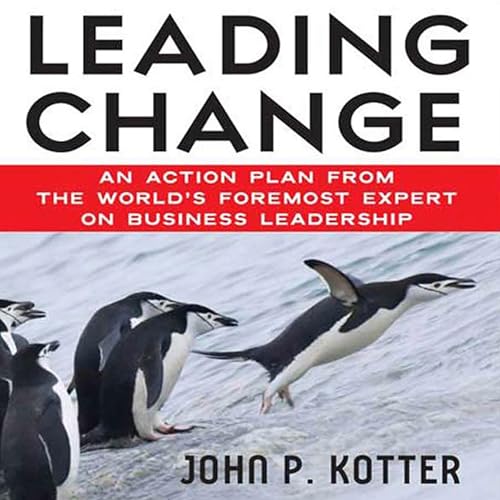
Author: John P. Kotter
Category: Leadership
Published: 1996
Pages: 208
Key Takeaways
- **Management vs. Leadership**: Management maintains complexity; Leadership drives change. Transformation requires leadership.
- **Establish Urgency**: Without a gut-level determination to move now, change will fail. Kill complacency aggressively.
- **The Guiding Coalition**: No single leader can do it alone. Build a powerful team with position power, expertise, credibility, and leadership.
- **Vision is Critical**: A clear, communicable vision directs the effort. If you can't explain it in 5 minutes, you don't have one.
- **Communicate x10**: Under-communication is a fatal error. Flood the zone with the vision and lead by example.
- **Empower Action**: Remove structural, systemic, and human barriers that stop people from acting on the vision.
- **Short-Term Wins**: Plan for visible, unambiguous wins early on to build momentum and silence critics.
- **Don't Declare Victory Early**: Use early wins to tackle harder problems. Premature victory kills urgency.
- **Anchor in Culture**: Culture comes last, not first. It changes only after new behaviors produce proven results.
- **The 8-Step Process**: This is a sequential methodology. Skipping steps creates the illusion of speed but leads to failure.
About This Summary
EXECUTIVE MASTERCLASS: THE ARCHITECTURE OF TRANSFORMATION
An Implementation Guide Based on John P. Kotter’s Leading Change
INTRODUCTION: The Nature of Change & The Anatomy of Failure
In the modern business landscape, the rate of change is not merely constant; it is accelerating exponentially. Globalization, digital disruption, economic instability, and evolving workforce demographics have created an environment where the status quo is a death sentence. However, the statistics regarding organizational transformation are grim: nearly 70% of large-scale change initiatives fail to achieve their stated goals.
As a senior executive, you must understand that this high failure rate is rarely due to a lack of resources, brainpower, or market opportunity. It is almost always a failure of process and leadership.
The Distinction: Leadership vs. Management
The foundational error most organizations make is confusing Management with Leadership. While both are essential, they serve different functions, and successful transformation requires a significant pivot toward the latter.
- Management is a set of processes that keep an exceedingly complex system of people and technology running smoothly. It involves planning, budgeting, organizing, staffing, controlling, and problem-solving. Management produces a degree of predictability and order.
- Leadership, conversely, is about defining the future, aligning people with that vision, and inspiring them to make it happen despite the obstacles. Leadership produces change.
Most corporations are over-managed and under-led. When you attempt to use management tools (budgets, rigid timelines, command-and-control structures) to drive transformation, you will fail. Transformation is a leadership function.
The Eight Errors of Failure
To understand the solution—the 8-Step Process—you must first diagnose the pathology of failure. Kotter identifies eight fatal errors that derail transformation:
- Allowing Too Much Complacency: Failing to establish a high enough sense of urgency.
- Failing to Create a sufficiently Powerful Guiding Coalition: Relying on a single "change champion."
- Underestimating the Power of Vision: Relying on complex plans rather than a clear vision.
- Under-communicating the Vision by a Factor of 10: Thinking one meeting creates alignment.
- Permitting Obstacles to Block the New Vision: Failing to remove structural barriers.
- Failing to Create Short-Term Wins: Not providing evidence of progress.
- Declaring Victory Too Soon: Celebrating before the change is anchored.
- Neglecting to Anchor Changes Firmly in the Corporate Culture: Failing to connect new behaviors to success.
THE REMEDY: THE 8-STEP PROCESS
The following masterclass details the antidote to these errors. This is not a menu from which you can pick and choose; it is a sequential, cumulative process.
STEP 1: ESTABLISHING A SENSE OF URGENCY
The Foundation of Transformation
Great change requires great energy. The first and most critical step in any transformation is to examine the market and competitive realities and identify and discuss crises, potential crises, or major opportunities. The goal is to make the status quo seem more dangerous than launching into the unknown.
The Pathology of Complacency
Complacency is the enemy of change. Organizations with a history of success often suffer from high complacency. Executives often mistake "busyness" for urgency.
- False Urgency: Anxiety-driven activity. Running from meeting to meeting, putting out fires. It drains energy.
- True Urgency: A gut-level determination to move and win, now. It is focused, alert, and fast-moving.
Tactics for Raising the Heat
- Kill "Happy Talk": Stop spinning failures as "learning opportunities."
- Import External Reality: Force your teams to face external data (e.g., unhappy customer videos).
- Set Targets Higher than "Business as Usual": Set targets that require working differently, not just harder.
STEP 2: CREATING THE GUIDING COALITION
Building the Engine of Change
No single individual can single-handedly lead a complex change process. You need a powerful coalition to lead the charge.
The Composition of the Coalition
To be effective, it must possess four specific characteristics:
- Position Power: Are enough key players on board so that those left out cannot easily block progress?
- Expertise: Does the group have the relevant points of view?
- Credibility: Will their pronouncements be taken seriously?
- Leadership: Does the group include enough proven leaders to drive the change process?
Building Trust and a Shared Objective
Putting powerful people in a room does not create a team. You must actively invest in teambuilding (off-site retreats, eliminating silos). The Coalition must operate as a unified entity, representing the Enterprise, not their departments.
STEP 3: DEVELOPING A VISION AND STRATEGY
Directing the Effort
Urgency provides the energy; the Coalition provides the engine; the Vision provides the direction.
Vision vs. Plans vs. Budgets
- Budgets: Math and constraints.
- Plans: Logic and steps.
- Vision: Inspiration and the future state.
Characteristics of an Effective Vision
- Imaginable: Conveys a picture of the future.
- Desirable: Appeals to long-term interests.
- Feasible: Realistic and attainable.
- Focused: Clear enough to provide guidance.
- Flexible: Allows individual initiative.
- Communicable: Can be explained within five minutes.
STEP 4: COMMUNICATING THE CHANGE VISION
The Power of Repetition and Example
Kotter estimates that in a typical transformation, the change vision is under-communicated by a factor of ten. To penetrate the noise, you must flood the zone.
Key Elements of Effective Communication
- Simplicity: Eliminate jargon.
- Metaphor, Analogy, and Example: "Run the warehouse like a supermarket, not a museum."
- Multiple Forums: Meetings, newsletters, town halls.
- Repetition: Ideas sink in only after being heard many times.
- Leadership by Example: Nothing undermines change more than inconsistent behavior from leaders. If the vision is "Agility," but the CEO requires a 40-page report for a small expense, the vision is dead.
STEP 5: EMPOWERING BROAD-BASED ACTION
Removing Barriers
Step 5 is not about "motivating" people; it is about removing the friction that stops them from acting.
The Four Key Barriers
- Structures: Formal structures that block cross-functional work.
- Skills: Lack of necessary skills for the new way of working.
- Systems: Archaic IT or HR systems that don't align with the vision.
- Supervisors: "Blockers" who refuse to adapt.
Action: Confront these barriers. Reorganize reporting lines, invest in training, fix systems, and remove blocking managers. Empower risk-taking and create a "safe harbor" for experimentation.
STEP 6: GENERATING SHORT-TERM WINS
The Psychology of Momentum
Transformation takes time. Humans need evidence that the journey is worth it. They need short-term wins.
Definition of a Short-Term Win
A win must be:
- Visible: Large numbers of people can see it.
- Unambiguous: Little argument over the result (e.g., "Profits up 10%").
- Clearly Related to the Change Effort: Proves the validity of the Vision.
Strategy: Do not leave wins to chance. Identify "low-hanging fruit" that can be achieved in 6-18 months. Celebrate these wins to silence critics and build momentum.
STEP 7: CONSOLIDATING GAINS AND PRODUCING MORE CHANGE
The Danger of Premature Victory
Step 7 is the "Double Down" phase. Do not declare victory after the first win.
The Resistance Goes Underground
When you declare victory too soon, urgency drops, and resistance re-emerges. Use the credibility from short-term wins to tackle the "hard stuff"—deeply embedded systems and powerful resistors.
Keep the Urgency High
- More Projects: Increase the number of change projects.
- Delegate: Empower more people (the Volunteer Army).
- Eliminate Interdependencies: Force lagging departments to align.
STEP 8: ANCHORING NEW APPROACHES IN THE CULTURE
The Final Frontier
Culture is not the first step; it is the last. Culture changes only after new behaviors have produced results.
How to Anchor Change
- Results First: Prove that the new way works.
- Verbal Instruction: Explicitly talk about the culture and why it works.
- Succession Planning: Ensure the next generation of leaders embodies the new culture.
- Social Proof: Celebrate the heroes of the new culture.
The Reversion Risk: If new behaviors are not anchored in shared values, the old culture will reassert itself as soon as the pressure is off.
CONCLUSION: The Executive’s Mandate
Leading change is not a project; it is a discipline. It requires the courage to disrupt the status quo, the patience to follow the process, and the resilience to weather resistance.
As an executive, your role is not to manage the details, but to architect the environment. You must be the guardian of urgency, the builder of the coalition, and the narrator of the vision.