Business summary
Be Less Zombie Summary: Key Ideas and Takeaways
Read a practical summary of Be Less Zombie by Elvin Turner, including key takeaways, lessons, and useful ideas.
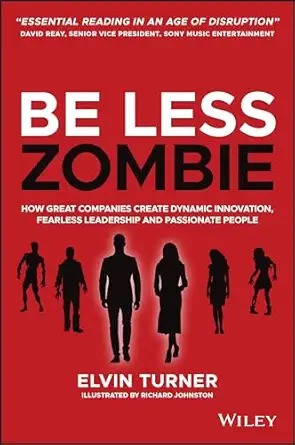
Author: Elvin Turner
Category: Business
Published: 2020
Pages: 416
Key Takeaways
- **The Zombie Company**: An organization that is busy but dead inside, prioritizing efficiency over efficacy and certainty over discovery.
- **The Efficiency Trap**: Applying factory logic to innovation kills it. Innovation requires variance and failure, which efficiency seeks to eliminate.
- **The Innovation Gap**: The difference between where the company needs to be and where the current products will take it.
- **Psychological Safety**: The foundation of innovation. Employees must feel safe to challenge the status quo and fail without punishment.
- **The Experimentation Engine**: Shift from 'Plan -> Execute' to 'Hypothesize -> Test -> Learn'. Lower the cost of failure to increase the speed of learning.
- **Metered Funding**: Fund innovation like a VC. Release budget in tranches based on validated learning, not upfront promises.
- **Leadership Ambidexterity**: Leaders must manage the 'Performance Engine' (today) and the 'Discovery Engine' (tomorrow) simultaneously.
- **Kill the Company Exercise**: A tool to break status quo bias by asking teams to design a strategy to put their own company out of business.
- **Pre-Mortem**: De-risking projects by imagining they have already failed and working backward to identify the causes.
- **Human-Centric Innovation**: Restoring curiosity and passion makes the business more robust and adaptable to change.
About This Summary
BE LESS ZOMBIE: A Deep-Dive Analysis and Implementation Guide
For Senior Leaders, Innovation Strategists, and Change Makers Based on the work of Elvin Turner
1. INTRODUCTION
The Core Diagnosis: The Rise of the Corporate Walking Dead
We are witnessing a silent epidemic in the corporate world. It is not a lack of capital, a lack of talent, or a lack of market opportunity. It is a systemic condition Elvin Turner defines as the "Zombie Company."
A Zombie Company is not necessarily a failing business—at least, not yet. It is an organization that is seemingly alive: people are busy, meetings are held, emails are answered, and quarterly targets are met. However, beneath this veneer of activity, the organization is dead inside. It has lost its sensory connection to the outside world. It operates on muscle memory, repeating the actions that made it successful yesterday while the world around it changes irrecoverably.
The defining characteristic of the Zombie Company is the prioritization of Efficiency over Efficacy and Certainty over Discovery. In these organizations, the "immune system" has become overactive. Designed to protect the core business (the "Performance Engine"), the corporate antibodies aggressively attack anything new, uncertain, or risky—effectively killing innovation before it can draw breath. The result is a workforce that has learned to keep their heads down, suppress their creative instincts, and simply "feed the machine."
The Urgency: Why "Business as Usual" is a Death Sentence
In the past, a company could sustain a competitive advantage for decades based on a single innovation or operational efficiency. That era is over. We are operating in a VUCA environment (Volatile, Uncertain, Complex, Ambiguous) where the lifespan of a business model is shrinking rapidly.
The Zombie approach—optimizing the status quo—is now a high-risk strategy. The urgency stems from a simple equation: The rate of external change now exceeds the rate of internal change. When the world moves faster than your organization, you are in a state of decay.
Turner’s premise is that most companies are designed to execute the known, not discover the unknown. They are optimized for predictability. But the future is inherently unpredictable. If you apply "Zombie management" (efficiency tools, six sigma, strict ROI analysis) to innovation, you will fail. You cannot efficiency-hack your way to the next breakthrough.
The Promise: Operationalizing Innovation
Be Less Zombie is not a plea for creativity; it is a manual for survival. The central promise of this analysis is that innovation can be operationalized. It does not have to be a chaotic, lightning-strike event dependent on a lone genius.
By reverse-engineering the habits of highly innovative companies (the "dynamic" organizations), we can build a systemic capability for innovation. This guide transforms innovation from a "nice-to-have" value on a lobby wall into a strategic habit. We will unpack how to turn the lights back on, re-engage the workforce, and build a dual-engine organization that delivers today while designing tomorrow.
2. DETAILED BREAKDOWN: THE ANATOMY OF SURVIVAL
PART 1: THE ZOMBIE DIAGNOSIS
Why Companies Die and the Biology of Stagnation
To cure the patient, we must understand the disease. The Zombie state is not accidental; it is the logical conclusion of traditional 20th-century management theory applied to a 21st-century reality.
#### 1. The Addiction to Certainty Zombie companies are addicted to data-backed certainty. Leaders demand spreadsheets proving the ROI of an idea before the idea has even been tested. This is a paradox: innovation is the process of turning uncertainty into certainty. If you demand certainty upfront, you filter out everything except incremental tweaks to existing products. The Symptom: "Show me the data" becomes the default response to new concepts. The Result: The company retreats into "safe" optimizations, leaving the radical disruptions to competitors who are willing to experiment.
#### 2. The Efficiency Trap Turner highlights that most organizations are structured to eliminate waste. In a factory line, variance is bad. In innovation, variance is essential. Zombie companies apply "factory logic" to "studio work." They view experiments that fail as "waste" rather than "learning." The Mechanism: Performance metrics (KPIs) are tied strictly to delivery and error reduction. The Consequence: Employees quickly learn that the path to promotion is flawless execution of the status quo, not the messy exploration of the new.
#### 3. The Silent Culture (Learned Helplessness) Perhaps the most tragic symptom is the disengagement of the workforce. In a Zombie company, employees have "checked out." They may have tried to innovate in the past, only to be blocked by bureaucracy or ridiculed for failure. They have learned that passivity is safer than proactivity. The Observation: Silence in meetings. Leadership speaks, and the room nods. This is not alignment; it is apathy. The Reality: Your employees are not zombies; the environment turns them into zombies. They go home and run marathons, paint, or lead community groups. They leave their passion at the door because the company has signaled it is not welcome.
PART 2: THE "TURN IT ON" FRAMEWORK
The Strategy for Awakening
How do we reverse the zombification process? Turner suggests we must "Turn It On" by addressing two fundamental questions: "Where are we going?" and "How will we get there?"
#### 1. The Quest: Framing the Strategic Ambition Innovation cannot happen in a vacuum. If you tell a team to "go innovate," they will panic or produce useless widgets. You must define the "Quest." Strategic Clarity: Leadership must define a clear, compelling destination that requires innovation to reach. The Gap Analysis: "Here is our revenue target/market position for 5 years from now. Here is what our current products will deliver. The difference is the 'Innovation Gap'." Actionable Insight: You must stop innovation from being a vague value and turn it into a specific strategic necessity. The Quest gives permission to take risks because the status quo is mathematically proven to be insufficient.
#### 2. Deconstructing the Barriers Turner argues that we must identify the "boulders in the road."
- Resource friction: Is it impossible to get $5,000 to test an idea?
- Decision friction: Does an idea require 12 signatures to move forward?
- Cognitive friction: Do we lack the skills to think differently?
The Strategy: You cannot just add innovation initiatives; you must subtract the bureaucratic friction that kills them. "Be Less Zombie" means removing the dead weight of useless process.
#### 3. The Innovation Portfolio A dynamic company manages a portfolio of bets, much like a venture capitalist.
- Horizon 1: Improvements to the core (70% of effort).
- Horizon 2: Extending the core into adjacent markets (20% of effort).
- Horizon 3: Transformational, new-to-the-world ideas (10% of effort).
The Zombie Failure: Zombies put 99% of effort into Horizon 1. To turn it on, leaders must ring-fence resources for Horizons 2 and 3, protecting them from the demands of the daily grind.
PART 3: PROCESSES AND PIPELINES
From Post-it Note to Profit
Innovation requires a distinct operating system. You cannot run the "Discovery Engine" (innovation) with the same software as the "Performance Engine" (operations).
#### 1. The Innovation Continuum Turner outlines a pipeline approach that moves ideas through stages of maturity.
- Curiosity & Insight: gathering signals from the outside world.
- Ideation: Generating high volumes of potential solutions.
- Experimentation/Testing: The crucible where ideas are validated or killed.
- Scaling: Integrating the validated idea into the main business.
#### 2. The Experimentation Engine This is the heartbeat of the non-Zombie company. Instead of "Plan -> Execute," the model shifts to "Hypothesize -> Test -> Learn." The Logic: We must lower the cost of failure. If an experiment costs $100 and takes 2 days, failure is acceptable. If it costs $1 million and takes 2 years, failure is a career-ender. Implementation: Teams must be trained in Lean Startup methodologies—building Minimum Viable Products (MVPs) to test assumptions before building the full solution. The Zombie Antidote: Replace "I think" with "I know, because I tested it."
#### 3. Governance: The Venture Board You cannot manage innovation through a standard steering committee. You need a "Venture Board" approach. The Shift: Instead of asking "Will this work?", the Board asks "What did we learn from the last experiment?" and "is this worth the next round of funding?" Metered Funding: Do not give a project the full budget upfront. Release funding in tranches based on validated learning milestones. This protects the company from huge losses and keeps the innovation team focused on evidence.
PART 4: CULTURE AND LEADERSHIP
Exorcising the Fear
Processes are useless if the culture is toxic. Culture is the operating system of the enterprise.
#### 1. Psychological Safety Turner leans heavily on the concept that fear is the enemy of innovation. If people are afraid of looking stupid, they will not share raw ideas. If they are afraid of being blamed, they will hide mistakes. The Leader's Role: Leaders must model vulnerability. They must admit when they don't know the answer. They must celebrate "smart failures" (failures that provided valuable data) publicly. Safety is NOT Comfort: Psychological safety does not mean being nice. It means it is safe to challenge, safe to disagree, and safe to fail in the pursuit of the new.
#### 2. Cognitive Diversity Zombies hire for "cultural fit," which usually means "more people like us." Dynamic companies hire for "cultural contribution." The Need: To solve complex problems, you need diverse perspectives. The Friction: Diverse teams feel less comfortable/efficient because there is more debate. Leaders must normalize this friction as a necessary part of the creative process.
#### 3. Leadership Ambidexterity The hardest task for a leader is to be "Ambidextrous." Left Hand: Manage the Performance Engine (ruthless efficiency, meet the numbers). Right Hand: Lead the Discovery Engine (curiosity, patience, experimentation). The Challenge: Most leaders are promoted because they are good at the Left Hand. They must consciously develop Right Hand skills or delegate them to those who have them.
3. THE TOOLKIT: OPERATIONALIZING THE STRATEGY
To move from theory to practice, use these specific tools derived from Turner’s methodology.
A. The "Kill the Company" Exercise
Objective: Break the status quo bias and identify vulnerabilities. The Setup: Gather your team. Split them into groups. The Prompt: "You are our top competitor. You have unlimited funds and knowledge of our weaknesses. Design a strategy to put us out of business in 12 months." The Outcome: The team will identify the exact weaknesses they are usually too polite to mention. The Action: Prioritize these threats and innovate to plug the holes.
B. The "Pre-Mortem"
Objective: De-risk a project before it starts. The Prompt: "Imagine it is one year from now and this project has failed spectacularly. Write down the story of exactly why it failed." The Outcome: You identify risks (legal, technical, adoption) upfront. The Action: Build mitigation strategies into the project plan immediately.
C. The "One Small Thing" Experiment
Objective: Overcome the paralysis of big change. The Rule: Ask every team member to identify one small bureaucratic annoyance that slows them down and grant them immediate permission to kill it or change it. The Outcome: Builds momentum and proves that change is possible.
D. The Innovation Cheat Sheet for Managers
Copy this and tape it to your monitor.
- When an employee brings an idea: Do not say "Yes" or "No." Say, "How could we test that cheaply next week?"
- When a failure happens: Ask, "What did we learn?" and "Did we learn it as cheaply as possible?"
- In meetings: Ask, "What evidence do we have for this opinion?"
- On Strategy: Regularly ask, "If we were a startup launching today, would we build the company the way it looks right now?" If the answer is no, you have a Zombie problem.
- On Fear: publicly reward someone who took a smart risk and failed. Signal to the herd that it is safe.
4. CRITICAL ANALYSIS & CONCLUSION
Synthesis: The Human-Centric Pivot
Be Less Zombie is, at its core, a humanistic manifesto disguised as a business strategy. Turner argues that the Zombie state is unnatural—it suppresses human curiosity and passion in the name of robotic efficiency. By restoring the human element—curiosity, safety, purpose—we do not just make the workplace happier; we make the business more robust.
The methodology succeeds because it aligns Strategic Intent (The Quest) with Human Capability (Culture) and Rigorous Process (The Pipeline). Traditional management often focuses only on one (usually Strategy or Process) and ignores the Culture that eats strategy for breakfast.
Why This Methodology Wins
Unlike academic theories of innovation (like Christensen’s Innovator’s Dilemma), which explain why disruption happens, Turner’s work explains how to survive it. It is superior for the modern practitioner because it bridges the gap between high-level strategy and Monday morning behavior. It acknowledges that you cannot simply "decide" to be innovative; you must build the infrastructure (processes) and the environment (culture) to support it.
Final Argument
The choice facing leadership today is binary: Evolve or Zombify. The comfortable path is the Zombie path—keep optimizing the core, hit the quarterly numbers, and hope the iceberg melts before it hits the ship. The leadership path—the "Be Less Zombie" path—is harder. It requires managing the tension between today’s profit and tomorrow’s survival.
Your role as a leader is not just to steer the ship; it is to ensure the ship is capable of navigating waters that are not on any map. Turn it on. Keep it on.